











Now, Japan is an unprecedented Japanese sword boom. Wakao has published many articles related to swords such as " Sengoku era in which swords were used in actual battles! Introducing legends of warlords and great swords ", but this time a basic commentary is provided for beginners to learn about swords. We will deliver.
Four questions about Japanese swords and swords
First of all, I asked Iroha of the Japanese sword to Toshihiko Suekane, a researcher at Kyoto National Museum and a specialist in metalworking!
Q1. What is the condition of the famous sword?
A. There is an excellent sword for each viewer. A beautiful sword from the beautiful. A great sword because there is an ugly episode. A good sword because it was possessed by a warring celebrity. Everything is "yes". Of course, there are standards such as “Iron is well-kneaded and processed well (a good skill)”, but the attraction is not unique. It is the goodness of the Japanese sword that each seer can find the ideal sword, and at the same time the attraction of Japanese art.
Q2. Does the Japanese sword change with the times?
A. Yes, not. The Japanese sword was made in the form that suits the way of the era. The beginning is the iron straight sword. Its appearance was in the Kofun period. After that, the senior warriors of the Heian period who fought on the horse top are long and warped big swords. In the Warring States period when we fought on foot, it seems to be a short batter. In the Momoyama period, a sculp-e-style picture depicts the figure of a sculptor with a bat. However, depending on the place of production and the creator, the difference is born, and there is also a sword whose shape and cutting edge (pattern of the blade. The features of the creator and the times appear) have been changed by regrinding. When he sharpened his sword, he drew an edge that he thought was beautiful with his scratching technique. I did make a makeup. What we are looking at is a form that involves a variety of factors.
Q3. Japanese swords, where are real names and where are nicknames?
A. For example, "Samurai" is the real name, "Yasuna" is inscribed, and "Doji Kiriyasuna" is a well-known name. The official names of all swords are "Sword", "Sword" and "Dagger". The inscription entered after that is what the author himself engraved, and it is written that the author name and owner name, production area and age, etc. There is also an unbeknownst sword. "Favorites OO" and "No OO" are nicknames. It depends on the sword who started calling when, but mainly "owner name" "feature and state of the sword" "legends and episodes" is the origin. The “Doko Kiriyasuna” was named after the anecdote where Yorimitsu cut off the demon, Shuten Doji, who lives in Mt. Oe of Tamba country (Tanbanuni).
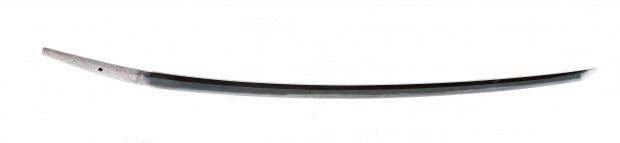 Famous item Doji Kiriyasuzuna [Mei-Zu] (Japanese name) Yasushi National Treasure Heian Period Yasukuni Yasuko Tsutomu 80.0 cm Warp 2.7 cm Cut Length 3.1 cm Tokyo National Museum Image: TNM Image Archives
Q4. What does Japanese sword mean in a word?
A. Mental support of samurai. It is "the ace of restraint" in baseball. Actually, Japanese swords are not the main weapon. Bows and arrows are the main weapons of senior warriors who fought on horses during the Heian period. I have always equipped with a sword and a low end sword (Koshigata), but I use the side arm only at the moment of emergency. It can be said that the Japanese sword was not only a weapon but also a mental support. A sword is drawn on the portrait of a samurai who was once considered to be Mr. Ashikaga, but the main weapon of this era was also bow and arrow. It will not change even if the times go down and the main weapons become firearms and guns. In other words, the Japanese sword is an eternal relief pitcher in baseball. It was an ace of curbs.
All you need to know is this! Japanese Sword Terminology
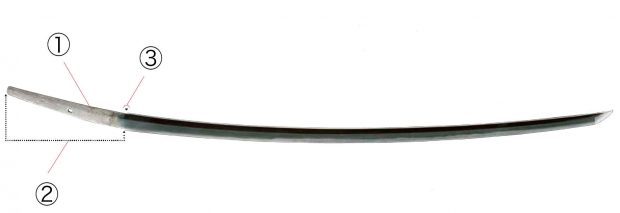
1.Mei
The author of the sword engraves his name and date. Here you can find information on the sword.
2. Stem (naked basket)
The part that fits in the handle of the sword, which differs in shape depending on the school. The inscription is inscribed here.
3. ward (Munemachi)
It is the border of sword and stem.
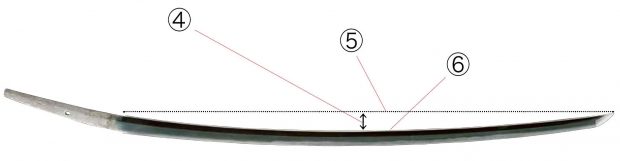
4. Warpage (sled)
The curvature of the blade and its degree. When it says "warp ◯ cm", it is the dimension of the part shown by the solid line.
5. Edge length (Hacho)
The length of the straight line from the ridge to the cutting edge. The dimensions of the sword are described here first.
6. Building (Mune)
It is the part that corresponds to the spine of the sword, also known as Mine. It is admiring with a spine, but "peaking".
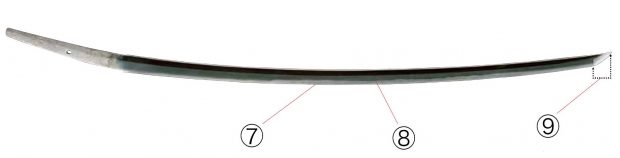
7. Cutting edge
The "white part in the eye" is the blade and the edge is the blade edge. The dark parts other than the blade are called "land" and "earth".
8. Hamon (Hamon)
The pattern appears on the blade (white part). A straight blade is called a "straight blade", otherwise it is called a "turbulent blade".
9. A sharp tip
At the tip, I also write "Saki". The edge of the cutting edge is called a "hat" and features of the author and the times appear.
I would like to say it out! Industry term of Japanese sword
"A lot of good luck"
It is a powerful sense of words, but it is a word that compliments the elegant silhouette of the sword blade. When the width of the tip is very narrow compared to the width of the waist part near the handle, it is said to be “strong in strength” or “a shape with good strength”. There are many styles for old swords.
"I'm getting angry"
I write "錵" and "沸" and read "Nie". Coarse brilliance of grain that floats at the border of blade and ground iron. If you can see the glow like a star in the night sky in Kumon, you'll see, "I'm buzzing well," "I can see a strong boil on my skin." It is a compliment.
"Skin bites"
It is a word to say against the skin of the sword. Iron is beaten well, and the state that the skin looks fine is referred to as "the skin is clogged", and it is expressed as "the skin is clogged well." If you can see a fine grain pattern, you can say, "The skin is clogged well".
Japanese swords that I did not know, words of the origin of the sword
There are many words that I usually use in my life, whose words are based on Japanese Swords. This time, I will introduce such a little Katana language. Knowing the original meaning may change the way you use words.
 Famous item Mikazuki Munezuki [Tateme Sanjo] National Treasure Heian Era Edge length 80.0 cm Tokyo National Museum Image: TNM Image Archives
【Depress sumo wrestling】
Turning from the fact that the swordsman alternates with each other and shows consent to the other party.
[Origami]
As the Honamé (honamike) attached an appraisal certificate (origami) to a sword, it points to a thing without a doubt.
Shinoki = ridge line between the sword and the blade. A sharp battle is turning so that the ax can be scraped, and a fierce battle.
【star performer】
The best sword is the best hit when you hit Goshintou. In turn, he is the best in the world.
【Supple warm】
Sup = ninja. It means that the ninja uncovers the secret from the sudden removal of the cutlery.
【Setsu Pack】
The fitting is a metal fitting that holds the collar. It is in a state of being chased so much that it can not move.
[Sled does not fit]
It will not fit in the sheath unless the sword and sheath are warped. It seems that I don't feel it.
【Directly inserted】
From cutting into a single enemy team with a single bite, to enter the main subject without pre-swing.
【pretension】
From the custom of adding only a burning blade to a sword that has lost a blade, it is your mastering in a quick meeting place.
【Tonchinkan】
I heard that the roar of a ton-ten-kan sounded like this, the chopsticks did not fit.
【Menuki Street】
Menuki is a decorative bracket that holds the center of a handle. Turn, a busy street in the center of town.
【Put it in and out】
From burning and forging the cutlery, to put alive and sanction on people.
【Have a good time】
The kindness is the sheath. It's time to move out of the pods, leaving home, throwing people.
My motto is "I'm serious about being stupid", and I am having fun and having fun every day.