






Japanese gardens can be found at temples, hotels, and other locations. Here is a guide to the foundational knowledge you will want to grasp before going to see them. Unfamiliar technical terms are often used in the explanations of gardens. However, the required knowledge is neither overwhelmingly extensive nor difficult. As long as you grasp these 30 basic concepts, the components and styles of gardens will become easier to understand, and we guarantee that you will be able to enjoy Japanese gardens much more.
Discover the Joy of Japanese Gardens: 30 Essential Basics
*In Japanese alphabetical order
Japanese Garden Basics 1: Ishigumi (石組)
Deliberate grouping of natural stones is called ishigumi, and it is an element that greatly influences the landscape of a garden. It could even be called the leading role of a Japanese garden. The themes of gardens indicated by ishigumi can be divided into the following three:
1. Representations of “Shinsei Shisou” (The Land of the Immortals) : Horai ishigumi (蓬萊石組, Mount Horai formations), Tsurukame ishigumi (鶴亀石組), Yodomariishi (夜泊石, “Night-Anchoring” Stones), Funaishi (舟石, Boat shaped stones) etc.
2. Mount Horai formations : Sanzon ishigumi (三尊石組, Buddhist Triad Formations,), Shumisen ishigumi (須弥山石組, Mount Sumeru Formations) etc.
3. ‘Representations of folk beliefs and traditions’: Shichigosan ishigumi (七五三石組, The 7-5-3 Groupings), Inyoseki (陰陽石, Yin-yang stones) etc.
Japanese Garden Basics 2: Ishidoro (石灯籠)
Stone products for illumination introduced along with Buddhism during the Asuka (飛鳥) period. Initially, they were votive lanterns placed at the front of Buddhist halls, and from the Heian (平安) period onwards, they were also used in shrines. They were sometimes placed in Jodoshiki Gardens (浄土式庭園), but they came to be incorporated into gardens from the Momoyama (桃山) period, when they were used to light the ‘roji’ – the narrow, functional, and highly spiritual path that leads a guest from the mundane world to the sanctuary of the tea house. At first, mitatemono (見立物) objects repurposed to evoke a new poetic meaning, as stone pagodas were used, but eventually, various designs were devised, and they became an indispensable presence in gardens.
Japanese Garden Basics 3: Kaki (垣)
There are takegaki (竹垣; bamboo fences) and ikegaki (生垣; hedges) made by trimming plants. Takegaki can be classified as follows:
1. ‘Open-weave bamboo fences assembled in a grid pattern’: Yotsumegaki (四つ目垣, Four-Eye Fence), Kinkakuji Temple style (金閣寺垣), Ryoanji Temple style (龍安寺垣), Koetsuji Temple style (光悦寺垣), Arrow-shield fence (矢来垣), etc.
2. ‘Screening fences assembled like a wall’: Kenninji Temple style (建仁寺垣), Ginkakuji Temple style (銀閣寺垣), Horsetail grass style (木賊垣), Gun barrel style (鉄砲垣), Bamboo blind style (御簾垣), etc.
3 ‘Fences woven from fine bamboo’: Otsu style (大津垣), Ajirogaki (網代垣, Wickerwork style) etc.
4. ‘Fences made of bamboo twigs or tree branches’: Takehogaki (竹穂垣,Bamboo twig style), Katsuragaki (桂垣, Katsura Imperial villa style), Minogaki (蓑垣, Rain-cape style), Taimatsugaki (松明垣, Torch style), Shibagaki (柴垣, Brushwood style), etc.
Japanese Garden Basics 4: Karesansui (枯山水)
A garden style that expresses a natural dry landscape without using any water. In the Heian period’s “Sakuteiki” (作庭記), karesansui is described as ‘stones or ishigumi set up in a place where there is no pond or yarimizu (遣水, winding manmade stream),’ but it is from the latter half of the Kamakura (鎌倉) period to the Muromachi (室町) period that it frequently appears. A representative early example is the karetaki (枯滝) created by Muso Soseki (夢窓疎石) in the upper tier of ‘Saihoji’ (西芳寺).In a karetaki, large, jagged rocks are arranged vertically to capture the raw energy and “falling” motion of water in completely dry landscape. Eventually, many stoic expressions were constructed, primarily at Zenshu (禅宗) temples.
Japanese Garden Basics 5: Kyokusui (曲水)
A ‘Kyokusui’ refers to a meandering waterway. As seen in the ‘Kyokusui no En’ (曲水の宴; Meandering Stream Banquet)—held since the Nara period, where one must compose a poem before a sake cup floated on the meandering stream reaches them—it has been used since the early days when garden culture was brought to Japan from the Asian continent. Kyokusui eventually developed into yarimizu, and it is used in the Edo period daimyo teien (大名庭園) ‘Kenrokuen’ (兼六園) and in ‘Murinan’ (無鄰菴), created by Ogawa Jihee (小川治兵衛) in the Meiji period.
Japanese Garden Basics 6: Keibutsu (景物)
‘Keibutsu’ refers to items used in the roji pathway, which developed alongside the tea ceremony. In addition to tobiishi (飛石; stepping stones) and shikiishi (敷石; paving stones) for walking through the roji, Chozubachi and Tsukubai stone formations arranged to create a water basin for rising the mouth and hands, and lanterns for providing light during a yobanashi (夜噺; evening gathering) or a dawn tea gathering, stone art pieces, bridges, and fences are also considered keibutsu. Keibutsu eventually came to be used in the gardens of ordinary households, and how effectively a garden designer employs them has become a showcase of their skill.
Japanese Garden Basics 7: Kobori Enshu (小堀遠州)
1579–1647. An early Edo period daimyo (大名). He styled himself Enshu because he held the title of Totomi no Kami (遠江守), and his pseudonym was Kohoan (孤篷庵). He successively served as the shogunate’s sakuji bugyo (作事奉行; commissioner of buildings) and Fushimi bugyo (伏見奉行), and as a tea master, he succeeded Furuta Oribe (古田織部) to become the tea ceremony instructor for the shogun’s family. He also demonstrated his talents as an architect and garden designer, leaving behind highly original works such as Osaka Castle, Edo Castle, Nagoya Castle in architecture, and the Nijo Castle Ninomari Garden and Kohoan Garden in landscaping.
Japanese Garden Basics 8: Sakuteiki (作庭記)
Japan’s oldest guidebook for garden design. Its content primarily concerns the Shindenzukuri teien (寝殿造庭園) of the Heian period, and it explains in detail techniques for ishigumi, chisen (池泉; ponds), waterfalls, yarimizu, nosuji (野筋; gentle slopes), and planting. The author is unknown, but the prevailing theory is that Tachibana no Toshitsuna (橘俊綱), the third son of Fujiwara no Yorimichi (藤原頼通) who served as the Shuridaibu (修理大夫; Master of the Office of Palace Repairs), compiled it based on his profound scholarship and unique view of nature, focusing on the garden construction works he had observed since childhood.
Japanese Garden Basics 9: Shikiishi (敷石)
Paving of paths using stone materials, devised for walking in the roji zone. There are kiriishijiki (切石敷), which uses processed stones; tamaishijiki (玉石敷), which uses natural stones as they are; and yoseishijiki (寄石敷), which mixes processed and natural stones. Kiriishijiki includes ichimatsujiki (市松敷), tanzakujiki (短冊敷), rengajiki (煉瓦敷), and shihanjiki (四半敷) which use square processed stones, and kikkojiki (亀甲敷) and hyomonjiki (氷紋敷) which use irregularly shaped processed stones. Tamaishijiki is also known as ararejiki (霰敷), and those with large stones are called oararekoboshi (大霰零), whilst those with small stones are called koararekoboshi (小霰零).
Japanese Garden Basics 10: Shakkei (借景)
The practice of using the scenery surrounding a garden not merely as a background but as an important element of the garden design. It is believed that shakkei was already established in the Heian period, with representative examples being Mount Higashiyama (東山) viewed from the Shukuentei (縮遠亭) pavilion at ‘Saihoji’, and Mount Hieizan (比叡山) from the Upper Teahouse at ‘Shugakuin Rikyu’ (修学院離宮). In gardens from the Meiji period onwards, typical examples include ‘Murinan’ and Higashiyama, and ‘Isuien’ (依水園) in Nara with Mount Wakakusayama (若草山) and Mount Kasugayama (春日山).
Japanese Garden Basics 11: Shoinzukuri teien (書院造庭園)
A garden created to suit the samurai housing style centred around a shoin (書院) (study), which was established from the Kamakura to the Muromachi period. From the Muromachi period onwards, it developed by incorporating various garden styles such as karesansui and the roji of tea rooms. In the Momoyama period, masterpieces such as Katsura Imperial Villa, Ginkakuji temple, Jishoji temple, Daigoji Sambon-in temple were born by combining the Shindenzukuri teien of the Heian period with the Shoinzukuri teien.
Japanese Garden Basics 12: Jodoshiki teien (浄土式庭園)
In the late Heian period, when it was believed that the mappo (末法; Age of Dharma Decline) had arrived and the power of Buddhist law was weakening, nobles and commoners, becoming pessimistic and despairing, sought salvation in Pure Land Buddhism and prayed for rebirth in paradise. Nobles who believed they would be saved by praying to Amida Nyorai (阿弥陀如来) enshrined Amida Nyorai, who was said to reside in the Western Pure Land, in an Amida-do (阿弥陀堂) hall built on the west side of a pond, and worshipped from afar from the opposite shore of the pond. This is the origin of the Jodoshiki teien, of which ‘Byodoin’ (平等院) is a representative example.
Japanese Garden Basics 13: Shokusai (植栽)
The trees and plants planted in a Japanese garden. In ancient times, for auspicious reasons, evergreen cedars and camphor trees (kusunoki, 樟), which were considered the yorishiro (依代; vessels) of gods, were used. From the Nara period onwards, pine trees became the leading role of shokusai. Flowers and grasses of the four seasons were also favoured, but in karesansui gardens and roji paths, use of colour other than bamboo and moss were suppressed, with autumn foliage being heavily used as an exception. Additionally, in the Edo period, it became fashionable to use kakitsubata (杜若; rabbit-ear iris) in association with the ‘Tale of Ise’, which became a significant source of poetic inspiration for garden design, and to introduce imported cycads (sotetsu, 蘇鉄).
Japanese Garden Basics 14: Shinsenshiso (神仙思想)
A philosophy seeking eternal life that developed in ancient China based on Daoist thought amongst others. It was believed that immortal hermits lived on the Shinsen Islands floating in the Eastern Sea, and in China, gardens featuring Shinsen Islands arranged in a pond had been built since the Han dynasty. It was brought to Japan in the Asuka period, and ishigumi expressing Shinsenshiso began to be constructed. The Horai teien (蓬萊庭園) and crane-and-turtle style gardens that became popular from the Momoyama to the Edo period are also based on Shinsenshiso.
Japanese Garden Basics 15: Shindenzukuri teien (寝殿造庭園)
A garden created to accompany the Shindenzukuri (寝殿造), which was the housing style of nobles in the Heian period. The basic model involved surrounding the site with a tsuijibei (築地塀; mud wall), arranging buildings centred around the shinden (寝殿; main sleeping hall) on the north side, and placing a chisen style garden on the south side. Between the shinden and the pond, a white sand zone for ceremonies was established. According to the “Sakuteiki”’, its characteristic was to envision the scenery of vast nature in one’s mind and create a miniaturised landscape of it.
Japanese Garden Basics 16: Suhama (州浜)
In Japanese gardens, replicating natural scenery was an important theme, and ponds imitating the seas and coastlines of various parts of Japan were created. The technique used to represent a sandy beach at that time is the suhama, which is paved with stones. At Katsura Imperial Villa, a suhama cape is created, and delicate suhama can also be seen at ‘Sento Gosho’ (仙洞御所). Furthermore, at ‘Byodoin’, based on the results of recent excavations, the area around the central island and part of the water’s edge were remodelled into suhama.
Japanese Garden Basics 17: Daimyo teien (大名庭園)
Gardens created by Daimyo lords of the Edo period at their Edo residences and in their domains. They generally take the form of large-scale kaiyushiki (回遊式; strolling-style) gardens centred around a pond. They were primarily built as facilities for the daimyo’s own entertainment, hobbies, and cultivation, and the like were interwoven. ‘Koishikawa Korakuen’ (小石川後楽園) and ‘Rikugien’ (六義園) in Tokyo, ‘Kenrokuen’ in Kanazawa (金沢), ‘Kairakuen’ (偕楽園) in Mito (水戸), ‘Korakuen’ (後楽園) in Okayama (岡山), and ‘Ritsurin Koen’ (栗林公園) in Takamatsu (高松) are famous.
Japanese Garden Basics 18: Taki (滝)
In Western and Islamic gardens, fountains are often used, which is also a symbol of humans controlling water. In contrast, a taki (waterfall) is the natural flow of water as it is, and it is considered an expression symbolising that Japanese gardens replicate nature. It was from the Heian period that waterfalls came to be consciously incorporated into Japanese gardens. The “Sakuteiki” also provides meticulous explanations on how to create them.
Japanese Garden Basics 19: Chisen (池泉)
A pond created in a garden. It is generally considered an expression imitating the sea. In the Shindenzukuri teien of the Heian period, large ponds were created, and because boats were floated on them to hold musical performances, gardens designed for boating are called Shuyushiki teien (舟遊式庭園). From the Kamakura period onwards, the scale of ponds became smaller, and strolling-styke kaiyushiki gardens, where one walks around the pond, developed. In the daimyo teien of the Edo period, large ponds began to be created again.
Japanese Garden Basics 20: Chozubachi (手水鉢)
A basin made with a stones placed to hold water for purifying oneself. From ancient times, this is based on the practice of cleansing one’s hands and rinsing one’s mouth when visiting shrines and temples. Chozubachi were incorporated into gardens along with the development of the roji from the Momoyama period. Initially, natural stones or stone millstones with holes bored into them were used, and eventually, mitatemono such as stone pagodas with holes, devised by Sen no Rikyu (千利休), appeared. In the Edo period, various designs were created.
Japanese Garden Basics 21: Tsukubai (蹲踞)
A set of chozubachi basins prepared in front of the tea room in a roji path is called a tsukubai, and it is considered the most important element in a roji. The tsukubai is composed of the chozubachi at the centre, surrounded by yakuishi (役石; functional stones) such as the maeishi (前石) on which one stands to use the water, the yutoishi (湯桶石) for placing a bucket of warm water, the teshokuishi (手燭石) for placing a hand-held candlestick, and the umi (海) which directly translates to ‘sea’, to catch spilled water. It is named from the action of crouching known as ‘tsukubau’, when washing one’s hands. The method of arranging the functional yakuishi stones differs depending on the school.
Japanese Garden Basics 22: Tobiishi (飛石)
Stones placed on a dirt path for walking. They came to be used in gardens from the Momoyama period onwards when the roji was established. The methods of laying tobiishi include ‘chidoriuchi’ (千鳥打ち), based on stepping one pace at a time; ‘suguuchi’ (直打ち), which is straight; and variations such as ‘nirenuchi’ (二連打ち), ‘nisanren’ (二三連), and ‘kariuchi’ (雁打ち). Each variation differs in spacing of the stones, which is designed to influence the visitors walking pace and gaze around the garden. Whereas Sen no Rikyu stated it should be “six parts for crossing (ease of walking), four parts for scenery (visual beauty of the arrangement),” Furuta Oribe is said to have proposed “four parts for crossing, six parts for scenery.”
Japanese Garden Basics 23: Nakajima (中島)
An island created within a pond. This term is used to distinguish it from a dejima (出島; peninsula) protruding into the water. Since ancient times, islands have been an integral part of ponds in Japanese gardens, and in Jodoshiki teien, three nakajima called Sanshinzan (三神山) representing the Pure Land of Ultimate Bliss, as taught in Buddhism, were created. The “Sakuteiki” notes that a nakajima must not be made by piling up earth, explaining that unless the area to become the nakajima is left untouched whilst digging the rest, it will be eroded and destroyed by the water.
Japanese Garden Basics 24: Hashi (橋)
Bridges placed over ponds and water streams, which are important elements of Japanese gardens, include types such as dobashi (土橋; earthen bridges), kibashi (木橋; wooden bridges), and ishibashi (石橋; stone bridges). Forms include hirabashi (平橋; flat bridges), soribashi (反橋; arched bridges), taikobashi (太鼓橋; drum bridges), yatsuhashi (八橋; zig-zag bridges), and roofed teikyo (亭橋; pavillion bridge). A soribashi style bridge carries the meaning of a boundary between this world and the next, and in a Jodoshiki teien, a soribashi is built from east to west. Yatsuhashi is a wooden bridge based on the influential ‘Tale of Ise‘,, built in a zigzag shape amidst clusters of kakitsubata.
Japanese Garden Basics 25: Funatsuki (舟着)
A mooring point at the edge of the pond for getting on and off during boating excursions. It developed in the Shindenzukuri teien of the Heian period, and in the Muromachi period, a mooring point called Godobune (合同舟; joint boat landing) at ‘Saihoji’ and a roofed boathouse called Yodomaribune (Night-anchored boathouse) at ‘Higashiyamadono’ (東山殿; present-day Ginkakuji Temple) were created. Furthermore, at ‘Katsura Rikyu’, there are mooring points at the imperial boathouse and other major buildings, and at ‘Hiunkaku’ (飛雲閣; Parr of Nishihonganji Temple 西本願寺), there is a Funairi (舟入) room allowing direct entry to the building from a boat.
Japanese Garden Basics 26: Hei (塀)
A continuous wall that encloses a garden and divides the grounds. In Shindenzukuri teien, an itabei (板塀; wooden board wall) with a tatejitomi (立蔀; standing lattice) having an itabuki (板葺き; board-thatched) roof was generally used, but it had the disadvantage of being easily damaged. In Jodoshiki teien and Shoinzukuri teien, kawarabei (瓦塀; tile-roofed walls) with shikkuinuri (漆喰塗; plastered) partition walls, and tsuijibei (earthen walls) with a rammed earth base and a kawarabuki (瓦葺き; tile-thatched) or kokerabuki (杮葺き; shingle-thatched) roof are used. In karesansui gardens, such as the rock garden at Ryoanji Temple (龍安寺), the walls also played a major role in the scenery.
Japanese Garden Basics 27: Hojo (方丈))
The residence of the chief priest in a Zen temple, a building also used for Buddhist memorial services and receiving guests. Originally, it came to be called a hojo because the living room of Yuimakoji (維摩居士; Vimalakirti) in India was one ‘jo’ (丈) square , a metric which equates to four and half tatami mats. From the end of the Muromachi period, a karesansui garden covered with white sand and featuring Ishiguni stone formations, and planting came to be established on the south side of the hojo. Representative examples are the hojo gardens of the temples, ‘Daitokuji’ (大徳寺), ‘Ryoanji’, and ‘Nanzenji’ (南禅寺).
Japanese Garden Basics 28: Muso Soseki (夢窓疎石)
A renowned monk of the Rinzai (臨済) sect who was active from the end of the Kamakura period to the Muromachi period (1275-1351), and who also demonstrated talent in garden design. He was highly revered by Ashikaga Takauji (足利尊氏), the first shogun of the Muromachi Shogunate, and successive emperors, receiving the title of Kokushi (国師; National Teacher) from Emperor Godaigo (後醍醐天皇). The garden centred around the Ryomonbaku (龍門瀑) waterfall, created at Tenryuji temple (天龍寺), which Takauji established to mourn for Emperor Godaigo, and the garden of ‘Saihoji’, which was remodelled in the Zen style, are early masterpieces of the karesansui style.
Japanese Garden Basics 29: Yarimizu (遣水)
A narrow, meandering waterway flowing into a pond, created in gardens from the Nara to the Heian period. Modelled after natural streams, in Shindenzukuri teien, it passed under the floor of the building and poured into the pond. For yarimizu, stones such as sokoishi (底石) placed underwater, mizukiriishi (水切石) for dividing the water flow, goganseki (護岸石) to protect the banks and tsumeishi (詰石) to support them, yokoishi (横石) to adjust the width, and mizukoshiishi (水越石) to create unevenness were used, achieving highly creative expressions.
Japanese Garden Basics 30: Ryomonbaku (龍門瀑)
A style of ishigumi stone formations based on the legend of the Toryumon (登龍門), which says that a carp that climbs a three-tiered waterfall in the middle reaches of the Yellow River in China turns into a dragon. It is said to have originated from Rankei Doryu (蘭渓道隆) (Daikaku Zenji, 大覚禅師), a monk who came to Japan from the Chinese Southern Song dynasty, and passed down to Muso Soseki. Centred around the mizuotoshiishi (水落石) representing the waterfall’s water, it is composed of varying stones including the rigyoseki (鯉魚石) representing the carp, the Kannonseki (観音石) representing the Goddess of Mercy, the Hekiganseki (碧巌石,The blue crag stone), and the Saruishi (猿石, monkey stone). The Ryomonbaku at the temples ‘Tenryuji’, ‘Saihoji’, and ‘Rokuonji’ (鹿苑寺; present day Kinkakuji) became the standard for later Japanese gardens.
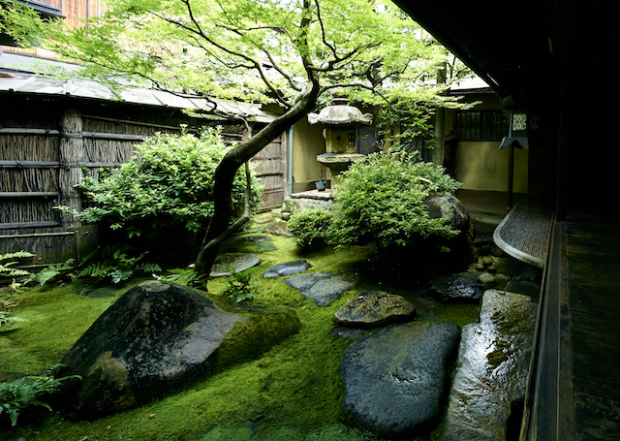
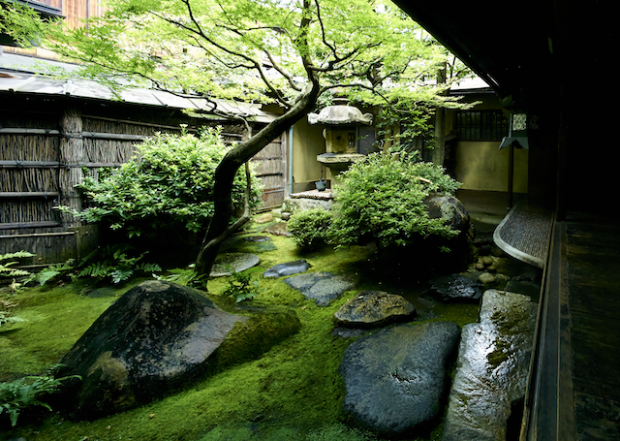 The photograph shows the tsuboniwa (坪庭; courtyard garden) of the ‘Sumiya Motenashi no Cultural Art gallery’ (角屋もてなしの文化美術館)
This article is translated from https://intojapanwaraku.com/rock/travel-rock/2233/