Letters, Too, Were a Form of 'Adornment'. The Communication of Heian Nobles, Deeper than Today. Sawada Toko ‘Biso no Nippon: The history of dressing up’
連載
Culture
2026.02.15
Letters, Too, Were a Form of ‘Adornment’. The Communication of Heian Nobles, Deeper than Today. Sawada Toko ‘Biso no Nippon: The history of dressing up’
Dressing up and adorning oneself with sparkling jewellery. There lies the human desire to be beautiful and to add colour to one's life. In our series 'Biso (美装) no Nippon: The History of dressing up', writer Sawada Toko traces the history of various ornaments and jewellery, and explores the mysteries behind the act of dressing up.
Today, the most commonly used means of daily communication is perhaps email. Among the younger generation, instant messaging via LINE and Instagram are also frequently used, and some are equipped with functions to notify you if the recipient has ‘read’ or ‘opened’ your message.
In the mid-Heian period (平安時代), when opportunities for people of status to meet face-to-face were rare, it is no exaggeration to say that the letter, the primary means of communication, send a great deal about the sender. Not only the written content, but what kind of paper was chosen? What was the colour of the ink? How was the handwriting? Particularly between young men and women, they would first gauge the other’s character through letters, and only after that make an opportunity to meet. Thus, it was no exaggeration to call a letter a tool to ‘adorn’ a human being before it was a means of communication.
For that reason alone, people with good handwriting or skill in composing poems for letters were in demand. This was because requests for ghostwriting flooded in from here and there.
――yasuraha de ne namashi mono wo sayo fukete katabuku made no tsuki wo mishi kana (やすらはで 寝なましものを さ夜ふけて 傾くまでの 月を見しかな)
(Had I gone to sleep without waiting, I would have slept; but now the night has deepened, and I have watched the moon until it sinks.)
This poem, also known for being included in reveres anthology Hyakunin Isshu (百人一首), is a representative work of the female poet Akazome Emon (赤染衛門), who is speculated to be the author of the historical tale Eiga Monogatari (栄花物語). However, in the Goshui Wakashu (後拾遺和歌集), where this poem was collected prior to the Hyakunin Isshu, an explanation is added: ‘Composed on behalf of her sister when the Naka no Kampaku (中関白; Fujiwara Michitaka (藤原道隆)), while still a Minor Captain, said he would come to her sister’s place but did not arrive until morning.’ Indeed, a poem ghostwritten for her sister has today become Akazome Emon’s representative work.
Akazome Emon is a woman whose birth and death dates are not well known, but the Goshui Wakashu was completed less than half a century after her death. Akazome Emon was renowned as a master of poetry, and even Murasaki Shikibu (紫式部), known for her somewhat biting character critiques, praised her compositions in the Murasaki Shikibu Nikki (紫式部日記). If so, the moment Fujiwara Michitaka received the poem from her sister, he must have realised, “Aha, this must have been composed by the sister who is a master of poetry.”
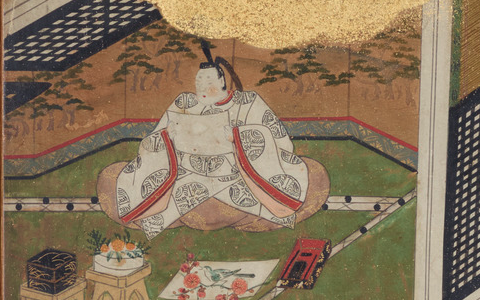
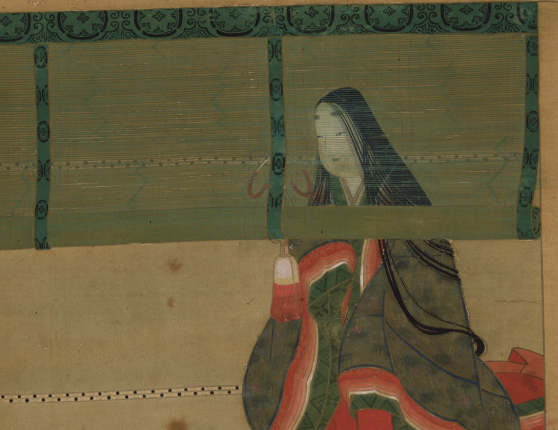
A section of the Genji Monogatari Zu Byobu (源氏物語図屏風). The centre of the image depicts a man reading a letter. (Edo Period / Kyoto National Museum collection. From ColBase [https://colbase.nich.go.jp/]. Thumbnail image as well).
‘Ghostwriting’ in the Heian Period
Furthermore, Akazome Emon often ghostwrote for her daughter and son as well, but interestingly, Emon’s husband, the literary noble Oe Masahira (大江匡衡), also wielded his brush for ghostwriting here and there. This is because the Oe family was known at the time as a family of Confucian scholars for generations, and ghostwriting petitions in Kanbun (漢文; Chinese writing) that high-ranking nobles presented in government affairs was effectively one of their duties.
However, the Jikkinsho (十訓抄), a collection of setsuwa (説話; anecdotes) compiled in the Kamakura period (鎌倉時代), records an episode where Oe Masahira was asked to ghostwrite a letter of resignation by a Major Counsellor named Fujiwara Kinto (藤原公任). Before asking Masahira, Kinto had made the same request to other prominent scholars of the time, but he was not satisfied with what they wrote. Knowing this background, Masahira was worrying about whether he could fulfil such a great responsibility, when his wife Akazome Emon learned of the situation and advised him on the content to be written—or so the story goes.
This anecdote was passed down in various historical materials as a demonstration of Akazome Emon’s talent. Since Jikkinsho is not a history book and contains many legend-like episodes, it is doubtful whether the content is definitely fact, but even so, it is interesting that unlike today, ghostwriting in general was not considered a shameful act at all.
Regarding ghostwriting, the aforementioned Murasaki Shikibu also composed multiple poems for those around her, but on the other hand, she seems to have been somewhat strict about artifices other than poetry. Once, Shikibu received a letter from Fujiwara Nobutaka (藤原宣孝), who would later become her husband, stained here and there with red dots. This was a deliberate artifice by Nobutaka, sent with the note “The colour of the tears I shed resenting your coldness,” but to this, Shikibu replied with a scathing response:
――kurenai no namida zo itodo utomaruru utsuru kokoro no iro ni miyu reba (くれなゐの 涙ぞいとど うとまるる うつるこころの色に見ゆれば)
(Crimson tears would be even more unbearable; for they look like the colour of a changeable heart.)
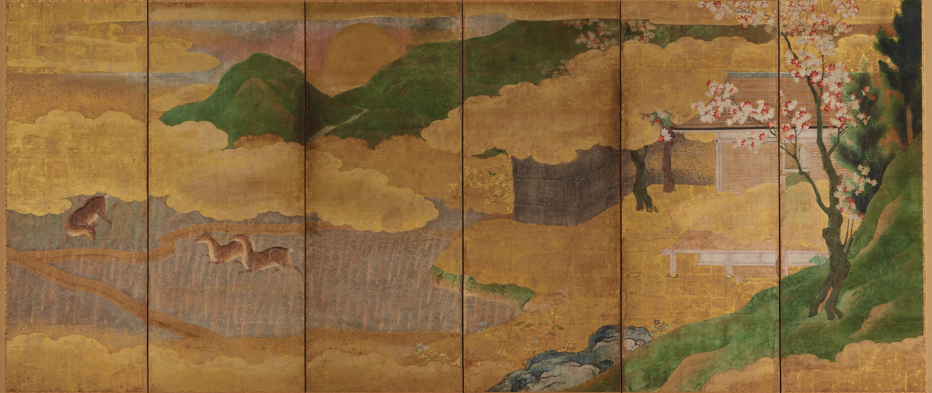
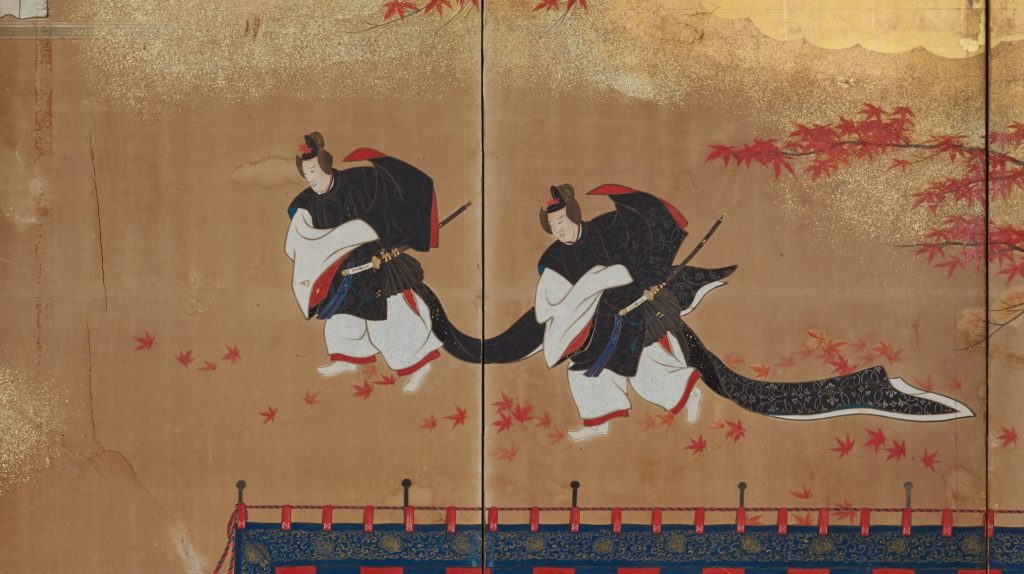
Yugiri Zu Byobu (夕霧図屏風) (Edo Period / Kyushu National Museum collection. From ColBase [https://colbase.nich.go.jp/].)
The Reason Yugiri Tied a Letter to Karukaya
That said, Murasaki Shikibu did subsequently marry this Nobutaka, but one cannot help but speculate that, from the perspective of a master poet like her, she was irritated by the fact that he sent a letter with visible artifices instead of competing with the poem or the text of the letter.
In the ‘Nowaki (野分)’ chapter of Genji Monogatari (源氏物語) written by Shikibu, Hikaru Genji (光源氏)’s son Yugiri (夕霧) writes a letter on purple paper and tries to send it tied to Karukaya (刈萱), a brown plant whose stalks are disheveled by the wind, only to be teased by a gentlewoman who says, “A purple plant would have been better.” However, while the colour combination of Yugiri’s letter was indeed poor, there was actually a romantic intention in tying the letter to the Karukaya with its disheveled stalks that Yugiri wanted to convey only to the recipient. Does the fact that he sought a further step of understanding, rather than visible beauty, not reveal Yugiri’s hardworking and serious personality?
Heian-era letters, where the sender could apply various ingenuities and the recipient could interpret them in various ways, are far deeper than today’s emails. Including whether the compatibility of both parties matches well, they can be said to be rare tools that exert a presence on behalf of the individuals themselves.
Born 1977, Kyoto. Graduated from Doshisha University, Faculty of Literature, and completed the Master’s course at the same university. She made her debut in 2010 with ‘Koyo no Ten(孤鷹の天)’, which won the Nakayama Yoshihide Literature Award(中山義秀文学賞); won the Shinran Prize(親鸞賞) in 2016 for ‘Jakuchu(若冲)’ and the 165th Naoki Prize in 2021 for ‘Hoshi Ochite, Nao(星落ちて、なお)’.