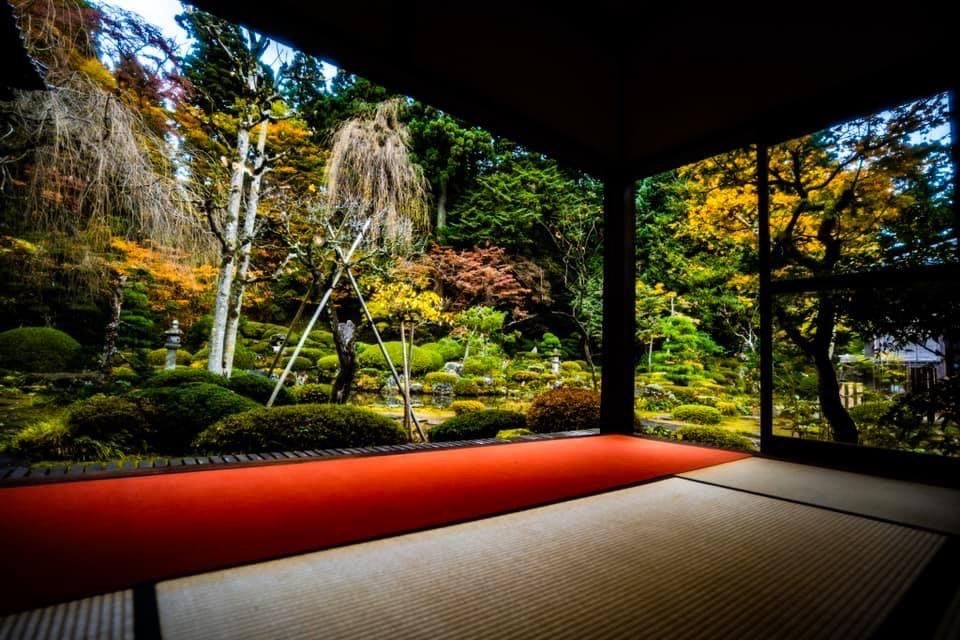







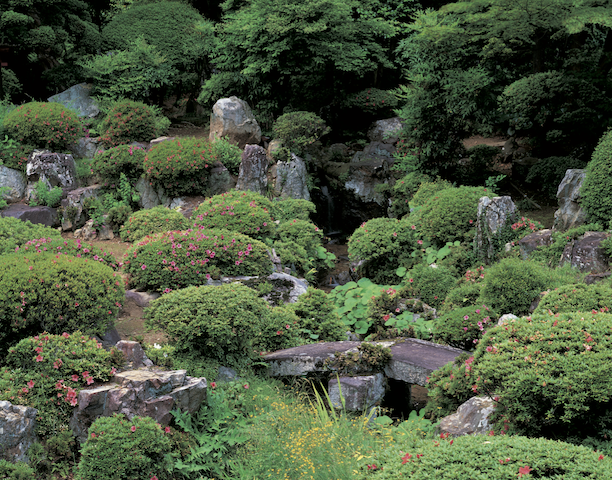
Zen masterpieces are so numerous, particularly in Kyoto, that it is impossible to list them all. From among these, we have selected four gardens that are essential for understanding the evolution of Zen gardens. As you gaze upon them, the Zen spirit imbued within each landscape seems to speak directly to the soul.
Commentary by Miyamoto Kenji (宮元健次) (From the March 2007 issue of Waraku)
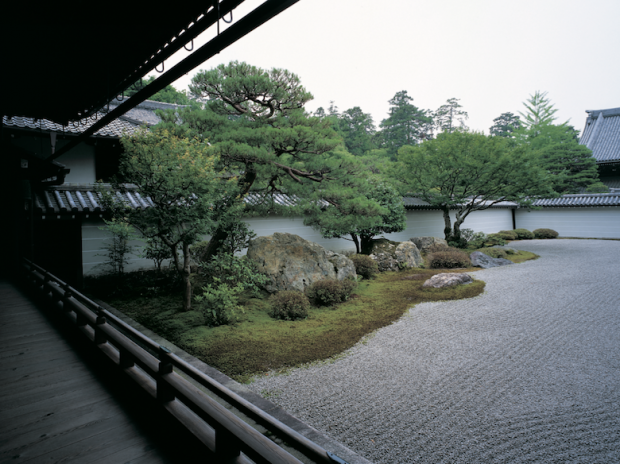
A Garden in the Style of Oribe, Born from the Connection with Tea Ceremony: Ryukozan Nanshuji Rinzai Shu (Sakai City, Osaka)
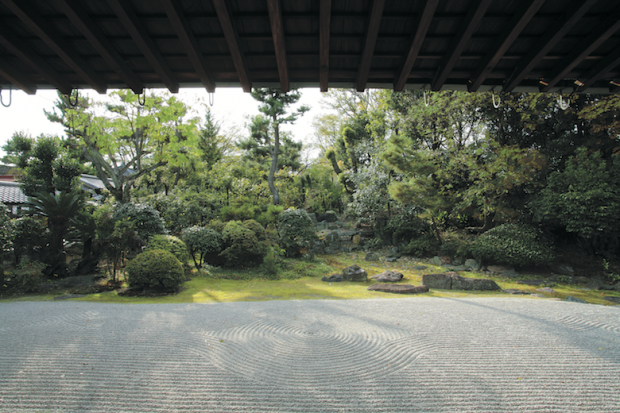
The history of the temple Nanshuji (南宗寺) began in 1526, when a high-ranking monk named Kogaku Sotan (古嶽宗旦)—then the head of Daitokuji(大徳寺), one of Kyoto’s most prestigious Zen institutions—converted a small local hermitage into a sanctuary called Nanshu-an (南宗庵). In later years, the powerful warlord Miyoshi Nagayoshi (三好長慶) expanded the site into a grand temple complex. Although it underwent repeated cycles of destruction by war and subsequent reconstruction, Nanshuji remains a rare and significant site. It is the only Specialized Zen Training Monastery of the Rinzai school (臨済宗) in Osaka Prefecture.
“Please take a moment to consider the significance of this city, Sakai. It was here that the Japanese Tea Ceremony (茶道) was perfected perfected under the masters Takeno Joh (武野紹鴎) and his successor Sen no Rikyu (千利休). The tea they practiced was built upon the philosophical foundation of Zen. Among Sen no Rikyu’s disciples was a group known as the Shichitetsu (七哲; Seven Sages), and the most outstanding among them was Furuta Oribe (古田織部). This garden is designed in the Oribe-kono-mi (織部好み; Oribe’s preference) style. A characteristic of Oribe’s taste is asymmetry—for example, placing objects at angles or shifting them diagonally. This is vividly reflected in the rock formations of this garden, giving one the sensation of looking at Oribe’s ceramic ware.” One of Furuta Oribe’s tea disciples was Kobori Enshu (小堀遠州), who created the garden at Nanzenji (南禅寺).
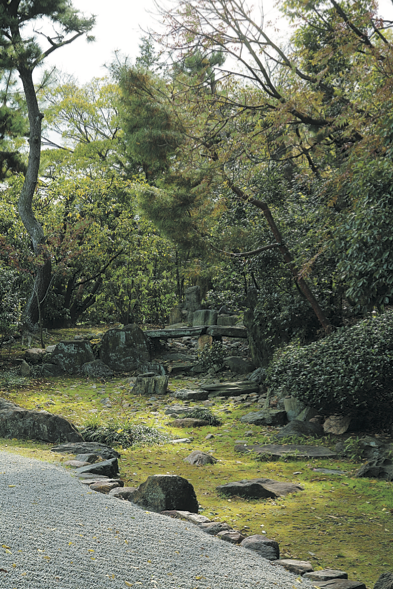 The spatial beauty of flowing water expressed through stone. On the right side, the flow of water from a waterfall to a mountain stream is represented by rock formations and pebbles. One can discern the preference of Oribe, who favoured asymmetry.
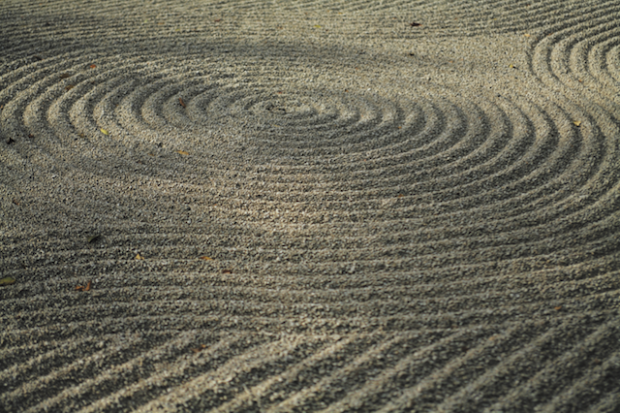 Swirling samon pattern (砂紋; sand ripples) create a sense of movement, making the scale of the garden itself feel even grander. It can truly be described as a garden that mirrors the workings of nature.
◆Ryukozan Nanshuji (龍興山 南宗寺), Rinzai Shu Daitokuji School
Address: 3-1-2 Minami-hatago-cho Higashi, Sakai-ku, Sakai-shi, Osaka
The Beauty of Yohaku (Empty Space): A Garden Created by Kobori Enshu at Zuiryuzan Nanzenji Rinzai Shu (Kyoto City, Kyoto)
In the world of Rinzai Zen, there is a formal ranking system known as the “Five Mountains” (Gozan). This system designated the five most important temples in Kyoto and the five most important in Kamakura. However, Nanzen-ji occupies a unique position even above these—it is officially ranked as “The First Temple Above the Five Mountains.” Because of this elite status, its “Abbots” (head monks) were not chosen from just one lineage; instead, the most brilliant and spiritually realized masters were recruited from across every branch of Rinzai Zen to lead the temple. Even today, it possesses a magnificent garan (伽藍; temple complex) that allows one to feel its elite institutional status.
“If the Sesshu (雪舟) gardens are a three-dimensional expression of suibokuga (水墨画; ink wash painting), the gardens of Kobori Enshu, who was active in the early Edo period, are characterised by the use of visual effects based on Western perspective. The Honbo Hojo (本坊方丈; Abbot’s Quarters) garden at Nanzenji can truly be called a masterpiece of karesansui (枯山水; dry landscape) gardening that makes full use of perspective. The rock formations in the Hojo garden become lower and more sparse as you move from left to right, and the trees are similarly lower and more scattered, making the right side appear further away. Furthermore, a spatial trick is employed to make the garden look as though it is moving from left to right, creating the illusion that the sand ripples in the foreground are moving like a gentle stream.”
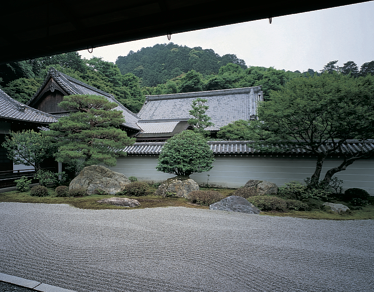 The Honbo Hojo garden is a sight to behold for its expansive space created through Western-style techniques. The rock formations are likened to a mother tiger leading her cubs across a river, and are known as Tora-no-ko-watashi (虎の児渡し; The Crossing of the Tiger Cubs).
◆Zuiryuzan Nanzenji (瑞龍山 南禅寺), Rinzai Shu Headquarters of the Nanzenji School
Address: Nanzenji Fukuchi-cho, Sakyo-ku, Kyoto-shi, Kyoto
Official Website
A Zen World Created with Rock and Water: Kinpeizan Zuisenji Rinzai Shu (Kamakura City, Kanagawa)
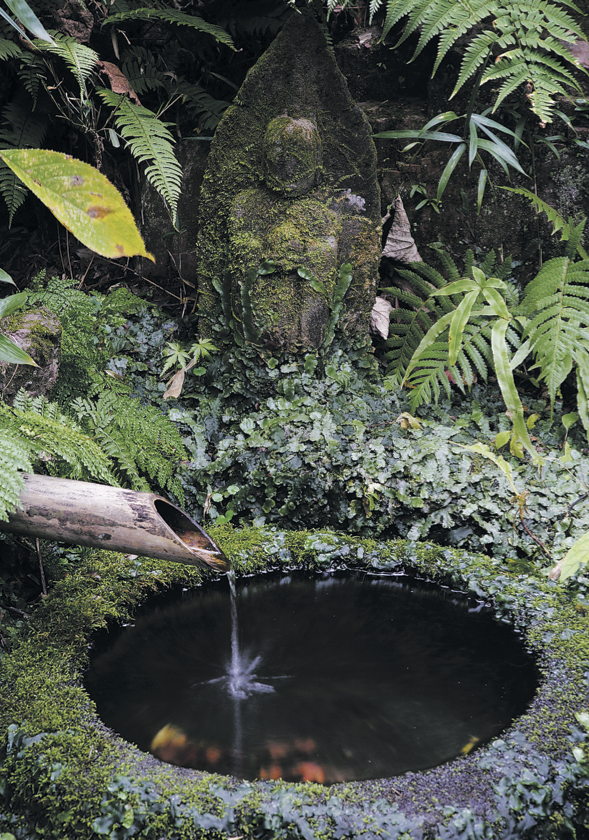
Even before working on the temple gardens of Saihoji (西芳寺) and Tenryuji (天龍寺), the national teacher Muso Kokushi (夢窓国師) was enthusiastically engaged in garden design. The primary examples of this are Zuisenji (瑞泉寺) in Kamakura (鎌倉) and Erinji (恵林寺) in Yamanashi (山梨).
Zuisenji was founded in 1327, during the late Kamakura Shogunate, by the 53-year-old Muso Kokushi. “Everything in Kamakura was once buried due to the great eruption of Mount Fuji during the Edo period. However, prior to that, Mito Mitsukuni (水戸光圀) had visited Zuisenji and left detailed measured drawings. When excavations were carried out based on these, Muso Kokushi’s garden emerged exactly as it had been.
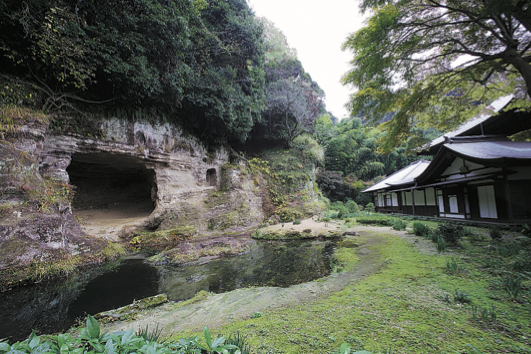
This garden possesses characteristics that can be called the prototype for masterworks later created by Great Zen Masters (Kokushi). These include the zazen-kutsu (座禅窟; meditation cave) carved into the Kamakura tuff, a man-made waterfall falling from the rocks, and a two-tiered composition consisting of the pond area and an observation deck. These elements are seen in his later gardens and cannot be overlooked.”
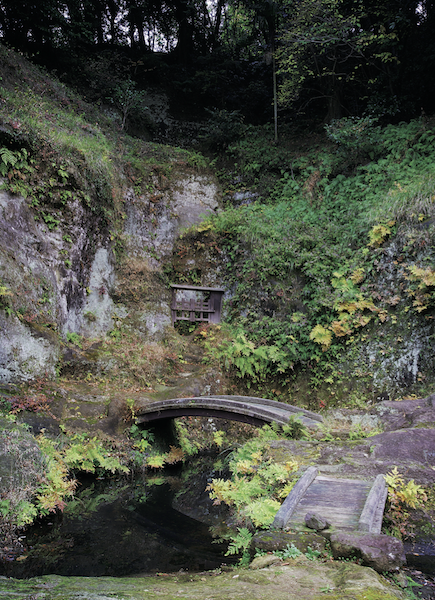 The entrance to the path leading up to the Henkai-ichiran-tei (徧界一覧亭) pavilion, which is currently closed to the public. There are many mysteries regarding its positioning; for example, on the spring and autumn equinoxes, the sun sets directly over Tsurugaoka Hachimangu (鶴岡八幡宮) when viewed from the pavilion.
◆Kinpeizan Zuisenji (錦屏山 瑞泉寺), Rinzai Shu Engakuji School
Address: 710 Nikaido, Kamakura-shi, Kanagawa
Official Website
Nature Condensed Through Skillful Rock Placement: Kentokusan Erinji Rinzai Shu (Koshu City, Yamanashi)
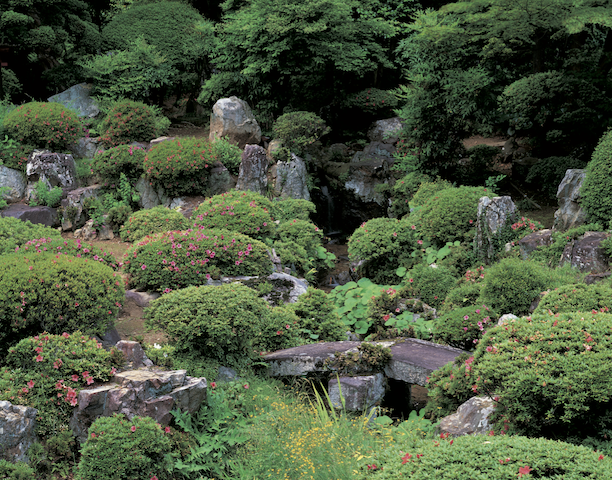 In the garden of Erinji, which employs numerous rock formations, one can see the characteristics of the Jodo-shiki (浄土式; Pure Land style) garden, which features a hall on a central island. Today, it is renowned for the beautiful harmony between the trees and the stones.
After leaving Zuisenji, Muso Kokushi worked on the garden of Erinji in 1330 (Note: The Japanese text says 1930, but the historical date is 1330), which would later become famous as the bodaiji (菩提寺; family temple) of Takeda Shingen (武田信玄). While there are many traces of modifications by later gardeners, and it differs from the original, the core characteristics of the Great Zen Masters’ garden remain unchanged.
“At Erinji, a typical example of an early-style dry landscape (Kareisansui) that retains remnants of the Jodo-shiki garden is preserved. A representative example is on the western side of the garden, the rock formations are densely clustered to represent the “Pure Land of the West”—the celestial paradise where believers hope to be reborn after death, while on the eastern side, you will find a “Cave of Rebirth.” This draws on ancient Japanese mythology—specifically the legend of the Sun Goddess, Amaterasu—symbolizing the return of light and the cycle of new life. This is truly an expression of the Buddhist view of life and death.”
◆Kentokusan Erinji (乾徳山 恵林寺), Rinzai Shu Myoshinji School
Address: 2280 Enzan-koyashiki, Koshu-shi, Yamanashi
Official Website
This article is translated from https://intojapanwaraku.com/rock/travel-rock/2527/