






Feel the Engineers’ Skill and Passion! Walk the Bridges and Understand Japan
Tokyo, a city of water. A cruise on the Sumida River allows you to view the city as you pass under and look up at numerous bridges, which makes it easy to understand why it is sometimes called the ‘Venice of the East.’
“Every bridge spanning the Sumida River is unique in shape and colour. It’s genuinely rare to find a river with such a diverse variety of bridges anywhere in the world. Moreover, the Sumida River has a relatively consistent width and topography, so building bridges with the same structure would save time and cost. Why, then, is there such diversity?”
This is the perspective of Kurebayashi Akio (紅林章央), who was involved in bridge construction as the former Chief Specialist for Bridge Structure at the Tokyo Metropolitan Government Bureau of Construction. Many of the bridges over the Sumida River were built as part of the reconstruction effort following the Great Kanto Earthquake of 1923; before then, there was little diversity in structure or design.
“The official in charge of the bridge reconstruction later explained their decision, saying that if all bridges had the same structure, they would all age at the same rate and break down simultaneously, and a major earthquake would affect all of them. They diversified the structures to mitigate this risk. However, that was the public justification (Tatemae; 建前). The true reason, it is said, was that young engineers rarely had such a chance to be involved in bridge construction all at once. By taking on various structural challenges, they aimed to elevate Japan’s overall bridge technology.”
In fact, Japan’s bridge technology, which had lagged behind Western countries, dramatically advanced through this reconstruction project, quickly placing Japan among the developed nations.
“At the time, even those at the section chief level involved in the bridge reconstruction were only in their mid-30s, and most engineers were in their 20s. What’s interesting is that while civil engineers handled the structural design, they invited young architects for the aesthetics. By moving beyond the popular Art Deco style of the time and incorporating Modernism into the design, they created a group of bridges with simple, functional beauty that remains timeless.”
The enduring appeal of these bridges lies in the fact that you can still feel the enthusiasm and passion of those young engineers today. Each bridge designated as an Important Cultural Property not only reflects the excellence of its structure, beauty, and technical skill but also conveys the atmosphere and dynamic spirit of Japan at that time.
“In every era, a bridge can be considered a symbol of cutting-edge technology and a work of art. I encourage you to pause occasionally and appreciate the Sumida River bridges, which are truly an ‘Exhibition of Bridges.’”
Nihonbashi
●Important Cultural Property / Completed: 1911 / Stone Arch Bridge / 49.1m
A Majestic, Elegant Bridge, 100 Years in Service, at Japan’s Zero Mile Marker
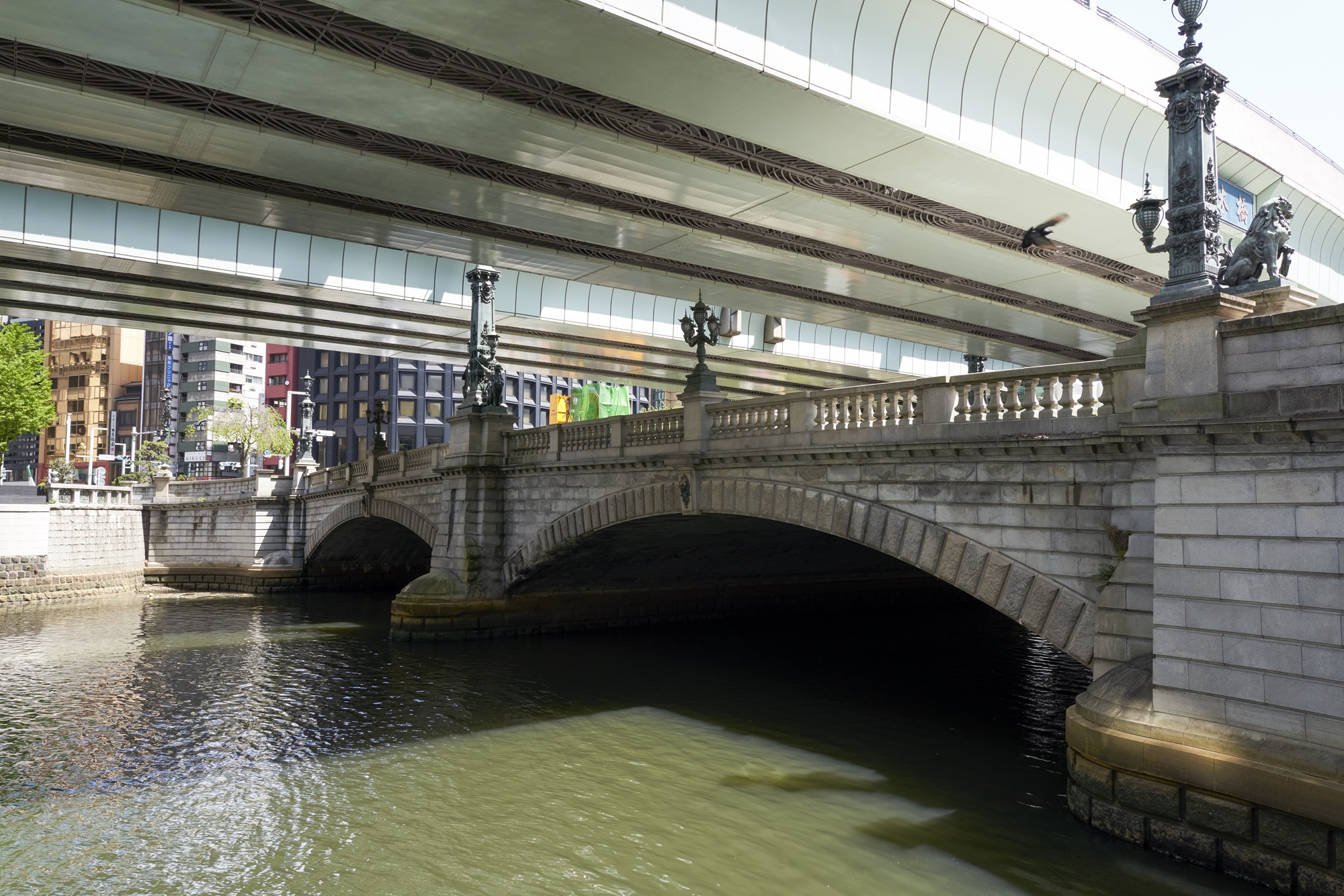
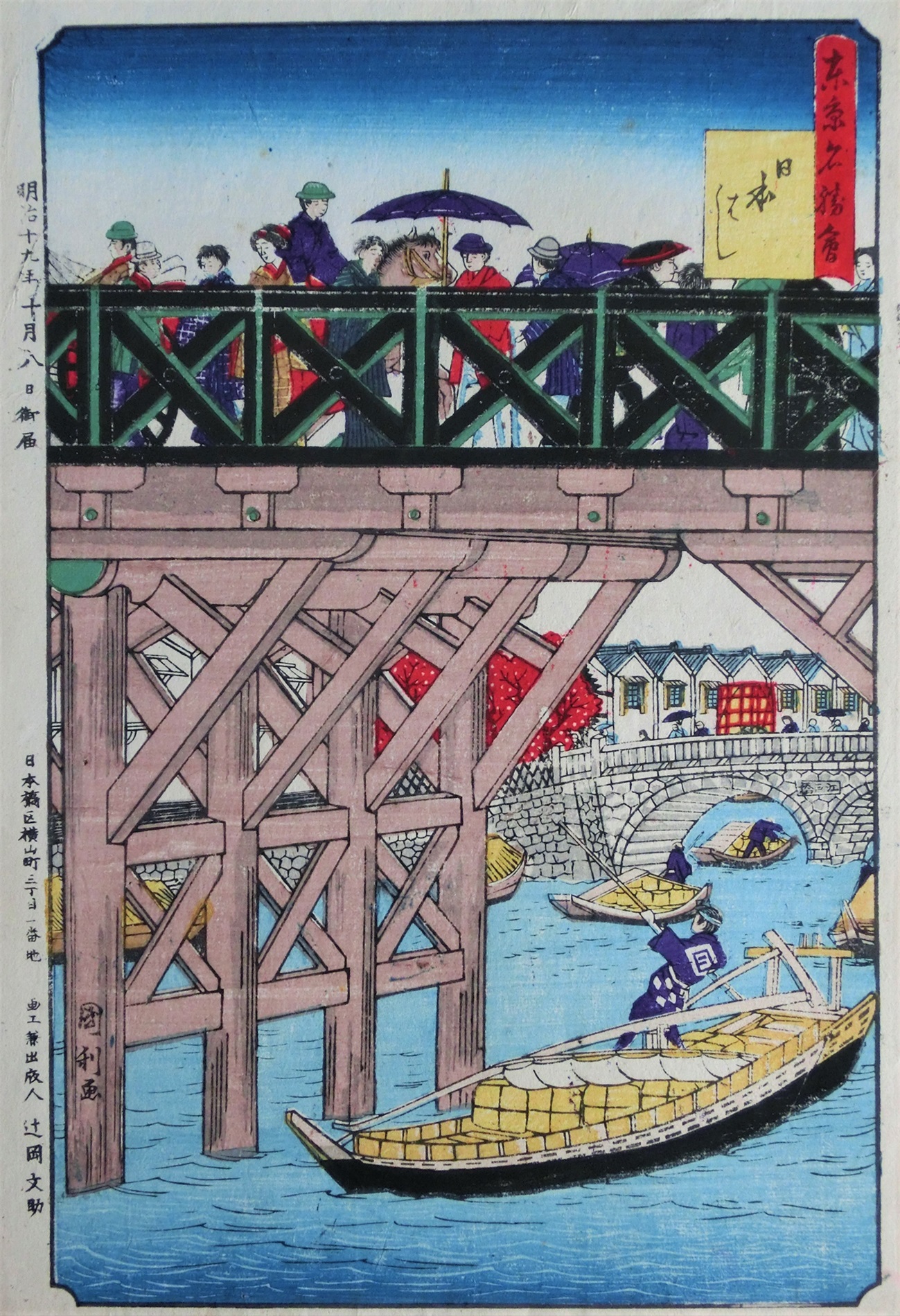
Nihonbashi (日本橋) marks the starting point for the five major Edo-period highways. In the past, you could see Edo Castle and Mount Fuji from the bridge, making it the best viewpoint in Edo. The first bridge was built around 1603. After dozens of replacements, it changed from a Japanese-style to a Western-style wooden bridge in 1872, and then to the current stone arch bridge in 1911. In 1999, its Japanese-Western eclectic style, which incorporates Western design with Japanese motifs, was praised for its outstanding design, leading to its designation as an Important Cultural Property. Currently, as part of the Nihonbashi redevelopment, work is underway to move the Shuto (首都) Expressway, which runs over the bridge, underground. This view will eventually disappear.
Kiyosubashi
●Important Cultural Property / Completed: 1928 / Self-Anchored Steel Chain Suspension Bridge / 186.2m
Modelled After the World’s Most Beautiful Bridge!
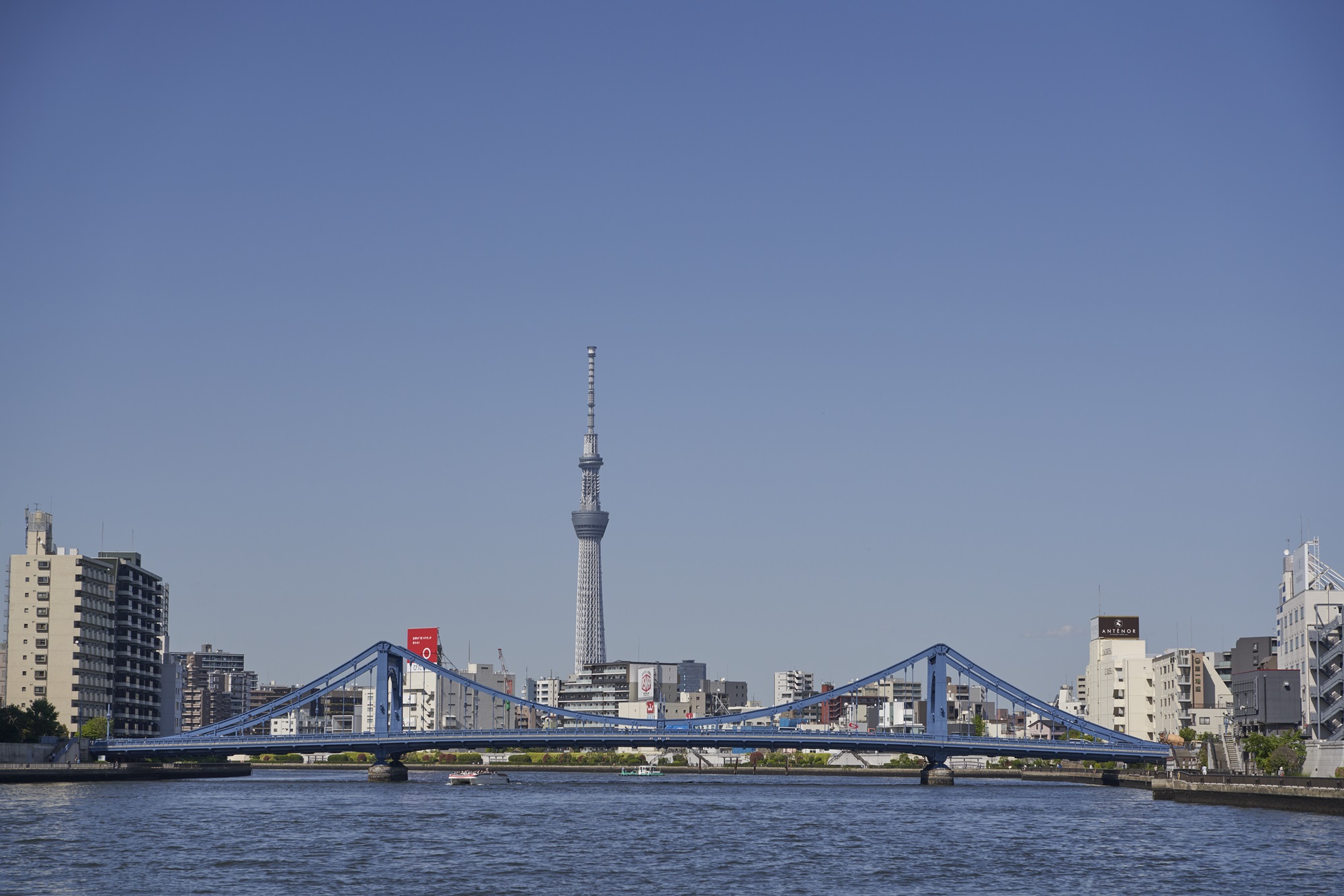
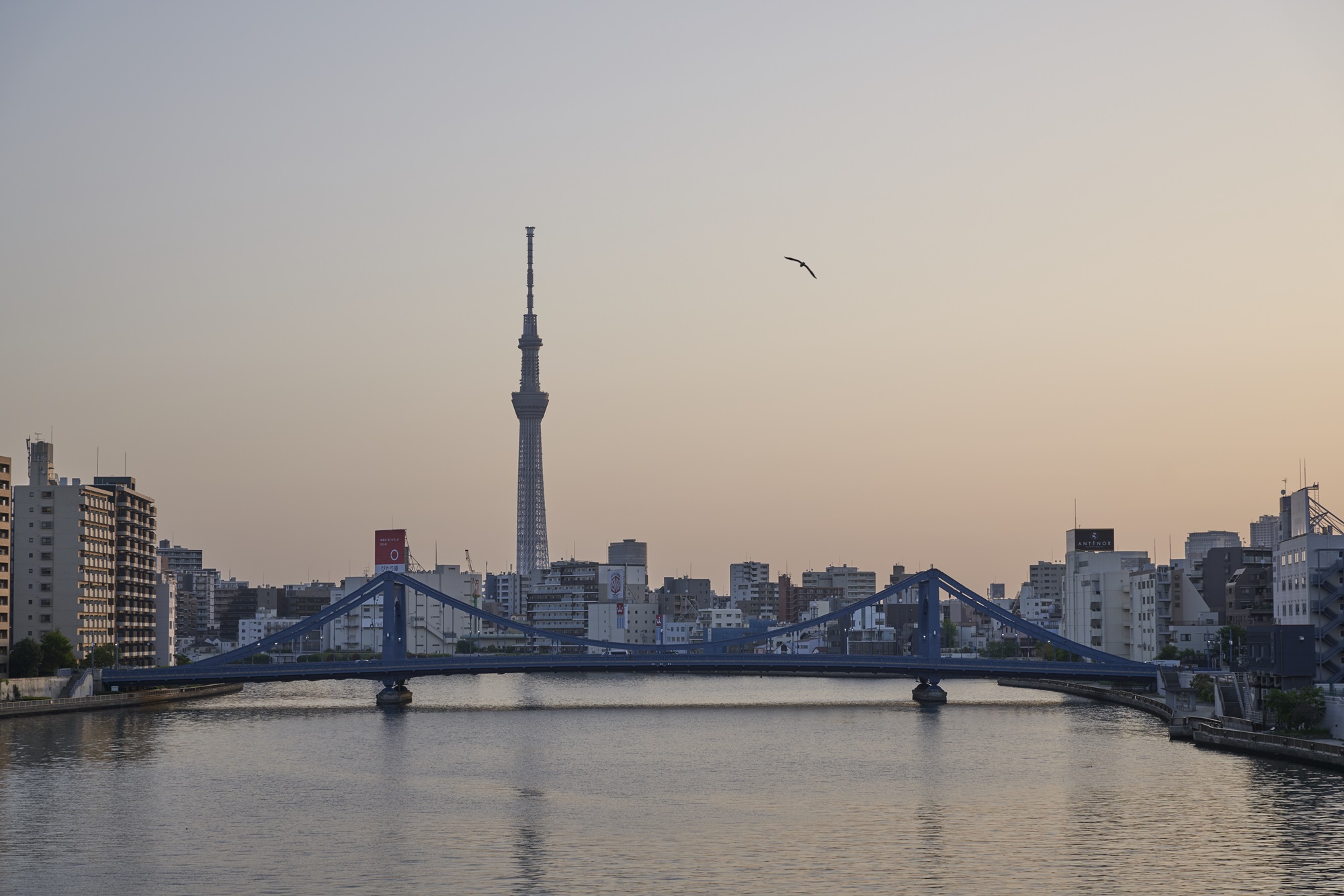
This bridge was modelled after the ‘Cologne Great Suspension Bridge’ on Germany’s Rhine River, which was hailed as ‘the world’s most beautiful bridge.’ Due to its graceful and feminine design, Kiyosubashi (清洲橋) was called the ‘Flower of the Earthquake Reconstruction’ and was featured on posters and commemorative medals for the reconstruction festival. Unlike typical suspension bridges, it uses steel plates connected as a chain for its main cables, not ordinary wire cables. Furthermore, it employs a self-anchored chain suspension structure, where the bridge deck acts as the anchoring system instead of requiring external anchorages on the riverbanks. It is the only example of this structure in Japan, and its rarity and beauty led to its designation as an Important Cultural Property in 2007. Kiyosubashi and Eitaibashi (永代橋) are equally popular among the Sumida River bridges. The image shows the pale blue suspension bridge standing out against the sky, subtly tinged with orange after sunrise. It is photographed from the Sumida River Bridge.
Eitaibashi
●Important Cultural Property / Completed: 1926 / Steel Balanced Tied-Arch Bridge / 184.7mm
Its Massive Form Against the Backdrop of Tsukuda Island’s Skyscrapers is a Famous View
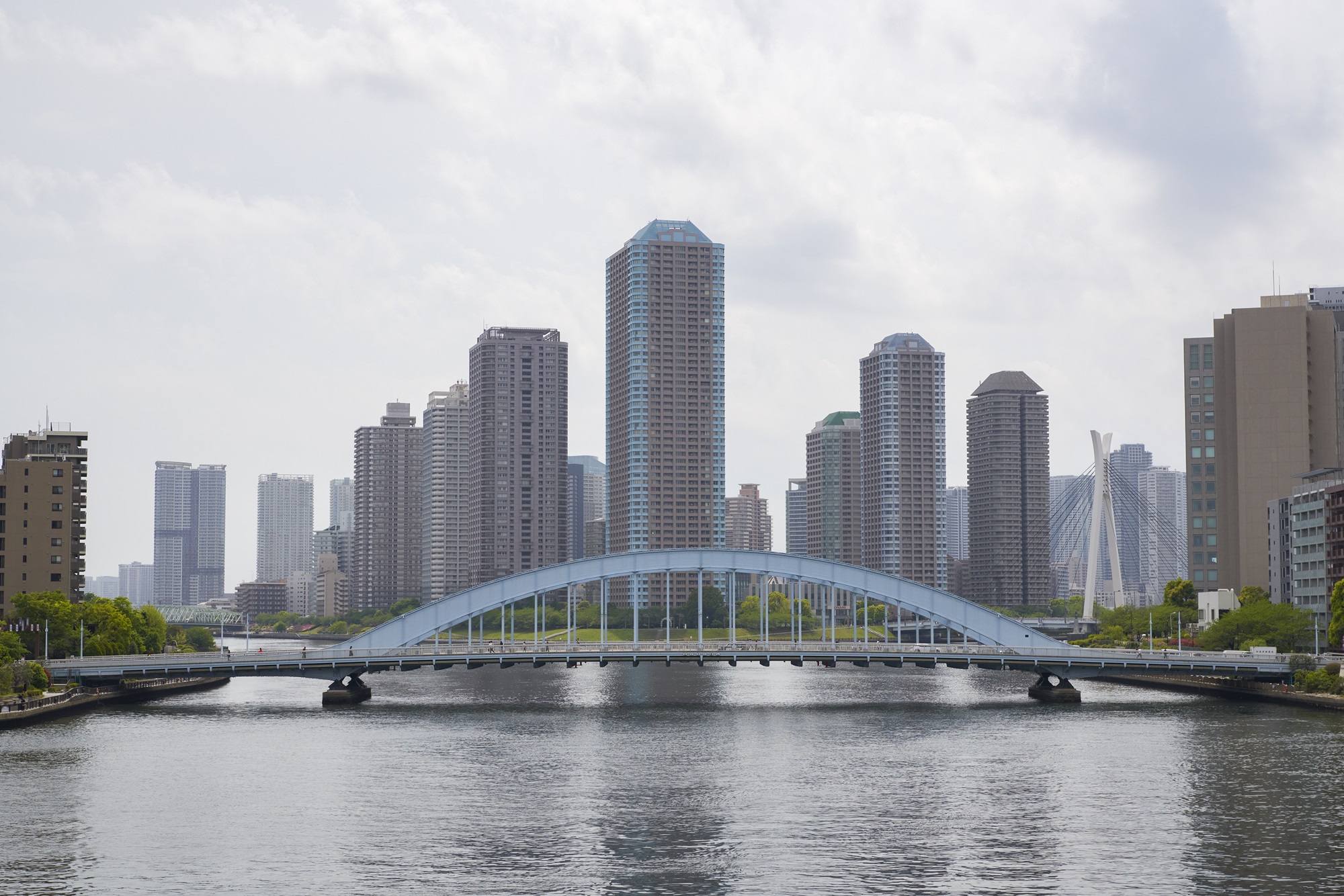
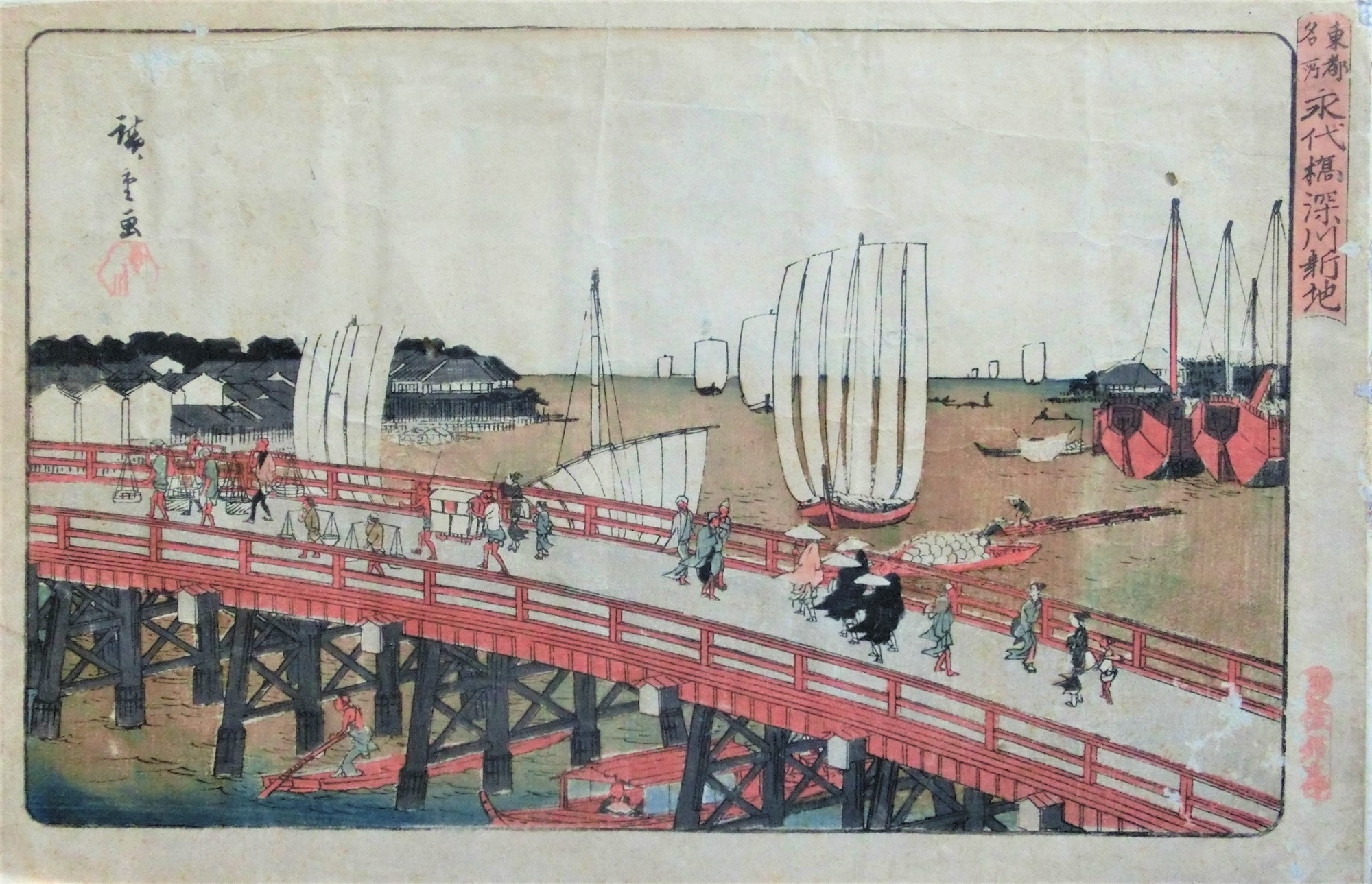
The first Eitaibashi was built in 1698 at the suggestion of Keishoin (桂昌院), the mother of the shogun Tokugawa Tsunayoshi (徳川綱吉), to celebrate his 50th birthday. Reibuilt after collapsing and then switching from a wooden bridge to Japan’s first steel truss bridge, it was finally reconstructed into the current arch bridge as part of the Great Kanto Earthquake reconstruction. It was the first bridge in the world to use Ducol steel, a high-grade steel used for warships, ensuring high strength and resulting in its substantial and beautiful form. It was designated an Important Cultural Property in 2007.
Kachidokibashi
●Important Cultural Property / Completed: 1940 / Chicago-style Double-Leaf Bascule Bridge + Steel Tied-Arch Bridge / 246m
Japan’s largest movable bridge, which once opened in a V-shape
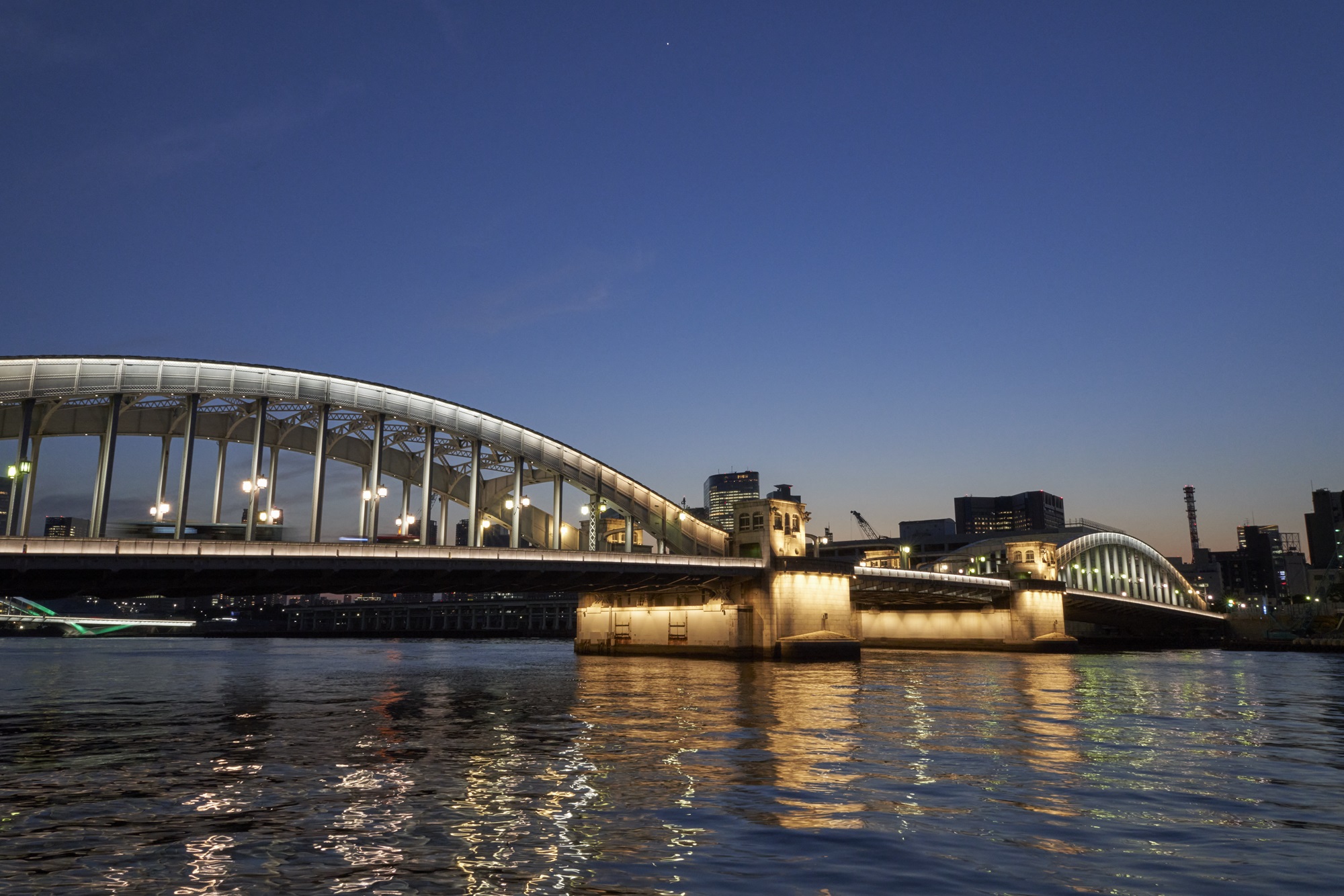
Opened in 1940 to improve access from central Tokyo to reclaimed land like Harumi (晴海) and Toyosu (豊洲). It was built as a movable bridge to allow large ships to pass, and its specifications were comparable to those of the Panama Canal. When it first opened, it used to open five times a day, drawing spectators to watch the 1,000-tonne bridge deck rise up to 70 degrees. The operation of the bascule mechanism ended in 1970. It was designated an Important Cultural Property in 2007 for its value as the pinnacle of pre-war Japanese movable bridge technology.
Hachimanbashi
●Important Cultural Property / Completed: 1878 / Cast Iron + Wrought Iron Bowstring Truss Bridge / 15.7m
Red, small, and Japan’s first Domestically Produced Iron Bridge, a Symbol of Civilisation
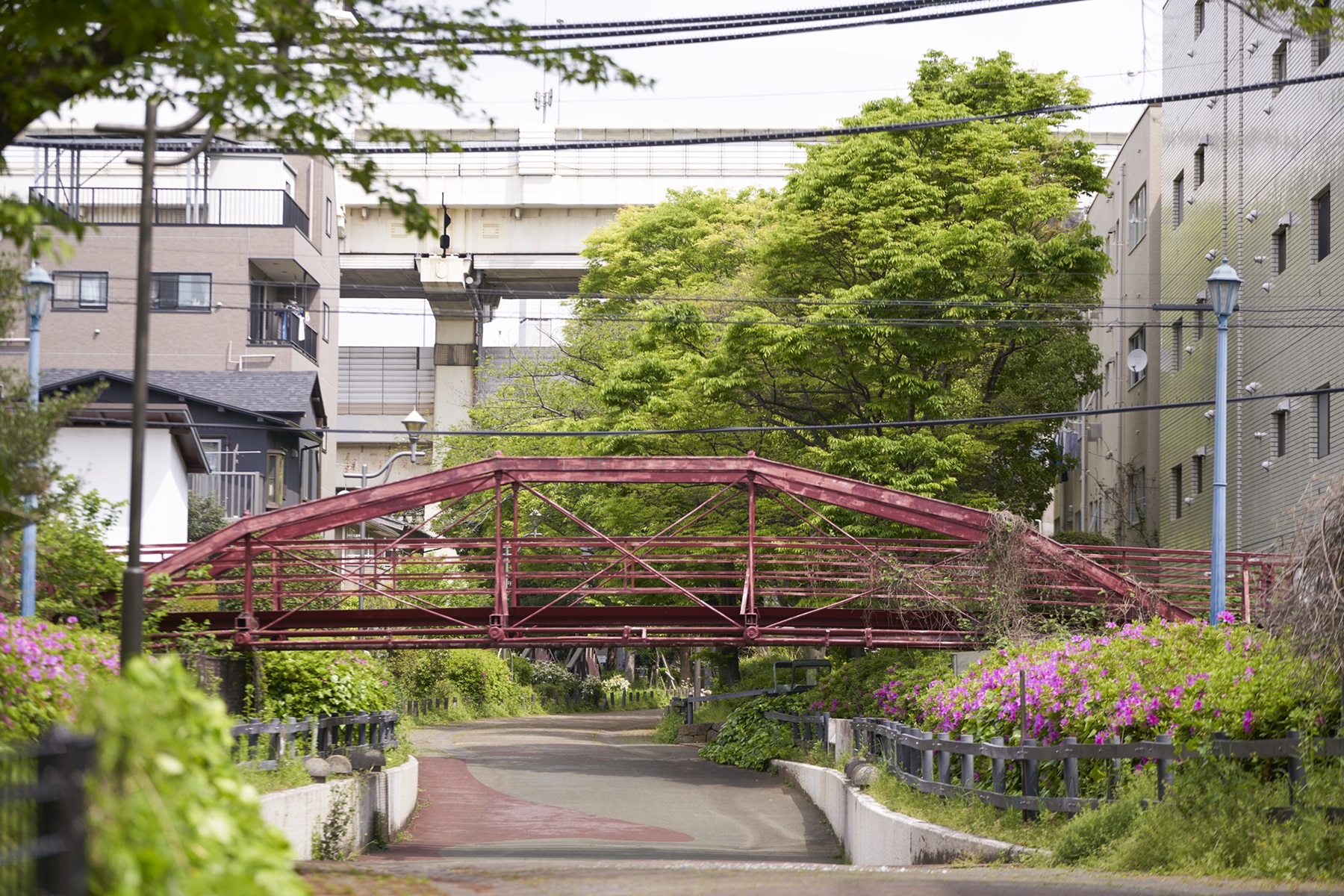
Designed by Matsumoto Soichiro (松本荘一郎), the first government-sponsored student to study in the United States, this was the first iron bridge where all the steel materials were produced domestically instead of being imported. It was initially built as the ‘Danjobashi (弾正橋)’ over the Kaedegawa (楓川) River in Chuo (中央) Ward, but it was deemed unnecessary during the post-earthquake reconstruction plan and relocated to its current location (a park behind Tomioka Hachiman-gu (富岡八幡宮) Shrine). In 1977, its value as a piece of modern bridge technology was recognised, and it was designated an Important Cultural Property. It also received an honorary award from the American Society of Civil Engineers, a first for Japan.
Commentary: Kurebayashi Akio, Former Chief Specialist for Bridge Structure at the Tokyo Metropolitan Government Bureau of Construction. Was in charge of the construction of many bridges, including the Okutama ohashi (奥多摩大橋), and the Yurikamome (ゆりかもめ) train line. His books include ‘Tokyo no Hashi 100-sen + 100 (東京の橋100選+100)’, Hashi o Toshite Mita Fukei (橋を透して見た風景)’, and ‘HERO: Tokyo o Tsukutta Doboku Enjinia-tachi no Monogatari (HERO 東京をつくった土木エンジニアたちの物語)’.
Photography: Osako Futoshi (尾嶝 太) Editing: Tanaka Miho (田中美保)
This article is a reproduction, having been re-edited from the magazine WARAKU (August/September 2023 issue).
This article is translated from https://intojapanwaraku.com/travel/282470/