







A Comfort I Have Never Felt Before
Recently, I tried taking something called voice training, which I had been curious about for some time.
Some of you might wonder, “Why voice training?” However, approaching the age of 50, I am certainly not aiming to become a singer; rather, I wanted to learn how to use my body in conjunction with producing a voice.
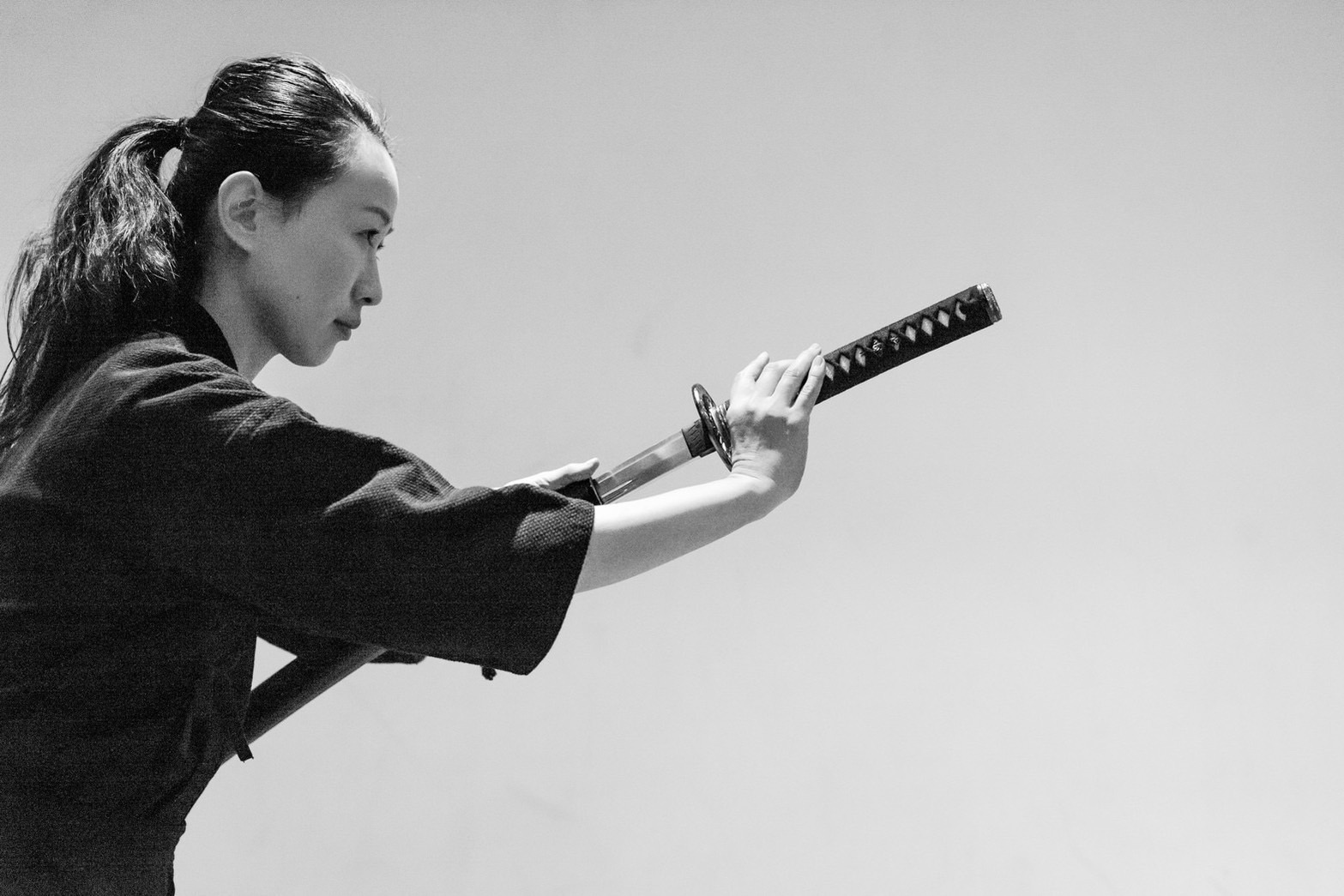
When I actually took the lesson, the training began with being taught the knack for using the body. Above all, what I was taught as “the most important” thing was to relax the entire body, loosen the muscles, and concentrate my awareness only on the areas necessary to produce a voice. Letting go of everything like wanting to sing well or wanting to be able to hit high notes, in a state of ‘nothingness’, just with the image of letting my favourite songs resonate through my whole body. As I sang a few songs in this manner, I experienced a pleasantness and comfort that I had never felt before. I was no longer that person straining with a furrowed brow, desperately trying to push out my voice.
What I felt after finishing my first voice training session was, might there be a commonality with how the mind and body are used when ‘draping’ oneself in a kimono?
To Wear a Kimono Beautifully and Comfortably
When I drape myself in a kimono, what I value most is setting aside the desire to wear it beautifully, relaxing my muscles, and directing my awareness to my bones.
I feel that a state where the muscles are not working excessively—a natural state—is one where a person’s inherent strength and beauty, their potential, so to speak, are being drawn out.
The Chinese character for ‘body’, karada (体), is written in its old form as ‘karada’ (體), combining the characters for ‘bone’ (骨) and ‘abundant’ (豊か). True strength and health are not about training the muscles, but rather having a solid skeletal structure, with the body resting naturally upon those bones. That was likely considered the original “strong and healthy body”.
The image of releasing the tension from the body and entrusting its weight entirely to the bones. When draping a kimono, I cherish that sensation.
There are plenty of insights to be found in traditional martial arts like kobudo(古武道) as well.
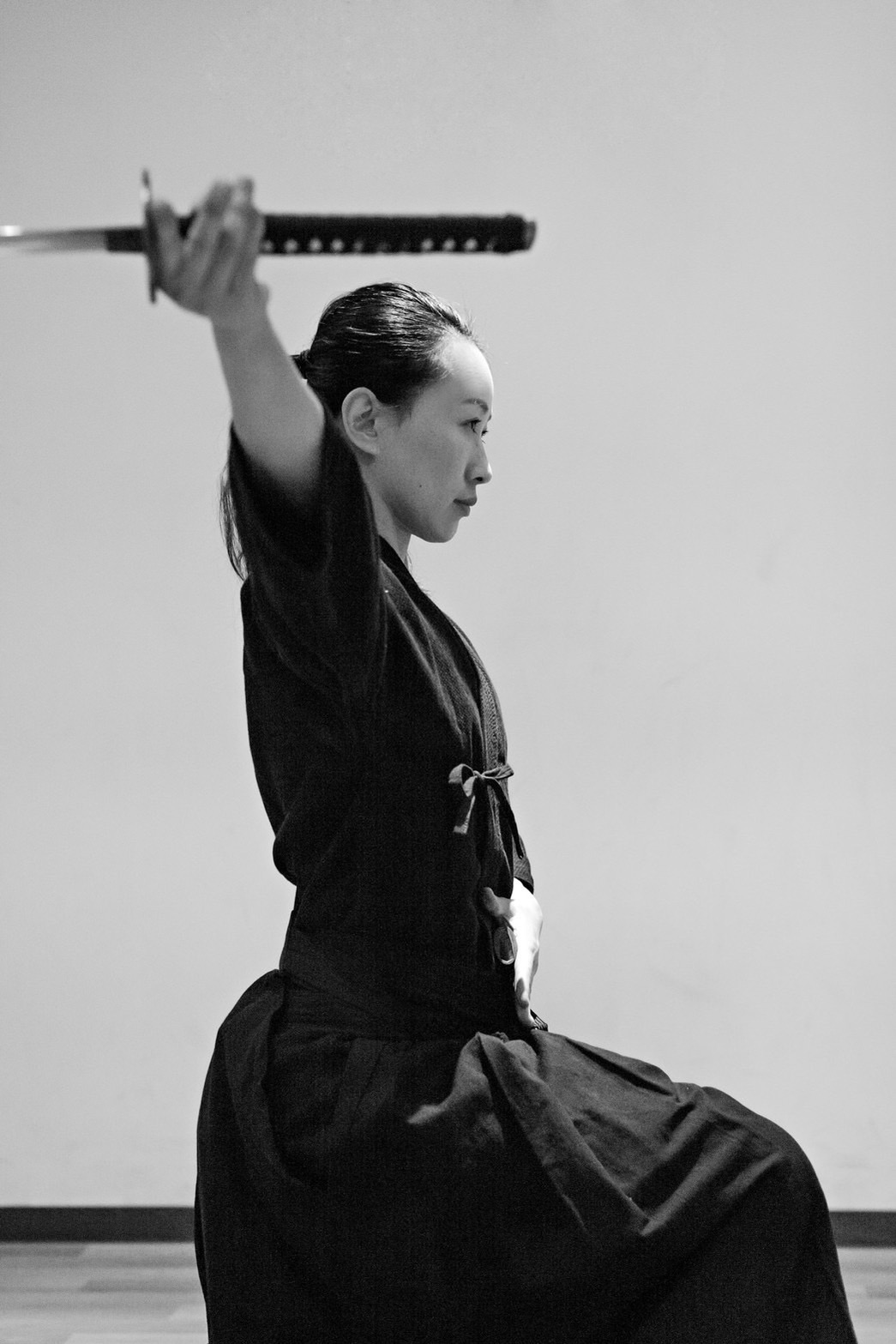
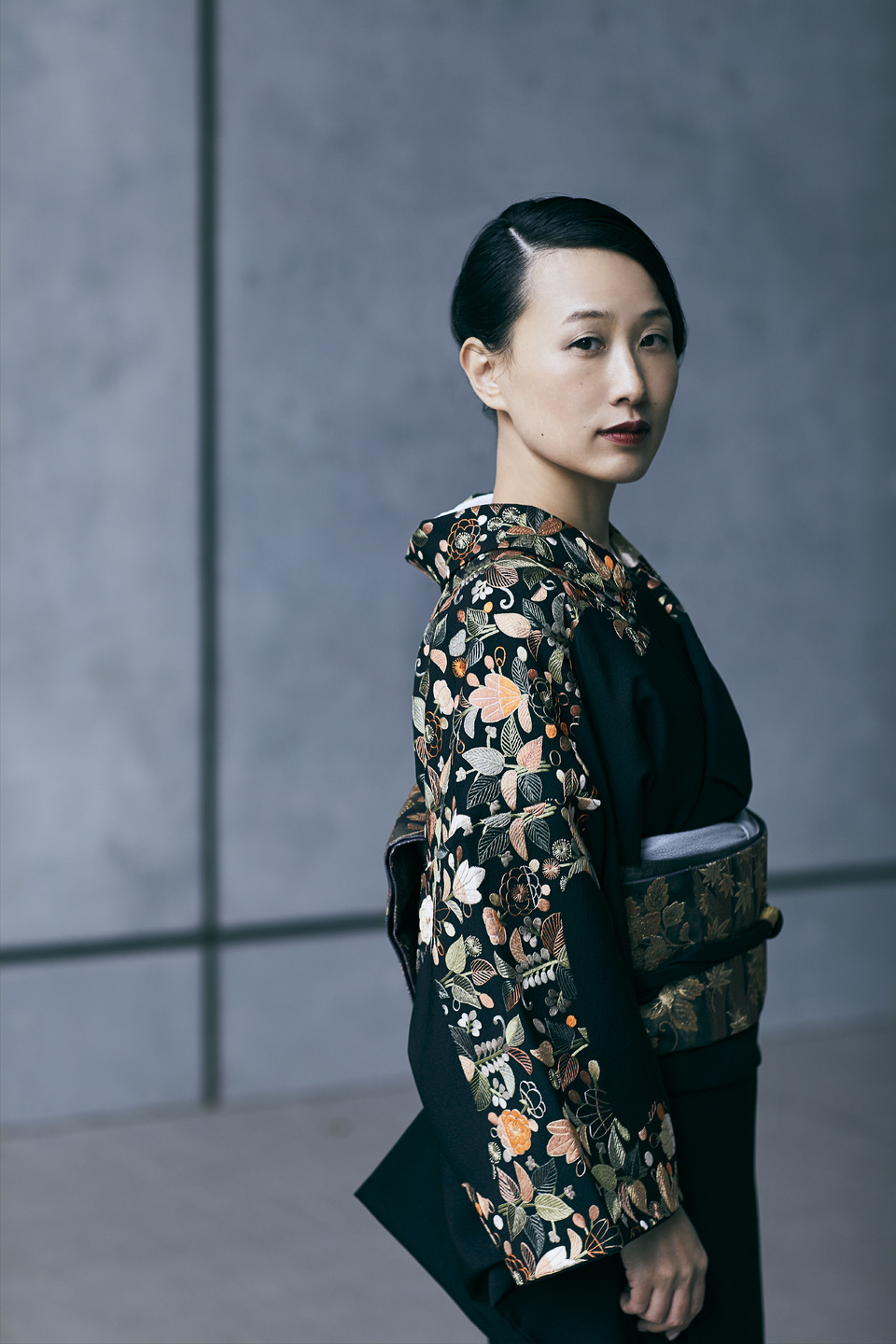
For example, the spine is the centre when first putting on a kimono. You align the back seam, the sechushin (背中心), perfectly with your own spine.
Even when tying the koshihimo, or waist cord (腰紐), you are conscious of the position of the pelvis. Tying it not at the “waist”, but above the pelvis. To do that, properly grasping where your own pelvis is becomes the foundation.
When adjusting the collar, you are conscious of the left and right collarbones. Using the hollow between them as a reference, you decide how much to overlap the collar.
For the back collar, or emon (衣紋), while feeling the cervical vertebrae at the base of the neck, you explore how much to pull the collar back—not by looking in a mirror, but through ‘your own senses’.
The folded part around the waist, the ohashori (お端折り), after tying the obi (帯), is adjusted so that it does not drop below the hip bones, with its bottom line running over the pelvis. If the ohashori falls below the pelvis, the overall balance will not look beautiful.
And finally, what determines the back view is the bottom line of the obi’s otaiko (お太鼓) knot. This is done so that the bottom line comes to the position of the tailbone. By doing so, the roundness of the buttocks is naturally accommodated, resulting in a very well-balanced back view.
In this way, when wearing a kimono, you look at the key points based on the bones, rather than the muscles. By positioning the kimono whilst feeling the locations of your own bones, rather than your muscles, the placement of the kimono that is comfortable for you and visually beautiful will naturally become clear.
Western clothes, by contrast, are something you “wear with the flesh,” I feel. Draping it with a slightly different sensation from how one wears Western clothes is an important point for wearing it beautifully and comfortably.
Being Conscious of the Inside of the Body
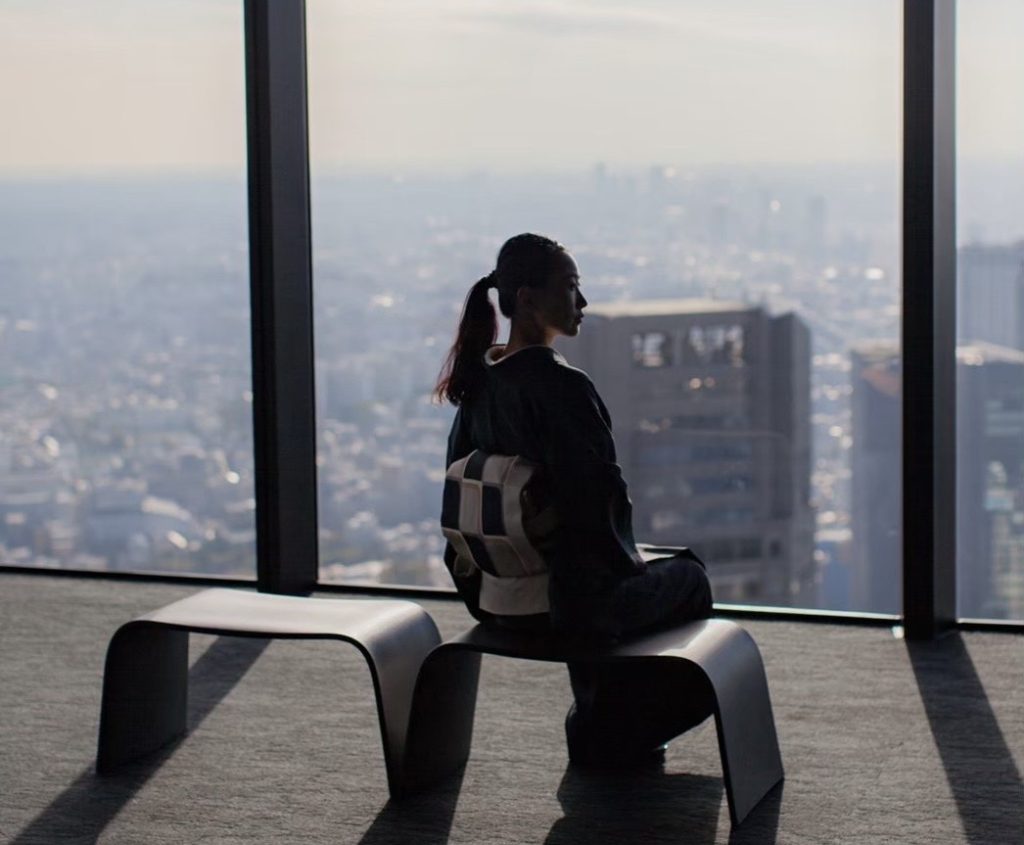
The concept of “draping to the bones” can be applied not only when putting on a kimono, but also when walking or sitting whilst wearing one. For instance, when the chest area becomes untidy, or when the emon slips and the front overlap begins to open, you gently rotate your shoulder blades to send the fabric backwards. If you think centred around the position of your bones, you can achieve a way of wearing it that is less prone to losing its shape just through how you use your body, and which is also easy to tidy up if it does become dishevelled.
Not merely directing your awareness to the visible parts, but being conscious of the unseen inside of the body. Returning your awareness, which tends to turn outwards, to the inward sensations of “how am I feeling right now?” and “what feels comfortable?”.
The accumulation of such sensations leads to knowing your own comfort, and subsequently, to refining a sensibility that belongs to you alone, and no one else. That is how I feel.
This article is translated from https://intojapanwaraku.com/fashion-kimono/295836/








真珠の耳飾りの少女-850x1024.jpg)