












We introduce six selections from ink, ukiyoe to oil painting
Mt. Fuji, the highest peak in Japan, has been an object of faith since ancient times as a symbol of Japan. It is not only because people have a sense of honor and dignity as a majestic mountain of independence, but at the same time they have also superimposed the mind of awe as a mountain of fire that repeatedly erupts. Such a beautiful and beautiful figure of Fuji continues to fascinate people's hearts, and has been sung in more poets than in Manyo and has become the subject of many famous paintings.
Here, we will introduce a wide variety of Mount Fuji paintings drawn by various masters from their own perspectives.
Yuichi Sakai "Handbook of Pictures (Mount Fuji)"
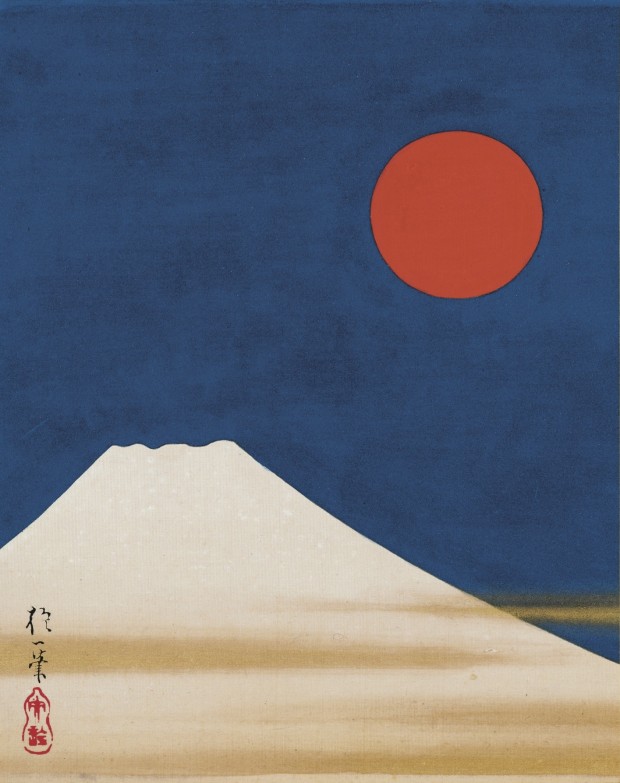 Paper book silk book and colored ink painting each out of seventy-two figures 25.1 x 19.9 cm 19th century Edo period The Seikado Bunko Art Museum collection The Seikado Bunko Art Museum image archive DNPartcom
Mt. Fuji by Sakai Houichi who is famous as a leader of the Edo-style school. This is one of the 72 paintings with various tastes, such as coloring and ink paintings, and it is one of the paintings, and it is a piece full of sense that it can be said that he further sharpened the light painting style that Hunichi kept private.
"Seitoku Taito Eden" (part)
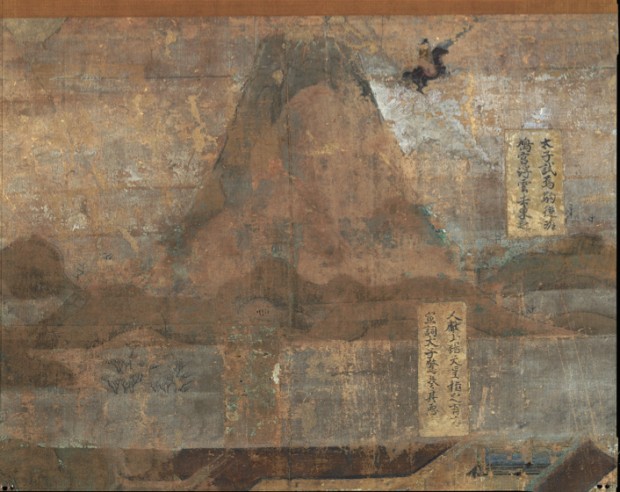 Of the ten sides, the third side Enomoto coloring 189.4 × 137.3 cm Yonku first year (1069) · Heian period Tokyo National Museum collection Image TNM Image Archives
It is not clear when the appearance of Mt. Fuji began to be pictorialized. However, the work that seems to be the oldest in existence is drawn here in the middle of the Heian period. It depicts a scene where Prince Shotoku jumps over Mt. Fuji over a black horse. Expressing the existence of superhuman grandfather by jumping over Fuji, Kamiyama.
舟 "Fuji Miho Kiyomi-zu map"
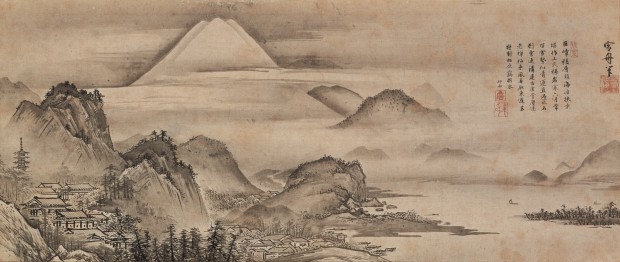 One width paper book sumi painting 43.2 × 101.8 cm 16th century, Muromachi era Nagaiso paperback collection
A composition that draws Mt. Fuji over Suruga Bay and Miho's Matsubara, which is familiar with the paintings of public baths. The work that can be said to be the originator of this composition that had a great influence on the painters after Sesshu, this work that Sesshu was supposed to have drawn in the Edo period (It is considered to be a faithful copy today) ). It is not clear whether Yukito visited this area, but instead of drawing the real view as faithfully as the "Amanohashidate" of the National Treasure (Kyoto National Museum collection), it was reconstructed to be a picture of what it should be Seems to be this Fuji figure. At the time, Kiyomi-dera, which is depicted on the far left, was under the protection of Ashikaga Shogun (Hiji), and was known as a scenic spot for nuns visiting the eastern country to stop by. So Sesshu darefully depicted the figure of the temple that should not be seen in this composition.
Yuki Nagasawa "Fujikoshi crane map"
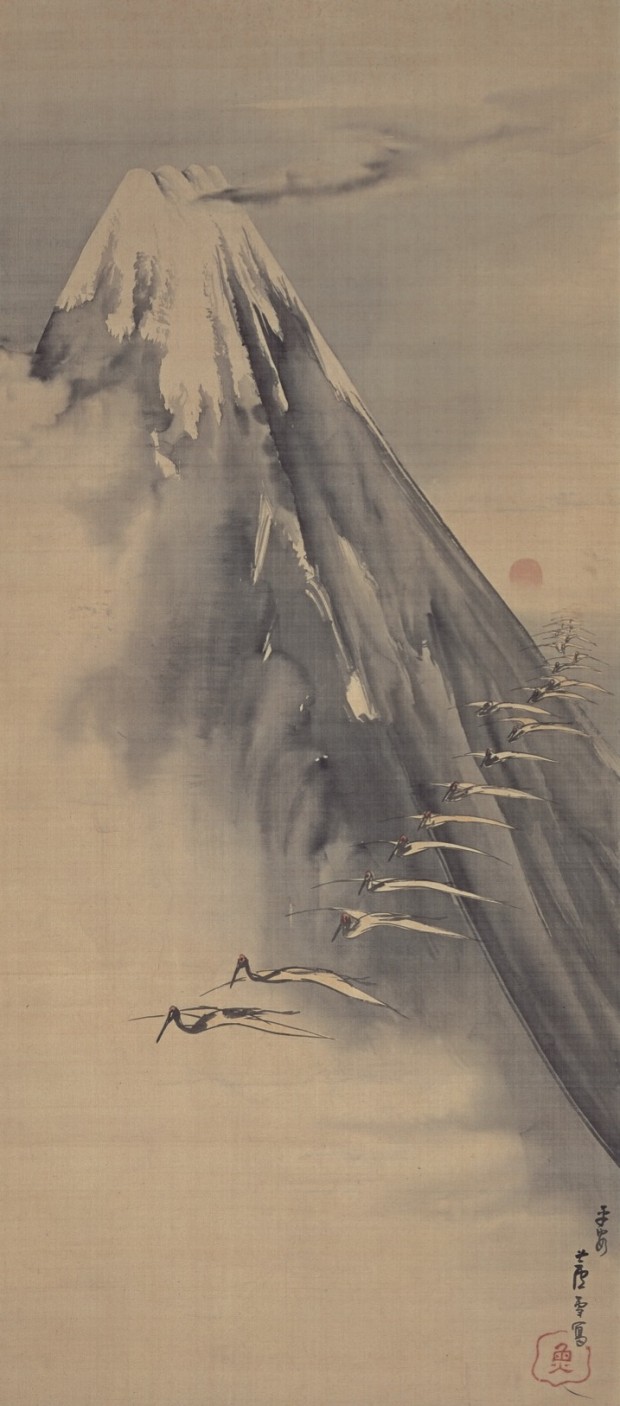 One width Silken ink painting coloring 157.0 × 70.5 cm Kansei 6 years (1794) ・ Edo period Private collection
There are many paintings that depict Mt. Fuji, but there will be no more unusual and original works. A disciple of Maruyama Ouki, who played an active part in Kyoto in the 18th century, and Ito Jakuchu, Soga Shohaku, etc. An illustrator named Nagasawa, an illustrator called "The Fantastic Three Wings" This work, which is hand-made by snow, depicts a flock of cranes gliding like a glider on the side of Mt. Fuji, which is too smart. Even though it depicts sacred Fuji, it is amazing that you can see and hide what it means to be a "wonderful painter."
Shima Jiang Han "Shukawa Bay Fuji distant view map"
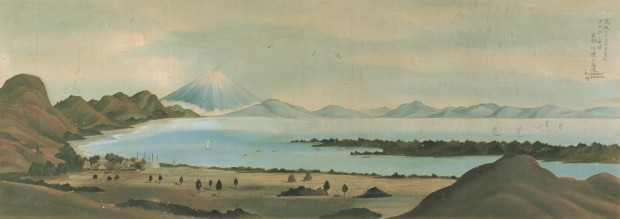 Body frame silk oil 3 36.2 × 100.9 cm Kansei 11 (1799) · Edo period Shizuoka Prefectural Museum of Art storehouse
This work, drawn by Shiba Kohan, known as an 18th century Western painter, was painted in oil on the influence of the transfer snow fence "Fuji Miho Kiyomi-ji map" introduced earlier. It is said that Jiang Han, who traveled to Kyoto, discovered and worked on the "Scenery seen by Sesshu" on the way. At the time, Jiang Han was influenced by a Western-style painting called “Akita Ranga”, which became popular in the upper warrior class of Akita Atsushi, including the first corroded copper engraving in Japan, perspective and shadowing. Active as a pioneer in Western-style paintings making full use of Even so, it is strange that the figure of Mt. Fuji also looks modern at a stretch when the drawing material changes.
Utagawa Hiroshi "" Tokaido 5 Ping Michinouchi Yui · Sakai "
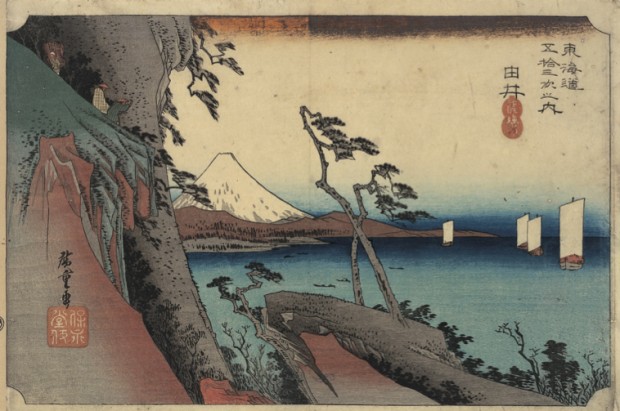 Of the fifty-five sheets, large-size 錦 23.0 × 35.0 cm Tenpo 4-7 years (1833-36)-Edo period Yamase Museum of Art collection
Some of the representative works of Utagawa Hiroshige who can say that there are no people who appear to the right of this person if you draw a scenic spot such as "Edo Hundred Scenic Spots", "Toto Famous Spots", "Omi Hakkei" Mount Fuji is drawn. Hiroshige who lived in Hokusai and the same period depicting bold Fuji, with free-flowing brushstrokes. This Fuji painted by such a Ukiyo-e artist is as humble as possible.