













Shrine construction is different here!
Ise Shrine and Izumo Taisha, which have become national ritual sites. Its main building architecture now conveys Japan's oldest style, but the structure is different. Its characteristics are clear when you compare it.
Ise Jingu Shrine is based on "Gemakura" and is the only one created by Shinmei
One of the common Shinto shrine constructions is "Shinmei-zushi". Among them, since the Ise Jingu Shrine is a special style that can not be used elsewhere, it is generally called "Shinmei-zushi". This is the development of the ancient stilts granaries into a palace form. The roof is the gutter of a gable (the sloping roof that looks down on a book), the entrance is flat, the digging formula is used to fill the pillars in the ground, and the ridged pillars are characterized. A straight, almost decorationless and simple beauty, made of oak wood, symbolizes Ise Shrine, which has been "Jouka" for 2000 years. 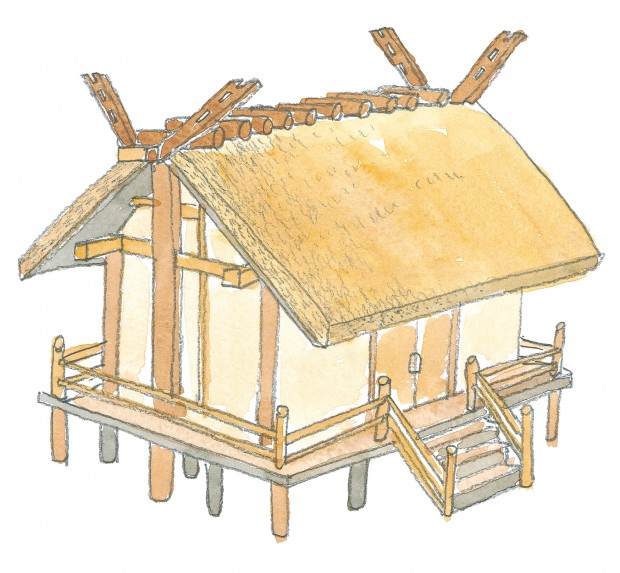
The entrance is in this direction
There is an entrance on the slope side of the roof, and a form called "flat entry". 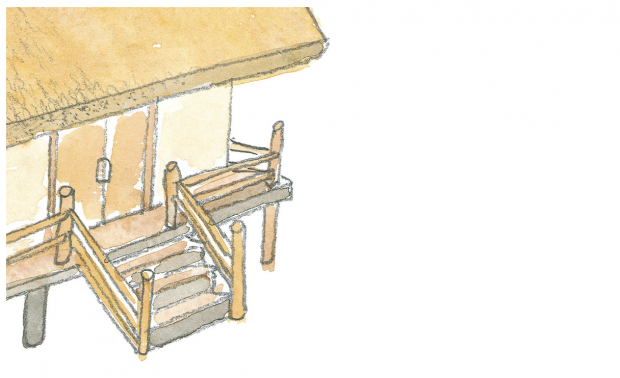
It is the same and different Uchinomiya and the outer shrine. The style of "Chiki" is also different
The tip of Chichi in Uchinomiya is an internal scraping horizontal to the ground, and the air holes are two and a half. At the outer shrine, the tip is cut vertically to the ground, and there are two air holes. There is a difference between the inner palace and the outer palace, with the passage of the sanctuary also being distinguished between right-handed (inner palace) and left-handed. 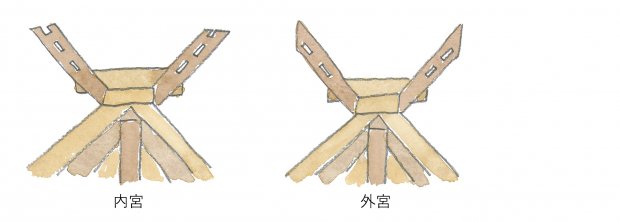
Izumo Taisha is "Daisha-made" close to "Dwelling"
The structure of Izumo Taisha's main shrine is "Daisha-made." From the ridge at the top of the roof, the roof flows on both sides, and there is an entrance to the wife (one with a view of Yamagata). Inside is a square space of about 11m in both depth and frontage, with a sacred "heart pillar" standing at the center, and nine other pillars are formed in a rice-shaped form.
The pillars stand on the foundation stone, but before the Kamakura period, they were in the form of a drilled pillar whose base was buried in the ground. The roof is covered with rattan skin, and the top of the ridge is covered with Tochigi and Chigi trees. The height from the cornerstone to the tip of the tree is about 24 m. It is possible that the ancient times were even higher, and it is recorded in the record that the collapse has reached seven degrees from the Heian period to the Kamakura period.
The current main hall has parts that have changed in detail depending on the age, but the basic style has not changed from the ancient one. There is also a view that it is considered as the origin of Japanese housing, and it is a valuable existence when talking about Japanese architectural history. 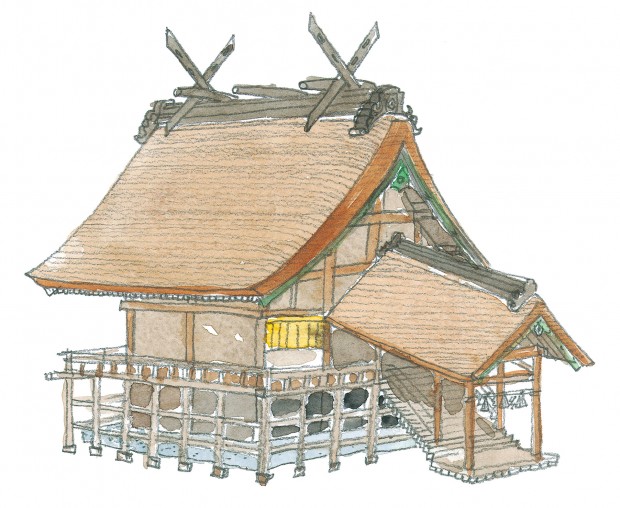
The roof of the persimmon skin is heavy. The thickness of the eaves is about 1 m!
Dense crusts protect the roof wood from the elements. The hides are carefully fixed with bamboo nails by artisans. 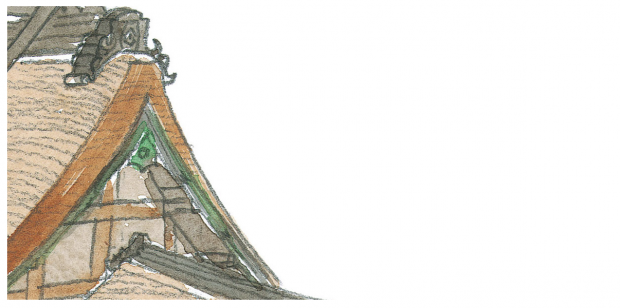
Traditional "Chan Fill" to protect Chigi and Tochigi
The jet-black paint applied to the roof decoration is a traditional technique called 'Chan-painting'. It has a role to protect the copper plate. 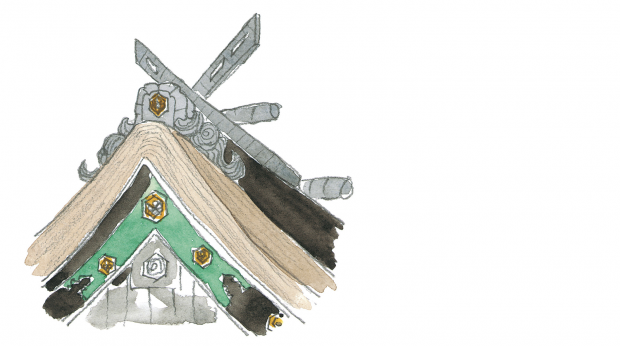
Ise and Izumo also differ in the shape of the torii!
The torii in Ise Shrine has a short material (punch) to connect the erected pillars, and no material on the top (Tochigi). Izumo Taisha has warps in Tochigi and the wood below it (island wood), and the penetration penetrates a cylinder. 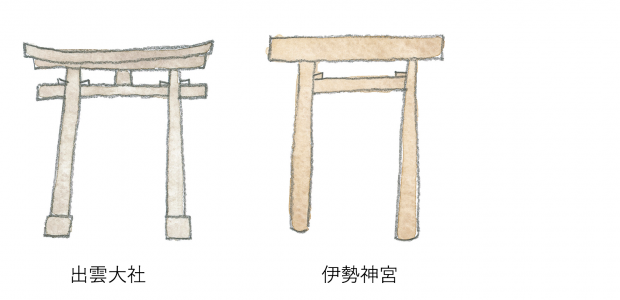
I want to read together
・The god of marriage “Izumo Taisha” God area ・ Premise walking guide!