The hidden history behind the fourth key rites of passage in Japanese culture Sawada Toko ‘Biso no Nippon: The history of dressing up’
連載
Culture
2025.07.26
The hidden history behind the fourth key rites of passage in Japanese culture Sawada Toko ‘Biso no Nippon: The history of dressing up’
Dressing up and adorning oneself with sparkling jewellery. There lies the human desire to be beautiful and to add colour to one's life. In our series 'Biso (美装) no Nippon: The History of dressing up', writer Sawada Toko traces the history of various ornaments and jewellery, and explores the mysteries behind the act of dressing up.
Perhaps due to my profession, which revolves around language, I often find myself intrigued by words that still exist in writing but are rarely, if ever, used in their original context. One such example is the word kan (冠, crown). As a kanji (漢字), everyone can read and write it, and most people have a vague idea of its meaning. However, I suspect that modern Japanese people almost never use it in daily conversation. If it is encountered at all, it is most likely within the four-character compound kankonsosai (冠婚葬祭, ceremonial functions).
In Japan today, kankonsosai is often used as a kind of shorthand for weddings and funerals. However, the term originally referred to the four key rites of passage in a person’s life: genpuku (元服, coming-of-age, 冠,), konrei (婚礼, wedding, 婚), soshiki (葬式, funeral, 葬), and sosen sairei (祖先祭礼, ancestral rites, 祭). Among these, the coming-of-age ceremony and ancestral rites have largely faded from daily life in contemporary society. As a result, the term’s meaning has effectively narrowed to just the wedding and funeral aspects.
So why does kan signify the coming-of-age ceremony? It is because, for males, the genpuku ritual was essentially the occasion on which one donned a crown for the first time. In pre-modern Japanese society, the crown was indispensable for any adult male of a certain rank. It was also a visible symbol attesting that the wearer had reached adulthood.
――Mukashi, otoko, uikaburi shite, Nara no miyako, Kasuga no sato ni, shiruyoshi shite, kari ni inikeri. (昔、男、初冠して、奈良の京、春日の里に、しるよしして、狩にいにけり。)
(‘Long ago, a man came of age, and with a connection to Kasuga (春日) village in the ancient capital of Nara, he set off to hunt.’)
This is the famous opening line of the Ise Monogatari (伊勢物語), a poetic tale from the Heian period whose protagonist is said to be modelled on Ariwara no Narihira (在原業平). The tale concludes, in its 125th episode, with the protagonist’s death:
――Mukashi, otoko, wazuraite, kokochi shinu beku oboekereba, tsui ni yuku michi to wa, kaneshi kikishikado, kino kyo to wa omowazarishi wo. (昔、男、わづらいて、心地死ぬべくおぼえければ、ついにゆく道とは かねし聞きしかど きのうけふとは思わざりしを)
(‘Long ago, a man fell ill and felt death approaching. Though he had long heard that death was the path one must eventually take, he never imagined it would come so suddenly—yesterday or even today.’)
Thus, the story begins with kan—the coming-of-age—and ends with so—death and funeral rites. It is a structure that eloquently reflects how significant a life event the act of donning the crown once was for people of the time.
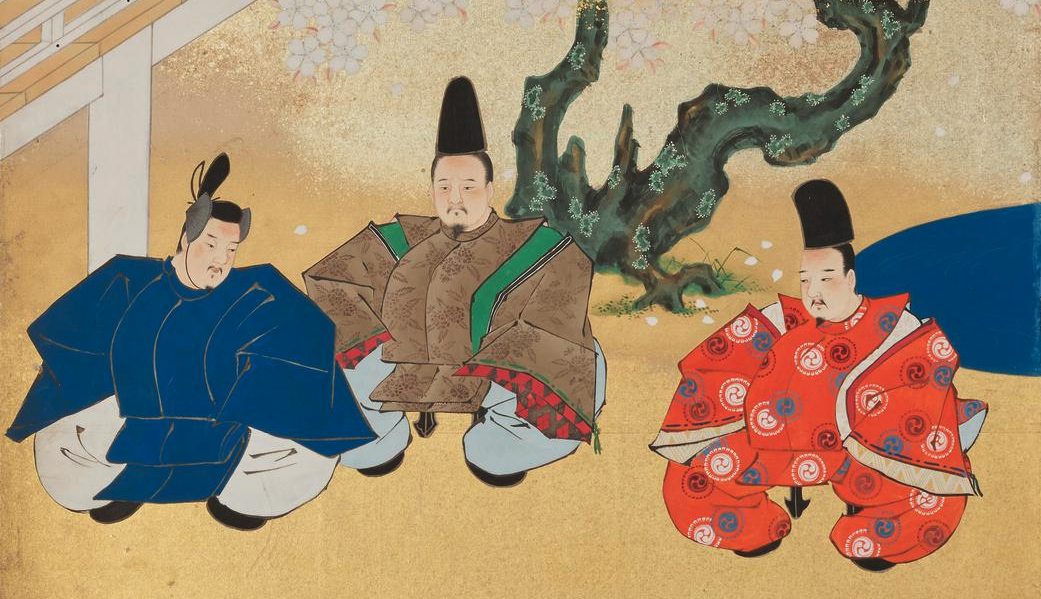
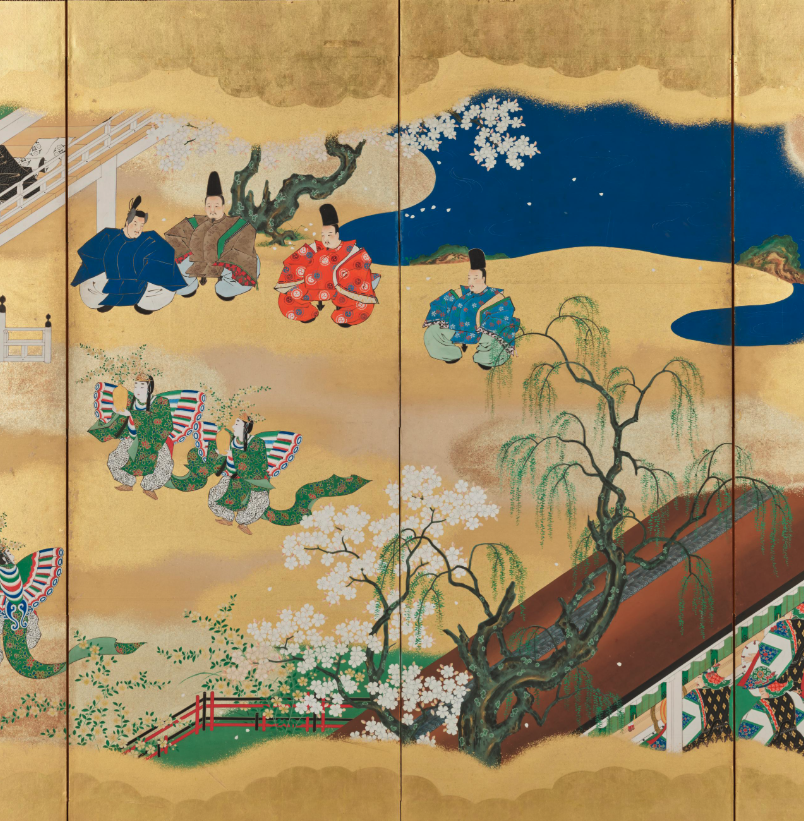
Detail from Scenes from The Tale of Genji: Picture Contest and Butterflies, painted by Kano Osanobu (狩野養信, Seisen-in, 晴川院). Of the three men wearing eboshi (烏帽子) headgear, the figure on the far left wears a crown adorned with a semicircular ornament known as an oikake (緌). This is said to be a stylised representation of the tasselled ends of the cords used to secure the crown, and it was typically worn by military officers or guards. (Edo period / via ColBase [https://colbase.nich.go.jp/]; also used for the thumbnail image)
How the Essence of ‘Kan’ was honoured in Noh theatre and poetry
Among the repertoire of nogaku (能楽, Noh theatre) works established during the Muromachi period, there is one play titled Eboshi-ori (烏帽子折). The eboshi (烏帽子) is a type of headwear traditionally worn by adult men, typically used in more private or informal settings compared to the more formal kanmuri. In this play, the protagonist—or Shi-te (what protagonists in Noh plays are refered to)—is depicted as the master of an eboshi maker in the first half, and then transforms into the notorious bandit Kumasaka Chohan (熊坂長範) in the second, making for a somewhat complex structure. Yet the real focal point of the play is not the protagonist, but rather the young boy who confronts him—Ushiwakamaru (牛若丸), who would later become the famed warrior Minamoto no Yoshitsune (源義経).
Ushiwakamaru is played by a kokata (子方), a child actor, and the story is set in what is now Shiga Prefecture, during the time when the Heike (平家) clan still held political power. As the orphaned son of Minamoto no Yoshitomo, Ushiwakamaru harbours the desire to avenge his family and overthrow the Heike. He escapes from Mount Kurama (鞍馬寺), where he had been in training, and aims to journey north to Oshu (奥州, present-day Tohoku, 東北). However, the Heike, having caught wind of his plan, dispatch pursuers across the provinces. Realising he risks being captured, Ushiwakamaru resolves to abandon his boyish appearance. He visits a local eboshi maker and undergoes the genpuku ceremony, formally entering adulthood.
This coming-of-age ritual is far more than a mere disguise—it is the first step in Ushiwakamaru’s transformation from boy to man, and in his pursuit of a lifelong mission. In today’s world, where the practice of genpuku has long since disappeared, the symbolic significance of the eboshi in this play may be difficult for modern audiences to grasp. Yet within the contemporary nogaku world, Eboshi-ori is known for its dynamic portrayal of Ushiwakamaru and is considered one of the most challenging roles for a kokata. In many cases, performing this role marks a child actor’s graduation and their first step towards becoming a full-fledged Noh performer. In this way, Eboshi-ori, with its theme of the first crowning, still serves as a rite of passage today.
Incidentally, there is a word that has now completely fallen out of use: kaja or kanja (冠者), which referred to a young man who had only recently undergone genpuku. Emperor Go-Shirakawa (後白河天皇), who would later become deeply connected to Ushiwakamaru—now known as Minamoto no Yoshitsune—was a great enthusiast of imayo (今様), the popular songs of his day. He compiled a collection of the songs he had learned, naming it Ryojin Hisho (梁塵秘抄), and among them is the following verse:
――Muko no kaja no kimi, naniiro no nanizuri ka kodo, kimahoshiki / kikujin, yamabuki, tomezuri ni, hanamurako / mitsunagashiwa ya ryugo, wachigai, sasamusubi, kokechi maetari no hoya no kanoko-yui (婿の冠者の君 何色の何摺りか好うだう 着まほしき 麹塵 山吹 止擦に 花村濃 御綱柏や輪鼓 輪違 笹結び 纐纈まえたりのほやの鹿子結い)
(What color and type of kimono might the young groom-to-be wish to wear? Perhaps kikujin (麹塵)—a soft, greenish-yellow once favored by nobility—or the golden brightness of yamabuki (山吹色), like the kerria blossom. Would the dyeing be tomezuri (止め摺り), with its sharp, defined edges, or the rich, saturated tones of hanamura-kosome (花村濃染め)? As for motifs—mitsunagashiwa (御綱柏), the stylized oak leaf crest; ryugo (輪鼓), shaped like a hand drum; wachigai (輪違), interlocking circles; sasamusubi (笹結び), a bamboo-knot design; or the delicate kanoko-yui (鹿子結) tie-dye on a hoya front cloth?)
All the terms following kikujin refer to various dyeing techniques or textile patterns. It is believed to be a song in which the parents of a newly welcomed son-in-law are deliberating what kind of kimono he might like, and what gift to present. While space does not permit a detailed explanation of every term, for instance, mitsunagashiwa is a crest based on the triangular oak leaf; ryugo resembles the hourglass shape of a drum’s body; and wachigai is a pattern of interlocking rings. One cannot help but feel uplifted by the image of these splendid garments, so fitting for a newly crowned young man.
And yet, the reason the kanja is shown such care and affection is because he has undergone genpuku, become a full-fledged man, and taken a wife. It may be ‘just a crown,’ but it is no trivial matter. Precisely because it is now so far removed from our daily lives, its historical significance feels all the more fascinating.
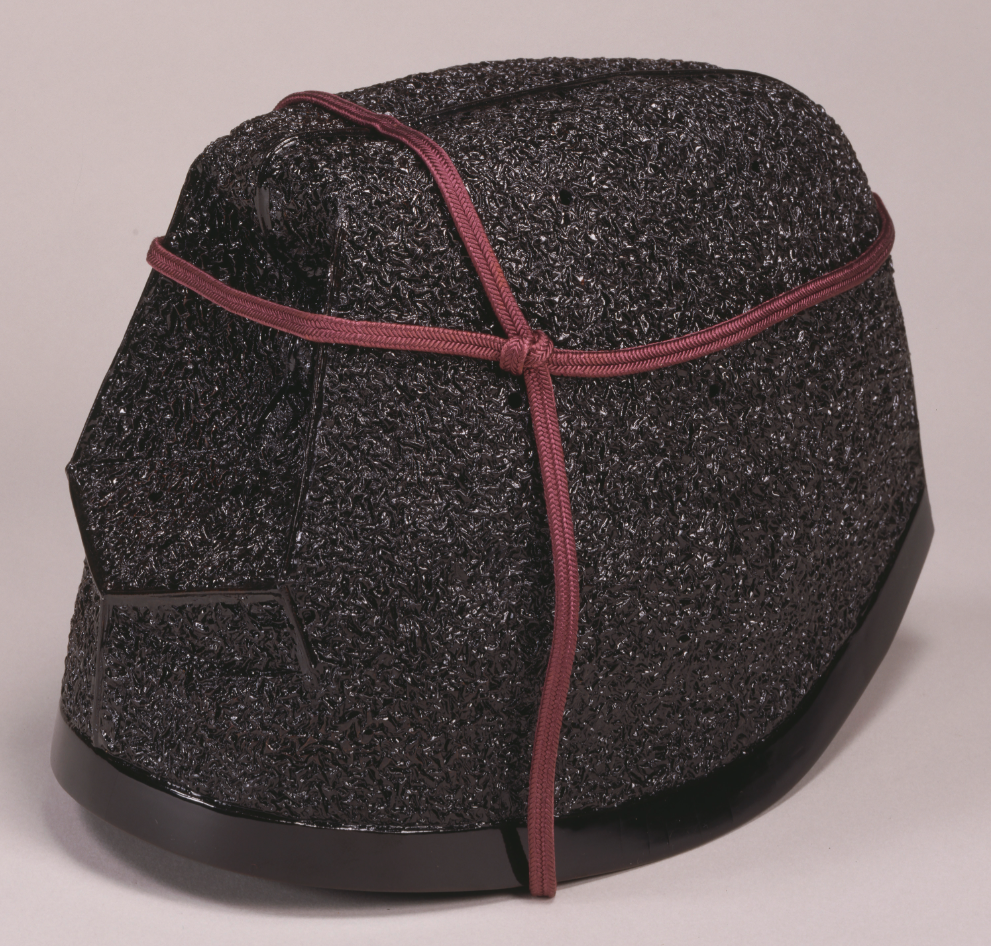
An eboshi made during the Meiji period. The eboshi was a type of headwear worn widely from the Nara to the Edo periods. Originally made from black silk gauze, it was later produced from paper hardened with lacquer. There are various styles, including tate-eboshi (立て烏帽子), kazaori-eboshi (風折り烏帽子), and hittate-eboshi (引っ立て烏帽子). (Via ColBase [https://colbase.nich.go.jp/])
Born 1977, Kyoto. Graduated from Doshisha University, Faculty of Literature, and completed the Master’s course at the same university. She made her debut in 2010 with ‘Koyo no Ten(孤鷹の天)’, which won the Nakayama Yoshihide Literature Award(中山義秀文学賞); won the Shinran Prize(親鸞賞) in 2016 for ‘Jakuchu(若冲)’ and the 165th Naoki Prize in 2021 for ‘Hoshi Ochite, Nao(星落ちて、なお)’.