






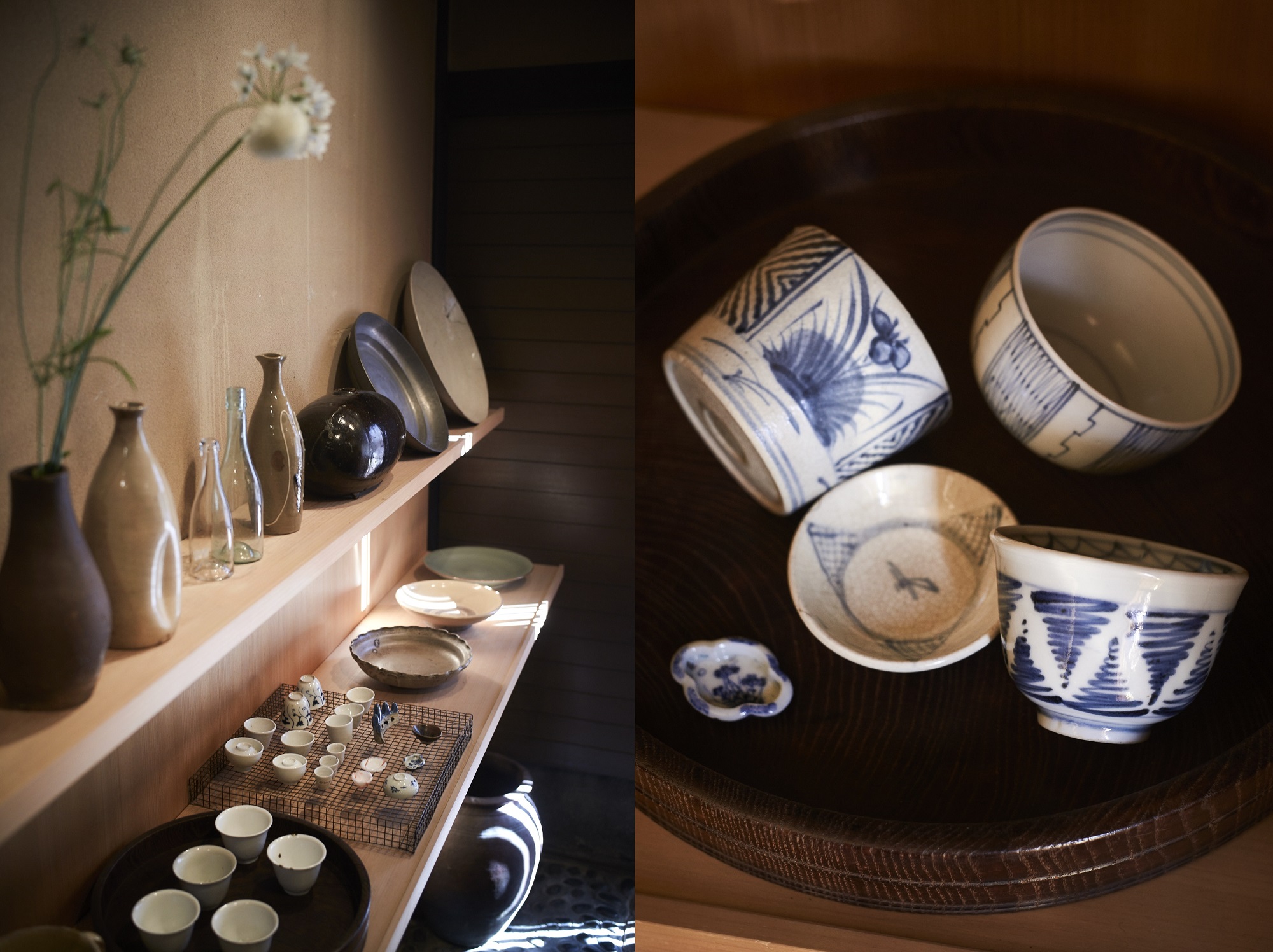
A place you’ll find yourself wanting to visit again and again during your stay! Daikichi, an antique shop where even beginners feel at home
“Actually, the very first antique shop I ever visited in Kyoto was Daikichi (大吉),” says chizu. This was over 20 years ago, during the era of the father of the current owner, Sugimoto Osamu.
“I wasn’t familiar with antiques at all, let alone those in Kyoto… (laughs). I remember opening the sliding front door with great trepidation. His father was a ceramic artist… Oh, this must be one of his,” she says, looking delighted to find a tea bowl by the predecessor, Sugimoto Tatsuo [art name Deigyu (泥牛)], on the display shelf.
“I’m captivated by the meeting of a timeless, traditional eye and an edgy creative instinct” (chizu)

It was in 1989 that Mr Sugimoto, who had been running a kappo (割烹) restaurant while creating ceramics, transitioned the business into an antique shop specialising primarily in Koimari (古伊万里). Osamu, who inherited the shop, had been studying in San Francisco, but upon returning to Japan, he immediately joined his father, driven by a desire to “work with antiques.” Today’s Daikichi is a fusion of Osamu’s personal tastes in design and music with the world of antiques from all times and places, centred around tableware.
“Please ask us anything. It makes us happy, too” (Mr Sugimoto)

“Since I love drinking, I suppose there are many vessels that can be used as shuki (酒器) sake ware. I am still learning myself, but please feel free to ask anything. We’re just happy to be able to talk about the pieces with others” says Mr Sugimoto. This openness is reflected in the selection and special exhibitions, which is likely why young people and absolute beginners—just as chizu once was—can feel at ease here.
There are textures that make the heart flutter

chizu’s select: The era, the origin, and the technique. The more you know, the more you fall in love
“I have a selection of sometsuke (染付)—classic blue-and-white porcelain—including choko (猪口 small sake cups) and rice bowls, perfect for tea time, mealtime, or enjoying sake.
In the late Edo period, Seto ware was overshadowed by the more famous Imari porcelain, but I find it quite admirable that they boldly decided to produce Seto ware with an Imari taste (laughs). I am told that because the clay in Seto ware is white, the contrast with the indigo blue is beautiful. It is wonderful to learn about such things on my visits to the shop,” says chizu.

【profile】chizu
Born in Kyushu in 1955. Stylist. A pioneer of styling focused on food and interiors. She is also involved in shop and product development. Her publications include Watashi o Gutto Suteki ni Miseru Otona no Oshare no Hitosaji (私をぐっと素敵に見せる大人のおしゃれのひとさじ) (PHP Institute).

Daikichi (大吉)
Address: 452 Myomanjimae-cho, Teramachi-dori Nijo-sagaru, Nakagyo-ku, Kyoto-shi, Kyoto
Telephone: 075-231-2446
Opening hours: 11:30 – 16:00
Closed: Mondays
*This article is a reprint from the magazine Waraku (和樂) (April/May 2024 issue).
*All listed prices include tax. Prices and opening hours are subject to change; please check before visiting.
This article is translated from https://intojapanwaraku.com/craftsmanship/247882/