






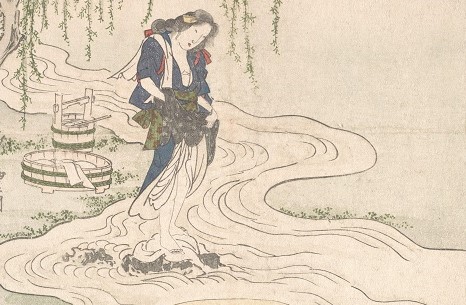
The riverside laundry spot is not only a place for washing clothes; it is also a place of encounters. In the tale of Momotaro (Peach boy), had the old woman not gone to the river, she would never have met Momotaro. In Hanasaka Jiisan (The old man who made flowers bloom), the puppy also comes floating down the river.
However, not every encounter leads to a happy ending. In Momotaro the old woman who was lucky enough to catch the peach at just the right moment might be considered fortunate, there are also examples where an encounter by the water has brought misfortune. Let’s begin by unpacking the gate of such folktales that start with 'laundry by the riverside'.
The outcome of a love too long awaited
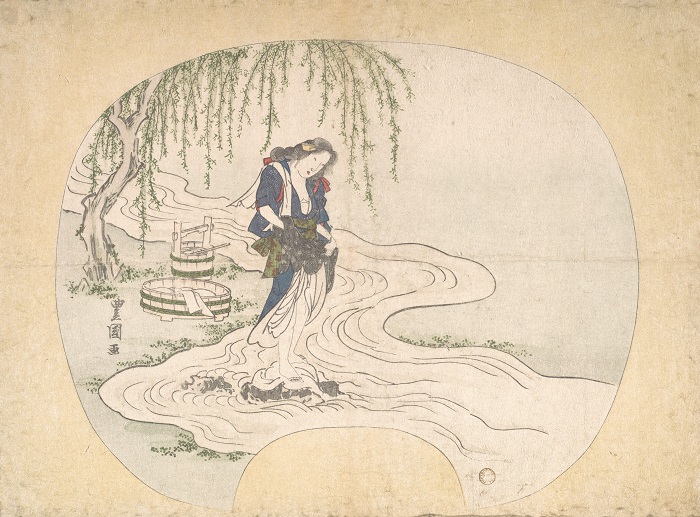
The oldest tale involving laundry can likely be found in the Kojiki (古事記), an ancient Japanese chronicle.
The heroine of the story is a maiden who happened to be doing her laundry on the banks of the Miwa (美和) River. One day, Emperor Yuryaku (雄略) was travelling in the area and was captivated by the beautiful maiden washing clothes by the river. Struck by her beauty, he impulsively called out to her.
“Whose daughter are you?”
The maiden of the Miwa River replied, “I am called Hiketabe no Akaiko (引田部赤猪子).”
In this era, a man asking a woman her name was tantamount to a proposal of marriage. Thus, when asked, the maiden must have immediately considered the possibility of marriage.
“Do not marry anyone else,” the Emperor said. “I shall send for you again.” With those words, he returned to his palace.
The maiden kept her promise and waited patiently, day after day, for the Emperor’s summons. But the years passed, and no one came for her. In the end, eighty years went by.
Finally, the maiden decided to visit the Emperor’s palace herself. She had waited for eighty years. Whatever the outcome, she wanted to convey the sincerity of her feelings.
But time is cruel. When she was finally granted an audience, the Emperor had completely forgotten about her. Still, her heartfelt devotion seemed to move him, and the thought of marriage crossed his mind. However, given their advanced ages, it was not to be. They exchanged poems and he gave her a gift.
‘Laundry’ in folktales
We often hear stories of fickle men who dangle the promise of marriage and keep women waiting forever, but eighty years is an exceptionally long time. In such a long period, she must have received marriage proposals from other men. A woman beautiful enough for an emperor to fall for must have had numerous admirers, and there must have been more than one occasion where she felt it was ‘time’ to move on.
Yet, she turned down every opportunity and continued to wait, holding on to that single promise. Her heart was deeper than the river and purer than the water, a sorrowful romance born from a simple act of laundry. Perhaps, this is what it truly means to love someone.
By the way, the traditional method of washing clothes in ancient Japan was ‘foot-treading.’ The reason it was more common to wash clothes by stepping on them with one’s feet rather than by hand is said to be because the fibres of old fabrics were so stiff and coarse. So, it is likely that the old woman in ‘Momotaro’ and the maiden in the ‘Kojiki’ were both washing clothes by treading on them.
The Tsurezuregusa (徒然草, Essays in Idleness) tells a story of a hermit who lost his supernatural powers because he was so distracted by the feet of a woman doing her laundry. It’s my own speculation, but perhaps the Emperor in the Kojiki also fell in love with the maiden’s feet as she was doing her washing.
Why is the old woman in folktales always doing laundry?
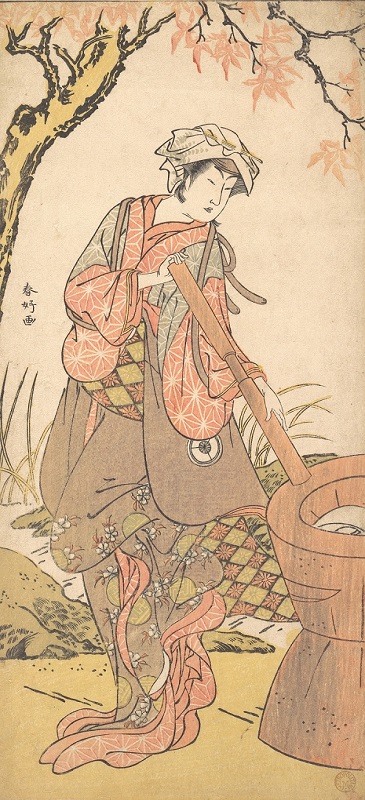
While the old woman in Momotaro is at the river, the old woman in Shita-kiri Suzume (舌切り雀, The Tongue-Cut Sparrow) is at the well (though sometimes it is also a river). The Hitachi-no-Kuni Fudoki (常陸国風土記, a Nara-period record of the culture and geography of Hitachi Province) contains a description of a village with “a pure spring where, in the heat of summer, men and women would gather to rest and enjoy themselves.” This suggests that during this era, people in the surrounding area would congregate at watersides in the summer to cool down.
Going to the river to do the laundry is a symbol of common life in ancient times. The area around a well was a laundry spot and a meeting place. Laundry was a part of daily life, but it also seems to have been a leisurely social activity.
With this in mind, the scene in the folktales changes slightly. The phrase “the old woman went to the river to do the laundry…” has a connotation of a housewife silently and diligently washing clothes alone. However, the old women may have been enjoying their laundry leisurely, chatting and socialising with their neighbours.
Ancient laundry matters
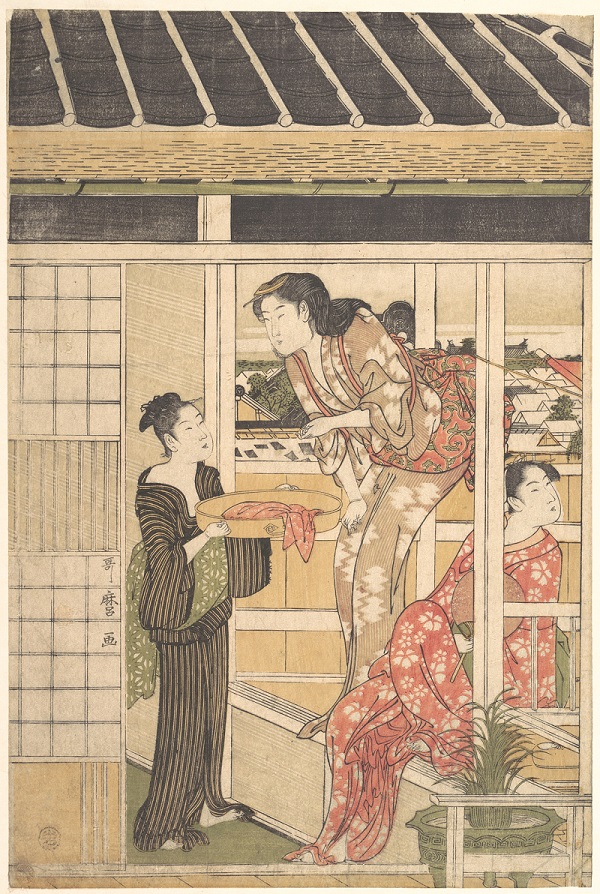
The Man’yoshu contains several poems related to washing, so the act of washing clothes had already become a routine part of daily life. However, the word sentaku (洗濯, laundry) itself is not found, with terms like tokiarai (ときあらい, washing by unpicking) and sarasu (さらす, to bleach or wash) appearing instead. According to reference materials, tokiarai refers to unpicking a tailored garment to wash it, while sarasu includes a bleaching and washing process.
What did the old women in folktales use as a cleansing agent? They were likely using soapberry (saikachi, さいかち). The pods of the soapberry contain an ingredient called saponin, which has been used for washing since ancient times. It is unclear whether the pods were soaked in water, boiled, or rubbed directly on the fabric, but it is said that washing with them did not damage the cloth and, in fact, left it with a lustrous sheen and a soft feel. It was likely a versatile and eco-friendly soap that was gentle on the skin, combining the benefits of both a detergent and a fabric softener.
Waterside Romance
The waterside is a place where stories are born, and it is also a place of purification. Rituals like suigyo (水行, water asceticism), takigyo (滝行, waterfall asceticism), mizugori (水垢離, cold-water ablutions), and bathing all share the common purpose of purifying the body with water. The word misogi (みそぎ, purification) is deeply related to rituals for a bountiful harvest, such as rice planting and harvesting. It could be said that purification for ancient Japanese people was intrinsically linked with water.
The reason the old women in Japanese folktales went to the waterside to do the laundry was not simply for the convenience of the narrative (though that certainly played a part), but because laundry was an integrated part of life and the waterside was also a place for purification and absolution. It is here that the seeds of strange and wonderful tales are sown.
Had the maiden who waited for her beloved while doing her laundry met the Emperor in a field or on a footpath, the story might have been different.
Reference:
Ochiai Shigeru (落合茂). Arau fuzoku shi (洗う風俗史). Miraisha (未来社), 1984
This article is translated from https://intojapanwaraku.com/culture/281675/