













Ito Jakuchu, a painter of wonder. We will introduce the representative works, life, and information about the exhibition.
What is Ito Jakuchu?
It is a rare painter who became popular in the Heisei era with "Kanuki Umezu" and the like, and it is Wakatsuki Ito. Most of those who become painters receive specialized education, but Wakatsuki opens the way by himself, and the brush did not decline until he died at the age of 85.
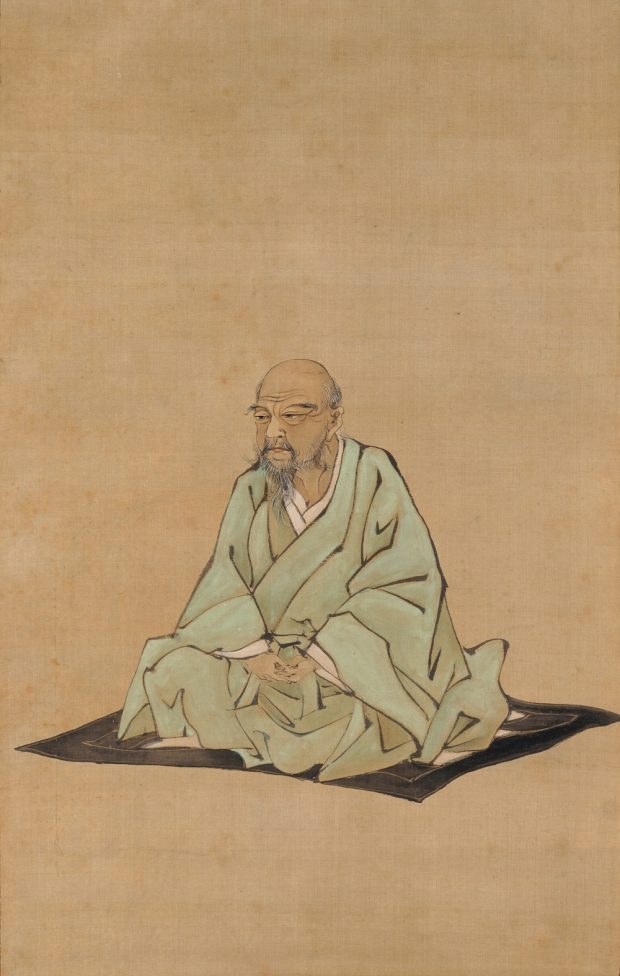 Kubota rice bowl "Ito Wakatsuki image" full width silk book coloring Meiji 18 (1885) 55.0 x 34.9 cm Aikoku-ji
Painter life of Ito Wakatsuki
Born as the eldest son of a blue pottery shop in Kyoto in the middle of the Edo period
In Shodo 6 (1716), which entered the middle of the Edo period, Ito Wakatsuki was born as the eldest son of the greenery store “Masgen” in Kyoto and Nishiki Market. At that time, the 8th Shogun Tokugawa Yoshimune (Yoshimune) succeeded in rebuilding the Shogunate finances with the reform of Kyobo, the townspeople became the leading figure of culture, and various cultures were trying to blossom in Edo and Kyoto. .
Apprenticeship to Kano school painter since mid teens
In such a world, Wakatsuki has an excellent artistry since childhood. It is said that she studied under the Ooka Harunbo, which has the flow of the Kano school (Kanoha), after her mid teens. However, the Kano school's tough teaching seemed unfriendly, so I was attracted to a Chinese original drawing (Sougenga), and I enthusiastically copied and mastered the technique.
We draw familiar fauna and flora and polish rare painters
We will keep a close eye on things around you, such as vegetables from the birthplace, fish in the salmon market, and chickens kept in the garden of your home. In this way, Wakatsuki nurtured the base of the style and technology of drawing the shapes of animals and plants lively and lively, in the same way.
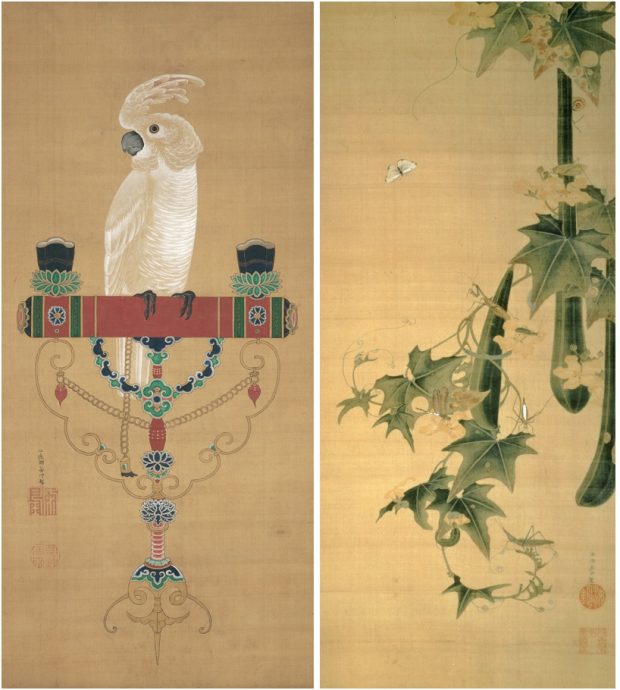 Left / Wakasa Ito "鸚鵡" wide band Silk coloring Colorary calendar 57.6 (1755-1756) Year 107.6 × 49.1 cm Chiba City Museum of Art Right / Waka Ito "Itosan group bug drawing" wide width Silk this coloring Middle Edo period · 18 Century 111.6 × 48.4 cm Hosomi Museum of Art
20's, painting way masigura
Unfortunately, when the young woman turned 23 years old, his father suddenly hurried. Since he is the eldest son, he has succeeded the 4th generation of "Linyuan", but it seems that drawing pictures is fun and unavoidable, and it is told that he was making sketches in the family business.
In such a day-to-day encounter with a knowledgeable master of the arts and sciences, and being recognized as a genius, the young woman is going to live in jealousy. Then, when I was 40, I gradually handed over my family supervisor (Katoku) and moved to Aikoku-ji Temple, where the master of the great martial arts lived, and aimed to build up as a painter.
Completed the masterpiece "Kotobuki", a masterpiece of Japanese art history
Wakatsuki is unbridled and demonstrates the artistry he has polished independently. We will work on the flower and bird painting "Kotobuki Sae (Doshoku Saie)" which carefully drawn the flora and fauna using the highest quality rock paint abundantly.
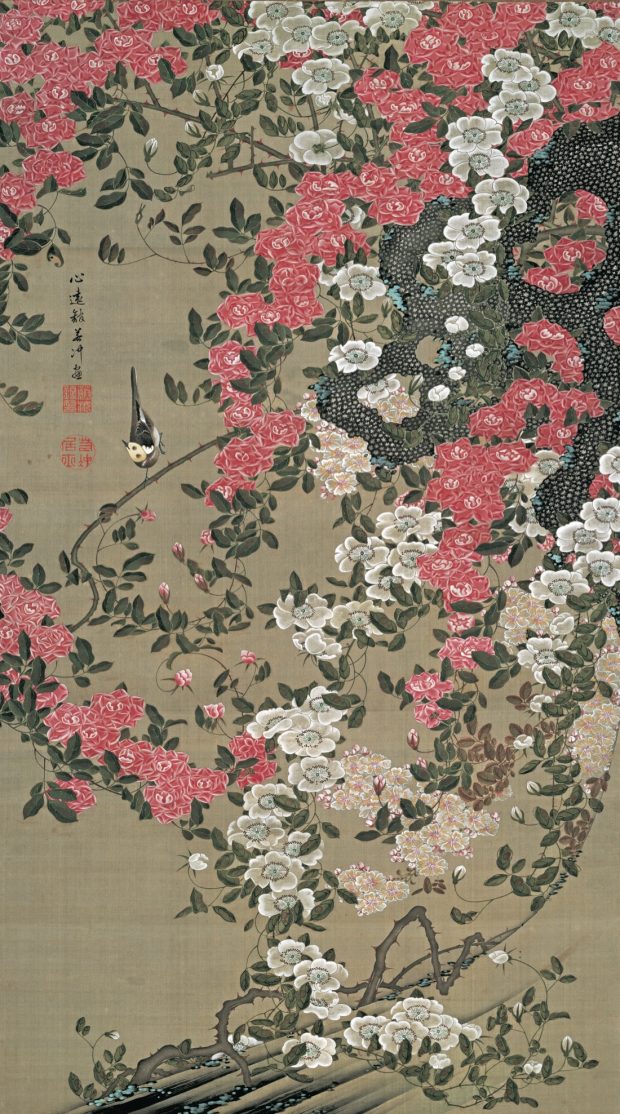 Ito Wakatsuki "Iki-Kotoe Ebuchi-kotori map" one-width silk book coloring Treasure calendar 11 ~ Miwa 2 (1761-1765) around 142.6 × 79.7 cm
Fifty-year-old, part of "綵 綵" to Aikoku-ji
The 50-year-old Wakatsuki donated 24 of the "Kotobuki Eki" and 3 "Shakada Sanzou" to Aikoku-ji, and the 33rd year of the father of the following year Donate 6 more widths to. In this way, the 30-piece masterpiece of "Hissei" was completed, but it is also about wishing for his parents, his younger brother's younger brother, and his own perpetual offering. It is
Soon after, the "Kanuki-e" published at Aikoku-ji overwhelmed the people of Kyoto, and the name of the painter and Wakatsuki became widely known. Furthermore, by donating to Aikoku-ji Temple, you can not miss the aspect that "Kanuki-e" has been carefully protected and has been transmitted until now.
From 50's to 60's, from coloring to ink painting
Wakatsuki, who has been in his 50s, is a master of print and ink painting that has become popular in Edo, but the number of works in his 50s and 60s has been dramatically reduced compared to that before.
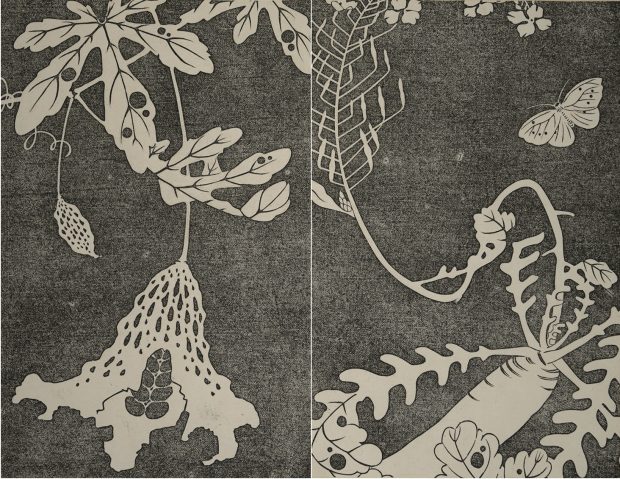 Wakaru Itoh "Xuanhua flower daikon, Ebi" 1 48 (Fig. 48) Takumi Ehon, Meiwa 5 (1768) years 28.2 x 17.8 cm each Metropolitan Museum of Art
The reason is that it was about the important job of the town market (more than a township). Just in the Kashiwa market, there are incidents that are on the verge of survival, and Wakasu's struggling to solve the problem remains in the old document "Kyoto Kashikoji Aoten Market Record". Surprisingly, Wakatsuki has played a role in the prosperity of today's Sakai market.
In the 70's, we set up a masterpiece of extra-high decoration again in Osaka
Wakatsuki who was in his 70s was in a state of self-reliance both in the family business and in the art of painting, but he was at a loss for good reason, and destroyed his home by the great fire of the Tenmei. I will head to Osaka relying on a former knowledge friend, Kimura Shido-do (Kenka-do), who has long been known as a literator and collector.
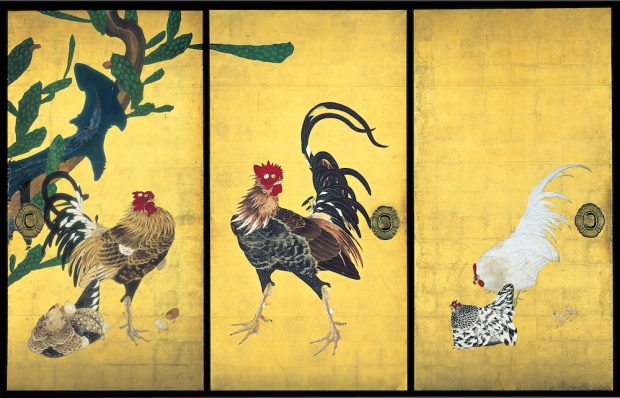 Ito Wakatsuki "Senjin Palm Group Chicken Figure Barrier Painting" Important Cultural Property 6-sided Paper Paper Gold Color Tenmei 9 (1789) Year 177.2 x 92.2 cm Saifukuji
However, rather than being depressed, the youngsters have a passion for painting rather than being freed from the family business, including the "Saboto-hermitage chicken figure barrier painting" that combines novel composition and glamorousness. I work on masterpieces one after another.
Produce a unique character in the late 70's and until the end of the year
And he escaped from the secular from the late 70's and took refuge in front of the gate of Ishimine Temple. Wakatsuki, who lives as it is in the issue of "Tobei An", which has the meaning of exchanging pictures with rice, drew a lot of unique works in his works, and he was 85 years old at 12 years (1800). I'm getting sick.
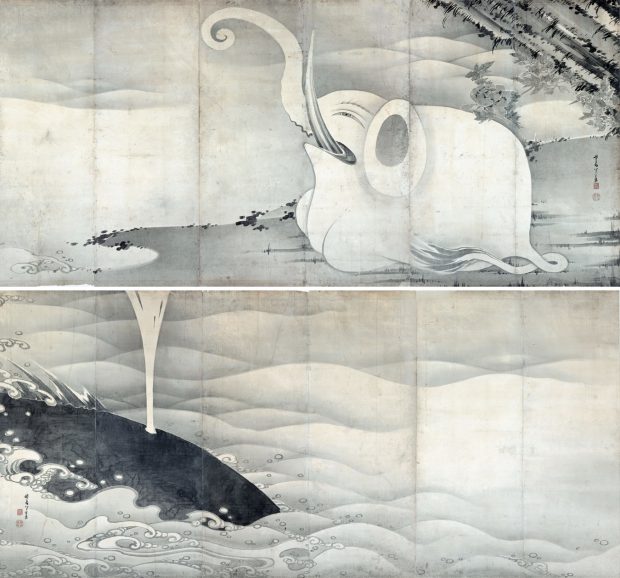 Ito Wakatsuki "Elephant and Zen-gura" 6 songs and a pair Paper book sumi art Hiromasa 7 (1795) 159.4 x 354.0 cm each MIHO MUSEUM
The life that has long sought for the picture that I want is must have been extremely happy.
Ito Wakatsuki's place is amazing! Highlights of techniques
Wakasa's dignity is the overwhelming depiction of detail, and even the vividness of the color, which is unlikely to be drawn more than 200 years ago. How was such a superhuman and outstanding depiction formed?
The vividness of the color unique to Wakatsuki
"Ajisai Sokeizu" has almost the same picture work as "Kanuki Tei", and its quality and quality in terms of drawing and color vividness, It is a work at the same level.
In this colorful work, there are no parts that are over-painted when viewed in small details, and with a thin coating that can not be imagined from the vividness of its color, chicken wings and hydrangea buds (gaku) You can see that is depicted. 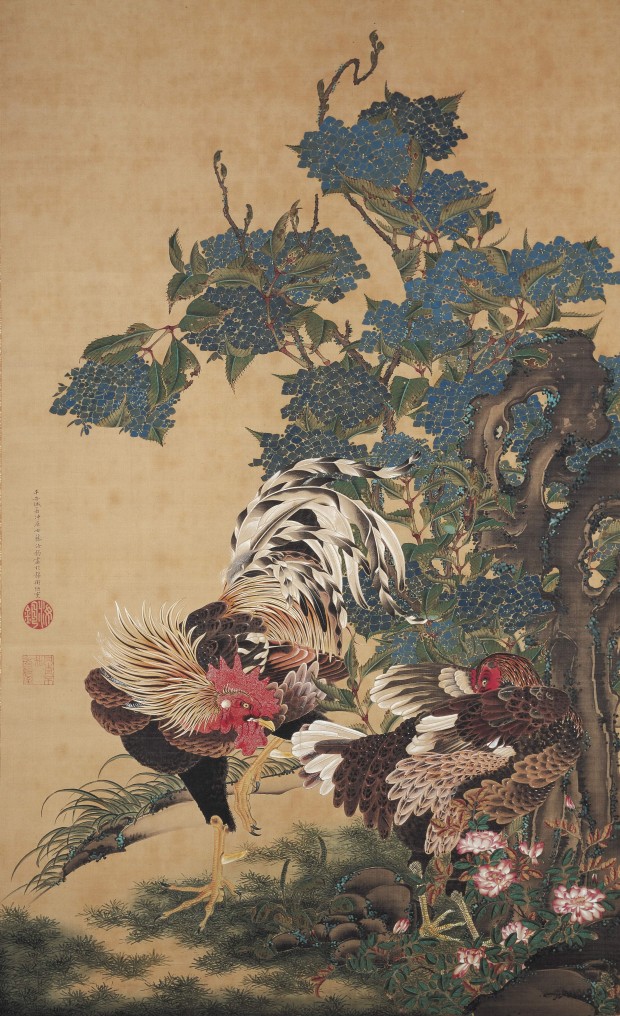 "Hyuga Hanaso chicken figure" full width silk book coloring 140.0 × 85.0 cm Edo period · 18th century Etsuko & Joe Price Collection
The work of Wakatsuki is said to be a miracle world of colors, and the reason why the vivid color has not been lost is the extremely high quality (that is, expensive) rock paint as well as the height of its depiction power It is thought that this is probably because it was thinly coated on a special drawing silk.
It can be said that it is the strength of Wakasu who did not get in trouble as a young man of the Kashiwa market, but it can be said that Wakasu's Wakasu Takiri (retain) is where he put his wealth of wealth to the purchase of exceptional painting materials. .
A genius for creating facial expressions! Humorous sensibility not seen in coloring pictures
A youth who has been told that he was a geek-like character in the modern day that he is not interested in learning or business, and he is not interested in home business at all, nor in liquor. However, the work that he drew was so colorful that I could not imagine from such a person. In particular, the humor often exhibited in ink paintings and the exquisiteness of creating cartoon-like facial expressions that are likely to spout unintentionally are other aspects of the young lady known for realistic detail. 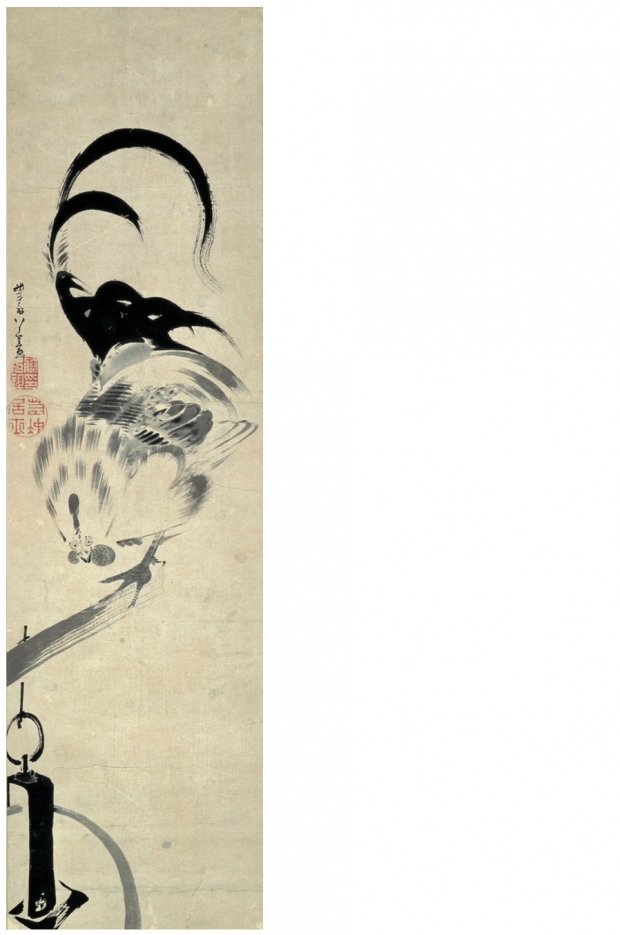 "A chicken figure in a fishing bottle" One width paper book sumi painting 99.4 × 27.8 cm Edo period · Kansei 7 (1795) Year Yamato Bunkakan
Along with the variety of works, new facts are being discovered one after another in the figure of the young woman. It is a young woman who has been shown to be completely uninterested in the family business, but he / she takes the lead in negotiating calmly and quietly with the dedication center who has ordered the business stop order and unreasonable tax claims in the 錦 market. Recent research has revealed that they are dealing with political decisions. 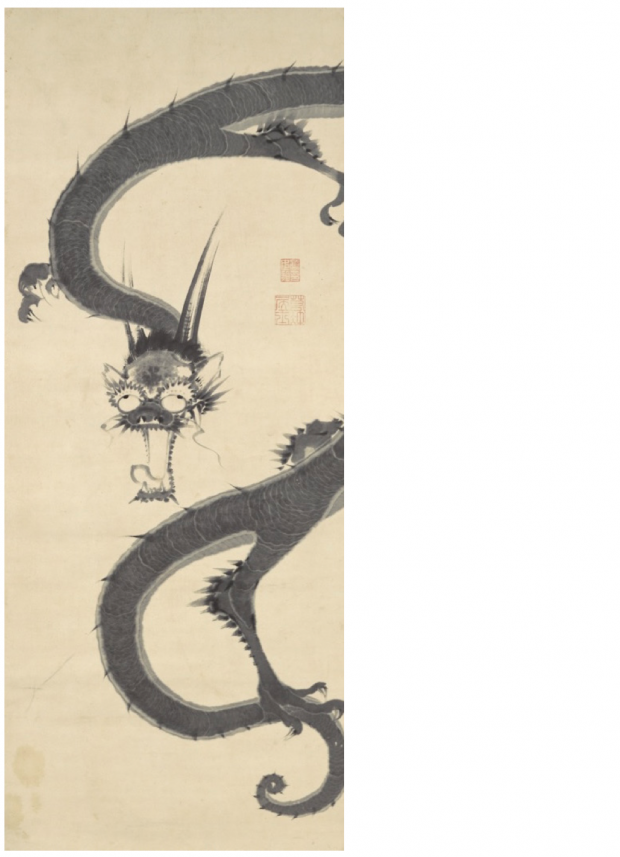 "Ameryu figure" width paper book sumi painting 130.5 × 53.0 cm Edo period · Meiwa 7 (1770) around personal storage
The humor and facial expression drawn in the ink painting may be the hidden expression of Wakasu himself who is drawn like a nerd.
-From the April 2013 issue of Wasabi-
Masterpiece of Ito Wakatsuki
"Kotobuki"
Even though the animals drawn by Wakatsuki are not drawn realistically, what looks like a chicken more than a chicken itself is what he says, "Devilliness". The extravagant depiction of the nephew is the result of continuing to observe the real thing. 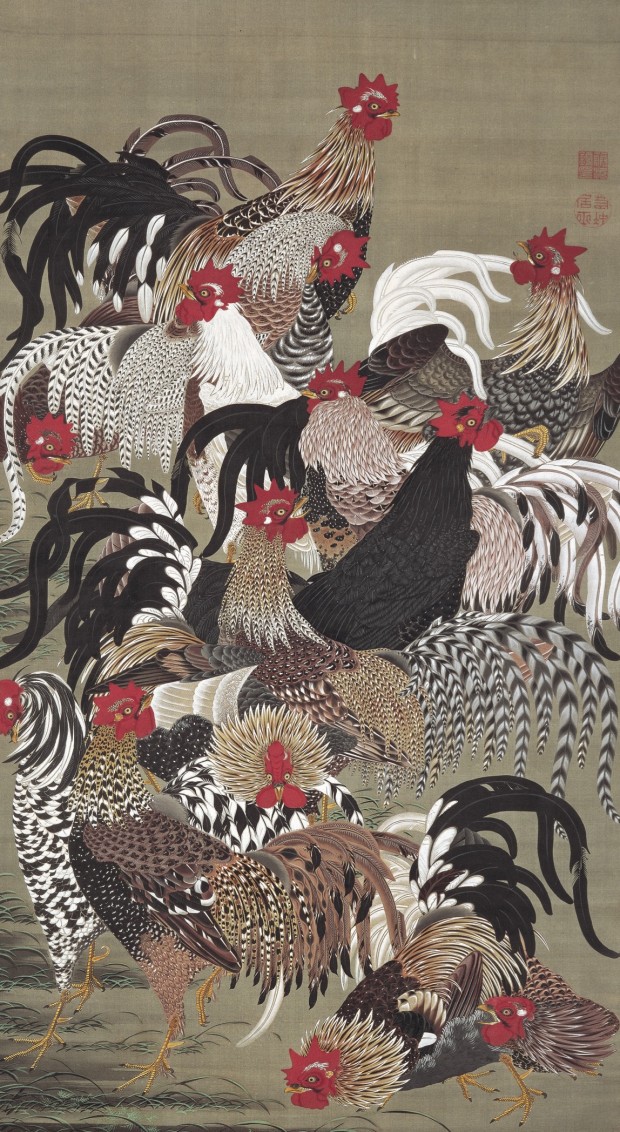
Furthermore, one of the techniques to make the brushstrokes stand out more clearly was the back-coloring (we also put paint on the back of the screen). It is thought that Wakatsuki adopted this back coloring in many silk-colored paintings, not limited to this “Kanuki-Koto-e”, and by manipulating the silk cloth and paints skillfully created a colorful and shiny world. This is a technique that is often used mainly for Buddhist paintings in the Heian period, and it is believed that Wakatsuki has learned this writing method while performing many copies.
In this way, the wakatsuki man's drawing power, as well as the natural genius, is a matter of skillful curiosity and traditional techniques, as well as being skillfully blended like a cocktail, and further established by his tireless efforts.
"The Buddha Three Buddha"
Currently, the “Kanuki-e”, which the Miyanouchi Sannomaru Shozokan holds, has a total width of 30, but it was originally a single work with a width of 33.
Originally "Maki-no-taki-e" is a Buddhist image drawn by Wakasu to Aikoku-ji, but only the 30-width part of the flower and bird paintings drawn to honor the Buddha unavoidably obliged to the Buddha in the Meiji Era The temple is left with only the three width of the Buddha statue, which can be said to be the central existence of a series of works.
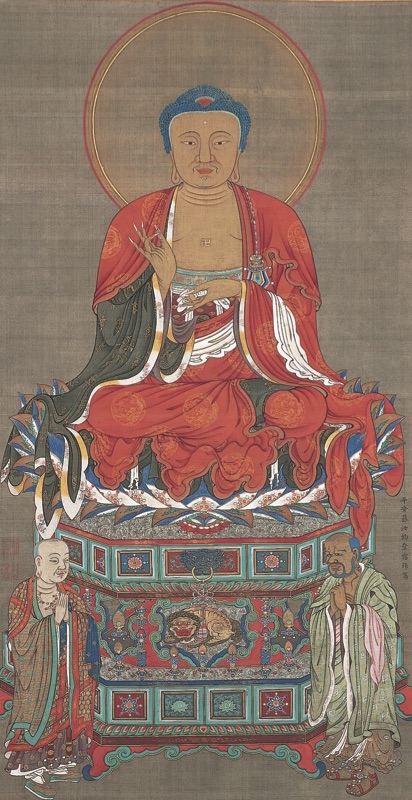 "Shakune Sanzo image, Shakuen image" One width out of three widths Silk coloration 210.3 × 111.3 cm Edo period · Meiwa (1765) Around Aikokuji Temple Photo courtesy Aikokuji Jotenkaku Museum of Art
By the way, this three-width "Shakurin Sanson Statue" is more than one turn larger than the current "Kotobukie", which is a flower and bird painting, and Wakasu has put the work on the height of Aikokuji Temple. It can be appreciated that the three central widths were calculated to stand out.
"Shakuganji Daishoin Barrier Drawing, Obscene Drawing"
What you notice when you look at Wakatsuki's work is that there are few pictures that let you feel the spread of the screen in the horizontal direction, such as barriers and folding screens, compared to the number of axis objects on the vertical screen. Furthermore, there is almost no kind of landscape painting. As an avant-garde artist and writer Akasegawa Hara, he describes him and calls it a "vertical person." However, such a 40-year-old only in four years after becoming a full-fledged painter, in Kyoto will be asked for a barrier picture of a high-rated temple to compete for one or two. That was a great work to fill the five rooms of this "Rakuonji Daishoin Barrier Art".
It is only a four-year effort to concentrate on the painter's path, and it is also a work that allows Wakasu's drawing skills to be entrusted with the barrier paintings of the Great Shoin Temple of the Shiho-ji Temple, the highest temple in Kyoto. However, if you think calmly, it is the owner of the great talent to ask if you ask! 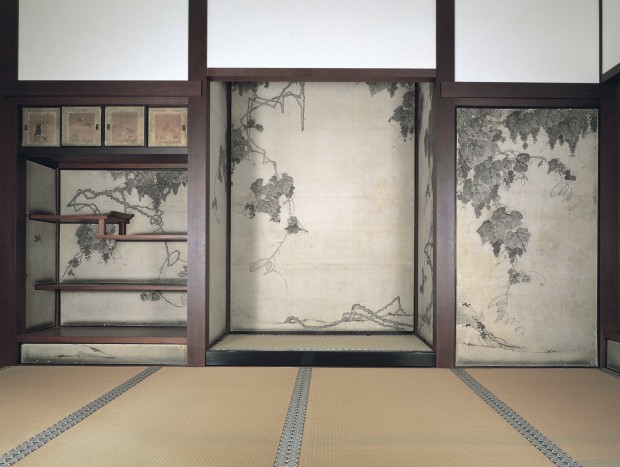 Walls, floors, different stacks of paper seventeen paper book sumi paintings Edo period, Takara 9 (1759) year Important cultural property Kazanji temple photo provided / Aikoku temple Jotenkaku art museum
"Senjin palm group chicken figure barrier picture"
In order to provide financial backing for a young man who had been affected by the great fire of Tenmei, it was drawn by the main owner of the drug dealer and Yoshinoya of Osaka who was a powerful family in Saifukuji. As the work of the gold land, the only major works (Kanaha-zu in Kanagawa and Okusho-in, Kagawa prefecture and Kotohira-cho, are “Kanasako”). 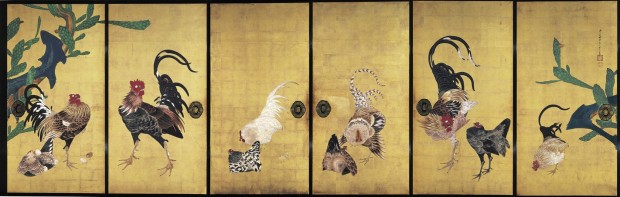 Edo period · Tensho 8 (1788) years Important cultural property Saifukuji storehouse
First of all, speaking of Kakanji Temple, it is a temple of Ashikaga Shogun family family familiar in Kinkaku. If it is such a temple with such a high rank, it is always asked to the general contractor group such as Tosa School and Kano School who boasted the prosperity in connection with the power at that time. However, by the imprisonment of the priests of Kagoshima Temple, who valued the talent of Wakatsuki found by the high priests and monks of Aikoku-ji, a town painter in Ikasa was greatly removed. If it becomes, according to the intention of the temple, it is likely to become "a very rich barrier painting", but the place where it is not possible is the 18th century Avant Garde painter, Wakatsuki Ito's true essence.
We have created a world of different deadly colors (Kotan) from flats and strokes with well-controlled ink strokes, as well as flattering subjects such as salmon, salmon, and even cranes and chickens. Besides the talents of Wakatsuki, the richness of the soil that gave birth to the giant of Wakatsuki is felt in the depth of the 18th century Kyoto culture that could support it.
Exhibition / exhibition report where you can see works by Ito Wakatsuki
Related articles related to Wakatsuki's moving plant drawings and ink paintings
■ We see with "Kotobuki picture"! Wakatsuki's 7 Super-Skilled Techniques
■ The ink painting of Ito Wakatsuki is so cute!
■ Wakatsuki also drew ink paintings! I thoroughly verified it with "Kotogi old man, peacock, chrysanthemum figure".
■ The world is surprised at the "glitter" technique of Ito Wakatsuki and Ogata Koji!
My motto is "I'm serious about being stupid", and I am having fun and having fun every day.