












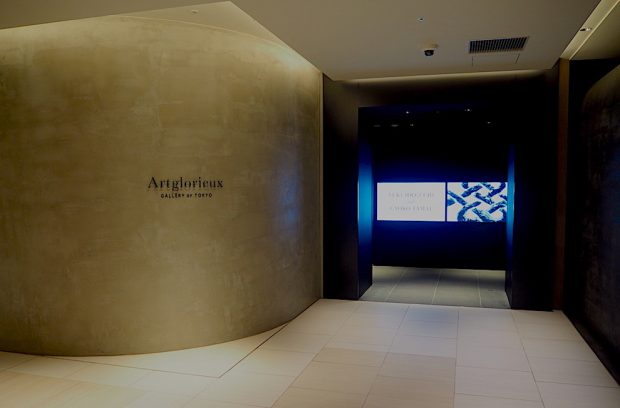
From the 21st to the 27th of March, at the Ginza area's largest commercial facility "GINZA SIX," a two-man show will be held with Japanese artists of different colors, Exit Yuki and Tamai Shoko. The gallery “ Artglorieux GALLERY OF TOKYO ” on the 5th floor of the GINZA SIX floor receives acclaimed internationally popular artists such as Yayoi Kusama and domestically and internationally. We have introduced the works of young artists.
At this exhibition, the works of highly-respected artists mainly from overseas, Yuuki Exit and Shoko Tamai, will be exhibited at 20 points each and 40 points at a time. Only now is the exhibition of two people based in NY seen in Japan! Is Contemporary Art Wakaranai? It's okay! We will report on the attraction of the work and the highlight of the exhibition.
Two young artists active across the world! What is your favorite career?
Yuuki Ideguchi is a contemporary artist from Japanese painting. While living in New York, he travels around Europe, Asia, and the Americas and sends works. While cherishing the traditional techniques cultivated in Japanese paintings, the techniques developed in modern times and the techniques of Western painting are incorporated to create a unique work world. His work has been featured in the Washington Post's art review, and has been acclaimed as "the elegant and traditional works, the works at the exit have a shocking impact on the future. "
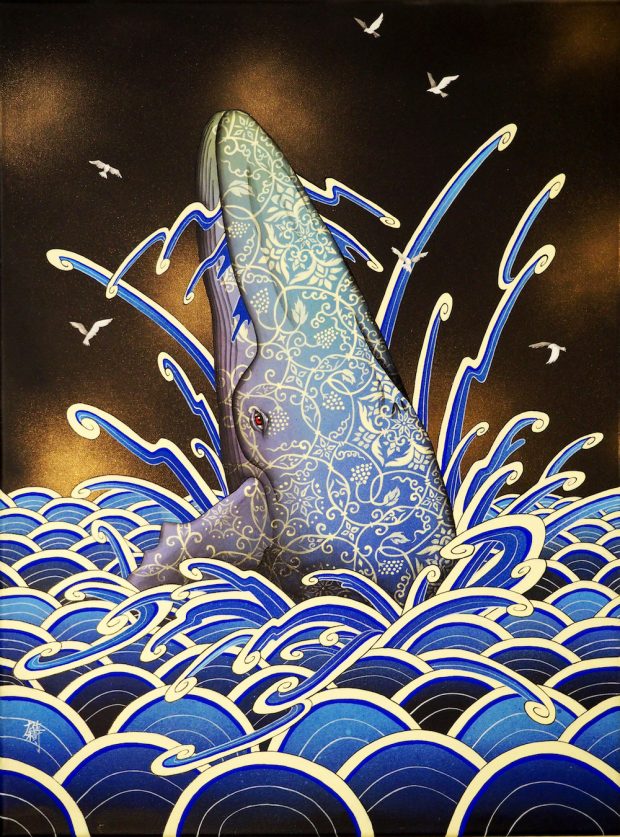
"Eating" Exit Yuki
Mr. Tamai Shoko, meanwhile, is from the music department. She has also published works around the world while living in New York. Sound is born and disappears, and born and disappears, but in order to keep the "raw" tremor of such a moment visible, it has shifted to visual expression. The unique style of "dying" with ink while scraping each paper fiber of Japanese paper with an iron pen has received high praise both at home and abroad as expanding the possibilities in the art scene of traditional art materials. You are
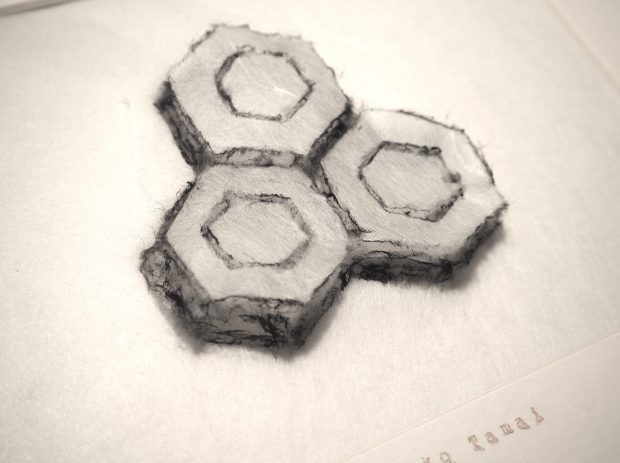
"Crest IV (three Mori Kame Komon)" Tamai Shoko
While flying around the world, they are highly influenced by contemporary art from around the world, but they value traditional Japanese art techniques and reduce them to their own methods. This exhibition is a unique opportunity to see 20 works and 40 works of such two artists. In this article, we will introduce the attraction of the work of two people separately!
Exit superb super skill 1 past and present meet in the painting! ?
First off is Mr. Yuuki Exit, a unique Japanese painter. It is characterized by a number of mysterious works that give a contemporary, light, pop impression, reminiscent of traditional Japanese art like ukiyo-e. That is because Mr. Exit is strongly conscious of "connecting the past and the present ." For example, Mr. Exit's work emphasizes fine detail expression and pattern expression, which are characteristic elements of classical Japanese painting, while incorporating modern colorful colors and gradations. The past and the present have made the expression which mixed both elements well.
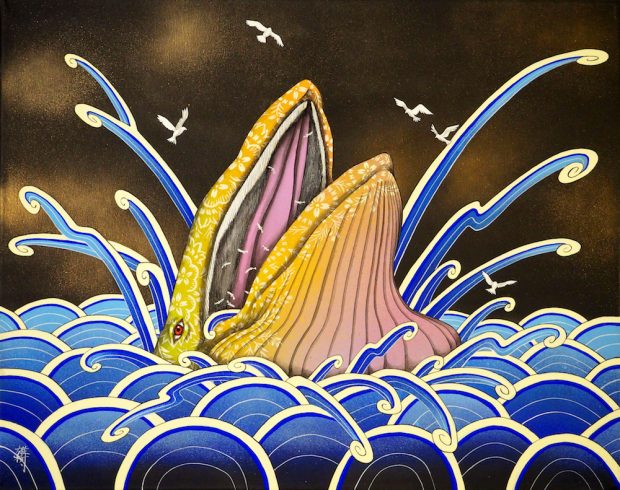
The “Ryokan” exit “Yuki” The portion of the wave is patterned. In traditional Japanese painting, repeating patterns are often used as metaphors of permanence.
Outstanding Yuuki's Super Skills 2 Oriental and Western meet in the picture! ?
In traditional Japanese painting, it is basically a flat impression as it does not draw shadows basically, but the work of Mr. Exit is three-dimensional like Western painting . Although it looks Japanese-style, it's real like photos ... It's because there are western expression techniques, directing light and shadows!
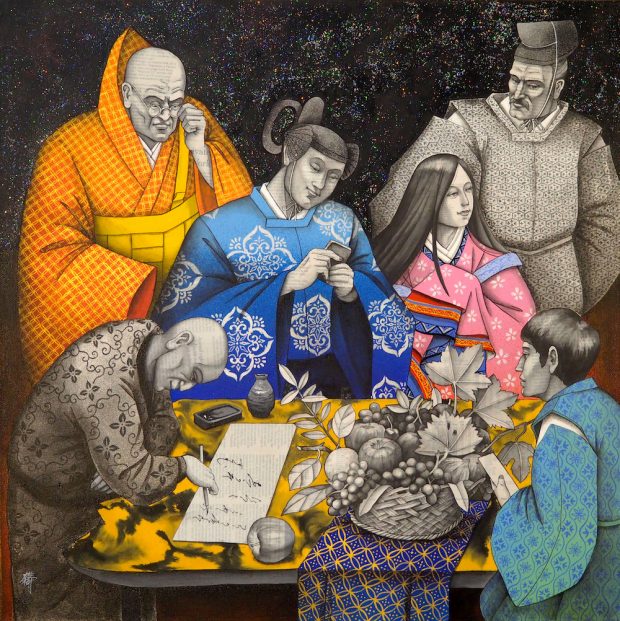
"Roku-kasen" Exit Yuki "Roku-kasen" is a representative of the six most popular poets listed in the preface of "Old Kowa Wakashu". It refers to six persons of Michijo Tokiaki, Inhara Shimpei, Wen-ya Yasuhide, Kiho Hoshi, Ono Komachi, and Otomo Black Lord.
The table's blur pattern in "Roku-kasen" is the "Tashimi-in" technique that is said to have been developed by the founder of the school, the Shoya Sotatsu, the collage technique using paper such as newspaper for the skin and fruits of people, colorful gradation The spray cans used in street art are used for Also in this work there is a detailed pattern expression, but this is a depiction with modern acrylic paint . Even in one work, there are so many western and oriental techniques and materials used in the past and present!
Is the point of view guided? !
It is called "viewpoint guidance" to devise the composition so that the viewer can easily appreciate the work. This too is one of the important elements in the world of classical painting. This time, I was asked to demonstrate the technology a little.
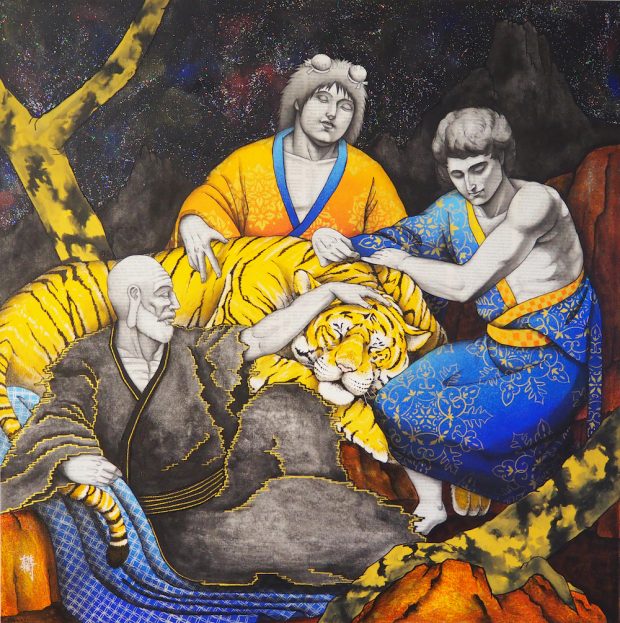
"Suisui" Exit Yuki "Suisuizu" is one of the subjects of classical Japanese painting, and it is a state where three Chinese nuns are sleeping with a tiger. It is said that it represents the place of enlightenment in Zen.
Please see the above picture. When you look at the picture, the line of sight first goes to the tiger that is placed in the center. After that, each arm's eyes move from the arm to the tiger, the owner of that arm, and the circle from there. The viewer's eye movement is induced by the face orientation, gaze, hand orientation, etc. of the depicted person. Of course there is no right answer in the way of viewing, but at the exhibition, one of the fun ways is to think about how the gaze is guided by the artist's intention.
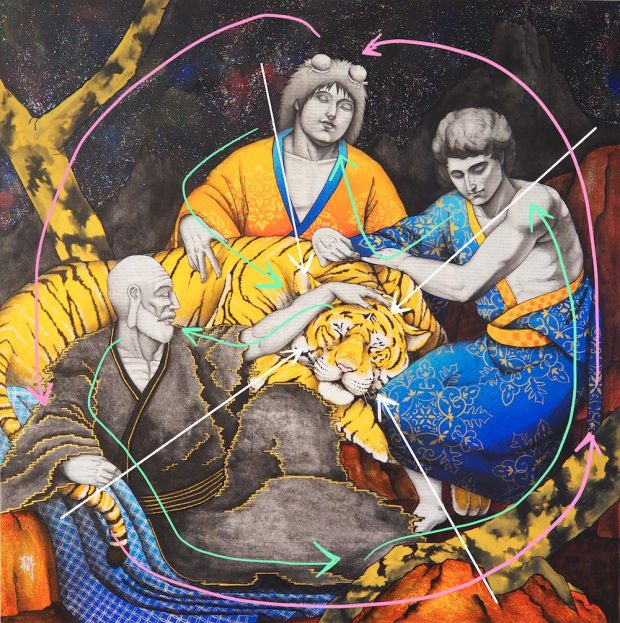
"Four Sleep" Exit Yuki (viewpoint guidance illustration)
I know something ... oh manga!
Another feature of Mr. Exit's work is sometimes referred to as "manga-like." Exit says that "manga-like is a deformed expression when drawing things in two dimensions" . The symbolization of natural events and the rendering of unrealistic space are certainly deformation expressions of reality, and they are the specialty of manga. In addition, in the world of modern Japanese paintings and western paintings, drawing outlines of people tends to be avoided, but it is rather common in Japanese paintings until the Edo period and in contemporary manga. It may be that such an element also helps to feel "manga" in Mr. Exit's work.
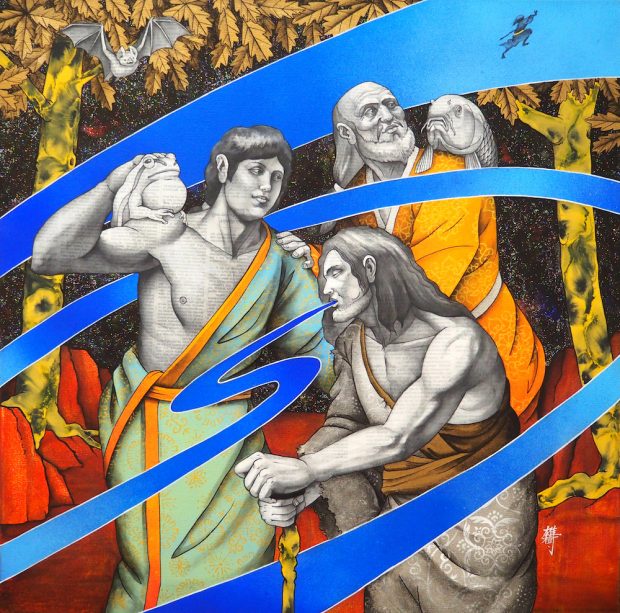
"Sakaisen (劉, 劉, 琴 高 仙)" Exit Yuki "Sakaisen" refers to the three Senjin with Shinto power that appear in Saiyuki. Both Ryukaisen, Ritenkai and Kinkosenn are subjects that have been repeatedly mentioned in classical Japanese painting. In the work of Mr. Exit, the sennin (?) Is depicted symbolically and in pop.
Contemporary art is not difficult! How to enjoy is very free
At the venue, when you face Mr. Exit's work, endless imagination works. This is because it gives a sense of narrative, like part of a picture scroll, or a piece of comics.
In addition, in the work of Mr. Exit, a lot of famous subjects drawn repeatedly in classical painting are also dealt with. You can also enjoy discovering which past works have been featured in which works, imagine the stories hidden behind the background of the picture and the developments before and after, or just love the beauty of the picture purely, The way to enjoy contemporary art is totally free . Of course, it is an ant because you like it intuitively or just enjoy it!
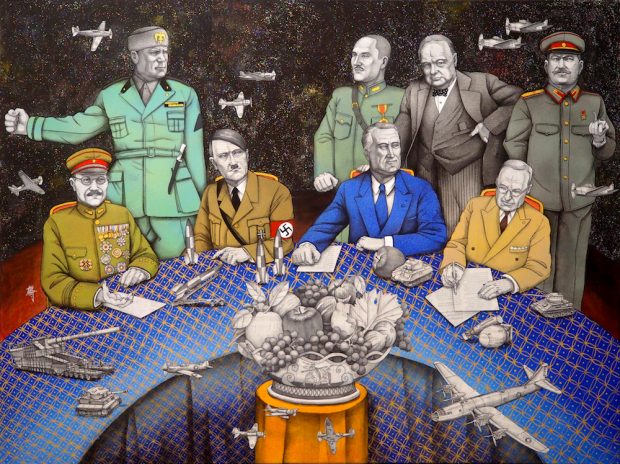
"One side of humanity" Exit Yuki Yuki politicians from around the world are discussing around the desk ... very meaningful. "It is impressive that Dante is meeting various people in his book" God songs ", and it is fun to imagine such a really impossible meeting" (Exit) What are you talking about ...? I will leave it to your imagination.
Is it the work where "the thinnest line in this world" rises in three dimensions?
From here, I will introduce the works of Mr. Shoko Tamai, another artist of this exhibition. A major feature of Mr. Tamai's work is that the work is semi-stereoscopic . Paper is a familiar Japanese paper familiar to Japanese people, and then I think that I would like to draw with a brush, but rather, an iron pen with ink is used. By scratching thin Japanese paper piled up with many sheets with an iron pen, a thin fiber with ink rises in three dimensions. While searching for "the thinnest line in the world that can be drawn with the naked eye", it seems that this style has arrived.
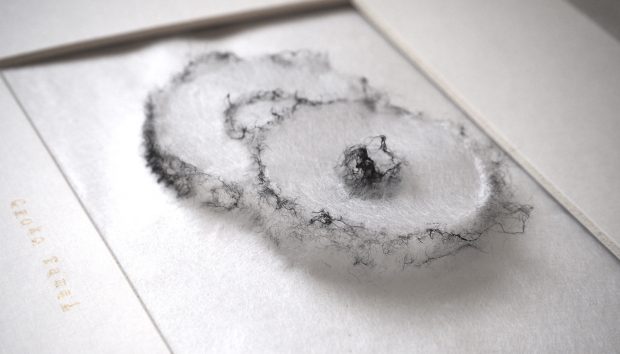
"Jamenome" Shoko Tamai (part)
Sign of "raw" that Japanese paper and ink occur
What Mr. Tamai found by launching "the thinnest line in the world " is the visualization of "signature" . The moment the air is vibrated, the presence of sound in a space where nothing exists. The moment when the air warms up, the presence of fog on the empty lake surface. Or when you enter a sanctuary such as a shrine, the change in physical sensation that occurs when you sense the "other things" that you were not aware of until then. Although it has been true for a long time , it is only a moment when things that can not be seen are visualized . A piece of dyed “ink dyed” one by one thin Japanese paper fiber that seems to disappear even now, the work that is drawn reminds me of a sense of the cell's lingering moment that is not verbalized.
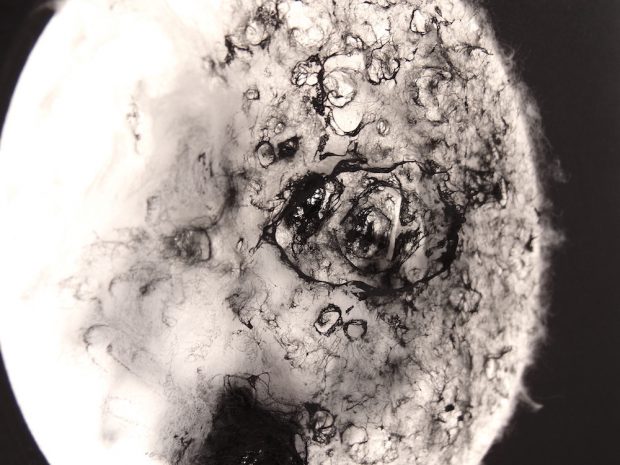
"Generometas" Shoko Tamai
From ancient times, the power of patterns revives powerfully!
Mr. Tamai's work, which visualizes the sense of the moment when "the sign" occurs, has a vague sense of mass, like the fog that is generated and disappears in the air. However, the works exhibited this time are surprisingly impressive. That is also the subject matter that Mr. Tamai selected this time is "pattern" . Pattern has symbolized the thought and culture of people since history, regardless of the east and west of the ocean. Mr. Tamai's work group highlights the invisible power of the pattern itself and the historically borne meaning by "spotting the pattern itself not as decoration of kimonos, crafts, wallpaper, etc." The contents are to be
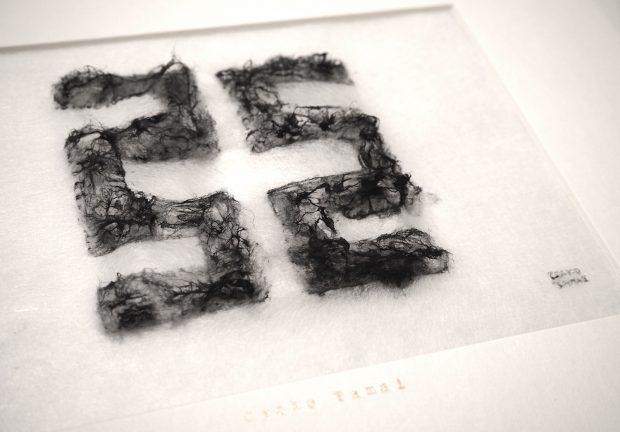
"Fuso" Tamai Shoko "Samurai" is one of the 12 patterns that symbolized the virtue that supreme Tenko should have in China during the Qing Dynasty. A pair of "bows" in a back-to-back pattern indicate that they hate evil and go for good. Mr. Tamai says that he chose it as the subject because he felt a keen desire to protect himself from evil and want to be so.
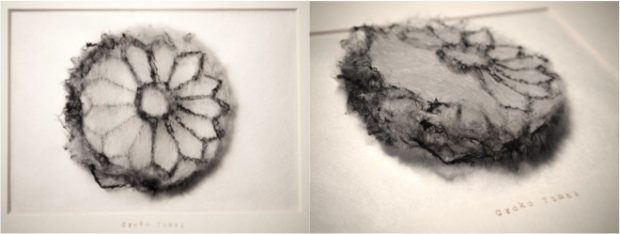
"Rosette (half)" Tamai Shoko (right side view) This is from the ancient Mesopotamia civilization. Rosette is one of the patterns used as a decorative design from prehistoric times. Mr. Tamai met this relief at the Metropolitan Museum of Art in NY, and recalled the decline and rise of the nation and civilization by having been exhibited as a relic of the late civilization while being in a form familiar to the modern day with the flower print "It's called.
There are many patterns that have the origin in the ancient times. In ancient times, where there was little or no textual expression, the role played by the pattern was extremely large, from thought expression to the establishment of identity, and even to prayer and curse. The design that focuses on Mr. Tamai's "invisible signs and senses" gives the feeling of vitality, as if the power entrusted to the pattern literally breathed back from ancient times.
I think in prehistoric times! Japanese pattern
According to the exhibition in Japan this time, Mr. Tamai is said to have adopted a lot of Japanese patterns. The history of pattern use in Japan can be traced back to the Jomon period, about 15,000 years ago. Also, as used in family crests etc., the number and types of patterns in Japanese culture are enormous. In Japan, where the beginning of the use of letters was relatively late in the kanji culture area, the history of the role played by the patterns was not only very long, but the custom continued until the Edo period.
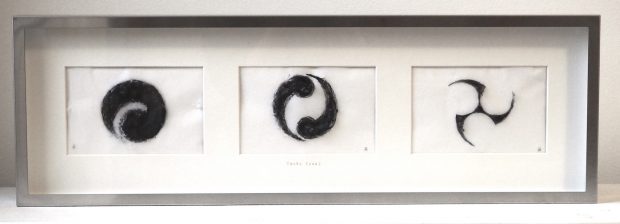
"Left-hand" Tamai Shoko Ayamon is one of the familiar patterns in Japan. The prototype is cloud air, running water, swirl, etc. and is considered to be a mark of fire and water. There are a lot of shrines that make the crest as a crest, probably because the ancient people represented the spirit by this crest.
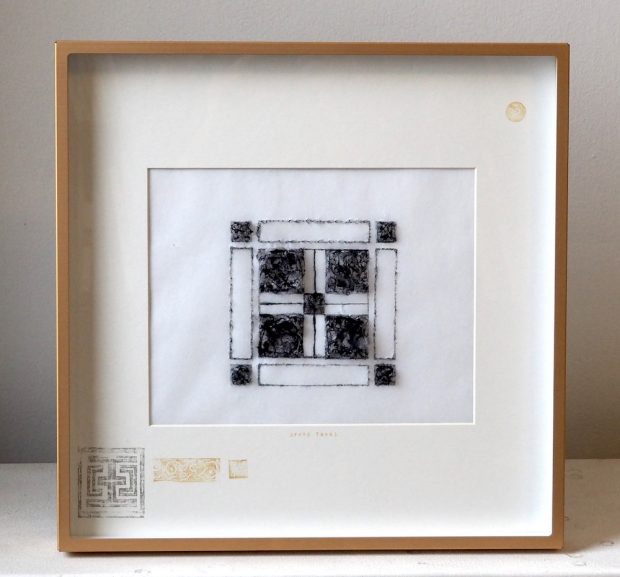
"ICHIMATSU" Tamai Shoko Ichi Matsumon is one of the patterns used in ancient times, and is also used for Minowa clothing from the Kofun period. Kabuki actor "Sanogawa Ichimatsu" in the Edo period is the origin of the name, but before that it has been popular in the name of "Cobblestone" and "Are". It is said that the special print that is the subject was adopted from the pattern of Sanogawa Ichimatsu Kimono.
Many of the three-dimensional works of Mr. Tamai seem to be very large, as they can only be seen when they are actually seen at a close distance. It is also good to see the patterns inspired by Mr. Tamai and try to reflect on ancient times.
A valuable seven days to enjoy the works of contemporary Japanese artists active in the world
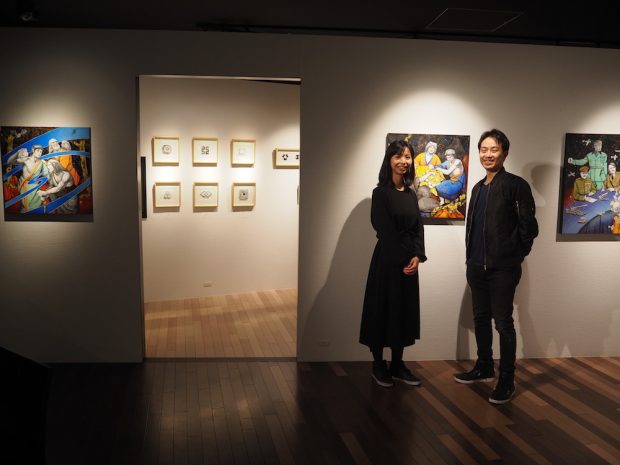
At this exhibition, the two artists will also return temporarily, and will be in the middle of the show! Can you meet if you are lucky?
One of the great attraction of this exhibition is that you can see 40 works of two people with completely different tastes, a figurative painting by Mr. Exit's precise depiction and a semi-stereoscopic abstract painting by Mr. Tamai. . But both are the same in that they apply traditional Japanese art materials and methods familiar to us to contemporary art. Both works are only familiar works that dispel the impression that "contemporary art is difficult". The latest Japanese contemporary art from New York, only 7 days and a short period, but there are works that can be recommended with confidence, so please check it out. Photographing of the work is also OK!
Sentence / Ami Aoki
Exhibition information
Exhibition name "Exit Yuki, Tamai Shoko 2nd Person Exhibition"
Place Artglorieux GALLERY OF TOKYO (Art Glorieux Gallery of Tokyo)
-10- 104-0061 6-10-1, Ginza, Chuo-ku, Tokyo GINZA SIX 5F
March 21 (Thu, congratulation) → March 27 (Wed)
Opening time 10:30 to 20:30 (no rest) ※ Closed at 18:00 on the last day
Official site