













Did you know that about half of the top 10 industrial robot manufacturers currently leading the world are Japanese manufacturers? The types of robots made in Japan, not only for industrial use, are increasing year by year. Robot power country, Japan. What made it the origin is in the smart heart of the Edo period when it was only trying to make something that people would like to make using the latest technology and knowledge.
"The wonderful thing that passion for entertainment in the Edo period is born" series, the third introduces the world of "Kamkuri" which can be said to be synonymous with Maid in Japan.
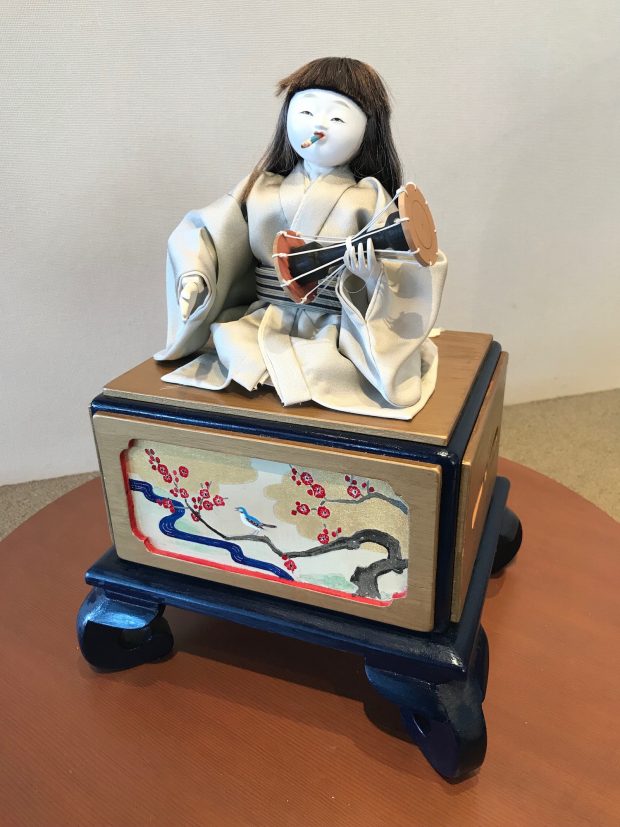
Heart-warming child (reproduction) (Ono Karakuri Memorial Museum storehouse) A manga doll that a boy beats a drum and blows a whistle. Not only does the doll move, it also makes sounds. The "Karakuri doll" here is a doll made to move automatically by a complicated device such as a thread, a mainspring and gears. No batteries or sensors are used!
Popularized latest technology! Great development from upper watch to common people's toy
The Edo period, which was in the world of Taihei Tensha, is also a period when popular culture flourished. The expertise possessed by some people was shared to the public level, and further skills were fostered from the general public. The Japanese watch, “Waiwa”, created during the Edo period, was created primarily for use by the daimyo in public affairs, but its technology is also handed over from engineers to the public, and popular culture As "Kenaki" was born.

A Japanese-style watch (made by Daimyo Clock Museum collection), a Japanese-style watch, is a unique watch made in Japan according to the indefinite time method applying western clock technology.
The moment that the mechanism became common people! Opening of Takeda Karakuri Theater
It is an event of Kanbun 2 years (1662). In Dotonbori, Osaka, a landmark modeling drama "Takeda Karakuri Theater" was launched. The beginning was the, the Awa country born of the contraption nurses, Omi Takeda (Omi Takeda). The idea of the play is said to have come up with a look at the children's play with sand. The Takeda Karakuri play consisted of various performances such as staged dolls, writings, transformations, etc., and kyougen and hand dancing between them.
The people are passionate about the groundbreaking show, and Takeda Karakuriza has a huge reputation in no time. The height of the publicity is such that it can be said that it will not come to Osaka if you don't look at Takeda Karakuri in the tourist guide paper "Settsu famous place design". The appearance of a knack play that can be seen by children at an affordable price, it was a moment when the knack became a common man.
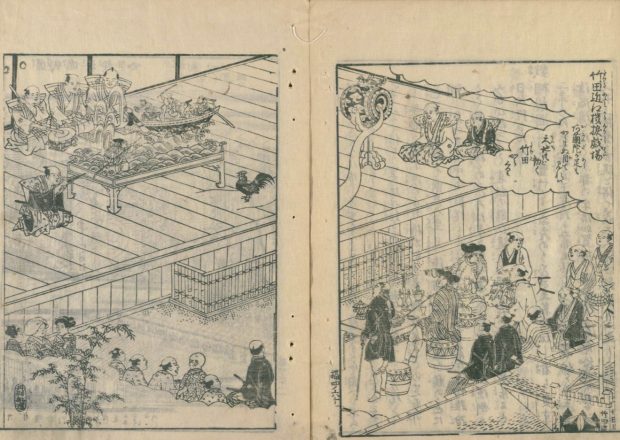
The Dutch people are surprised to see Takeda entrails from "Settsu famous place enlightenment" Kansei 10 (1798) (National Diet Library Digital Collection). On the side of "Taketa Komi Kiki Torch", there is an enthusiasm saying, "If you look at it with your eyes or feet, you can move the heavens and the earth."
world's first? ! Publication of "Karakuri Specialist Book"
It has been 130 years since Takeda Karakuri predominates in Osaka. In addition to the structure of the Japanese watch, a total of nine types of structures are available in the 1796 edition of “The Mechanical Dictionary (Marchuri-Zui)”, as well as the structures that can actually be made (Karakuri toys for playing indoors). . As materials, we use materials which are relatively easy to obtain by the people at that time, such as whales, trees and bamboo. It seems to have been a big bestseller, and after the first edition was published in Edo, it was reprinted in Osaka and Kyoto. It's easy to imagine that there was a mecha geek who was enthusiastic about making a Japanese-style room clock and a Japanese-style watch at work.
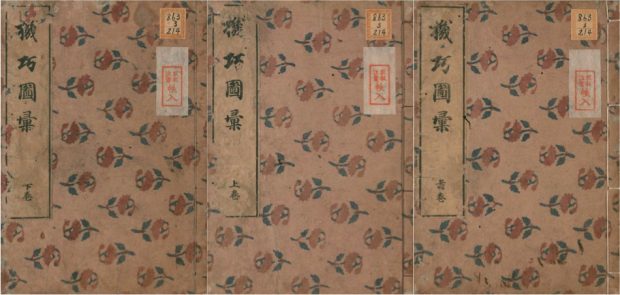
"Takumi-Keitai" Kansei 8 (1796) (National Diet Library Digital Collections) A specialized book of trickery technology that is said to be the world's first (!). The author is Yorinobu Hosokawa from Tosa. Born and raised, Tosa, who is Tosa, says that she learned the mechanics and calendars at the national level.
Unrelated to work efficiency! Tea carrying doll like human
Modern robots are often created to improve work efficiency, but the Edo era Karakuri dolls are not. For example, it is a tea-carried doll that is said to be the representative work of the parlor.
It says, "If you put the teacup in the teacup, the doll will go away. If the customer takes the teapot, it will stop. If you return the teacup to the teacup again, it will make a U-turn and return to the original place."
Reading this description is reminiscent of a modern service robot, but it was not created for speed or efficiency. Naturally, it is faster to carry it yourself. The other thing they asked for is a toy that surprises and impresses guests.
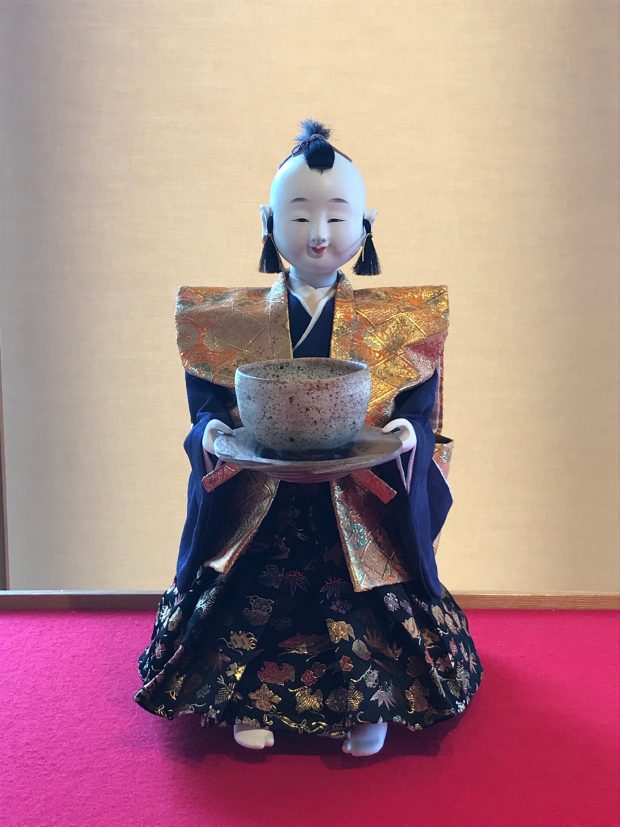
Tea carrying doll (reproduction) (Ono Karakuri Memorial Museum)
"A doll car carrying tea works ." It is a phrase of Ihara Nishitsuru. At the axe attached to the phrase, he said, "The movement of a doll is like a human being. If you think about this, there is no doubt that a master of Hida used to make a crane by himself, and that it really was a story that he put on his body and flew." Express a surprise. The object of surprise is movement just like a human with its soul. There must have been a time for a relaxing exchange between the puppet and the customer, such as a waiter serving tea for himself.
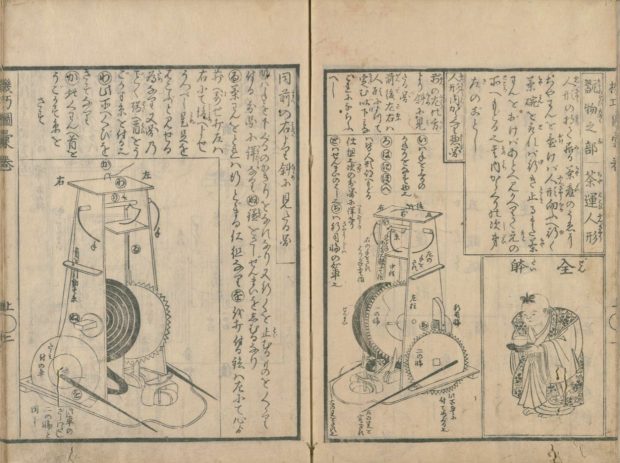
An introduction to the explanation and structure of tea-carrying dolls from the "Nature Dictionary" (National Diet Library Digital Collection). (part)
What I wanted to do with the idiot is (probably) this! Product ball doll
During the Edo period, the company created a spirited doll for the purpose of improving work efficiency, just to surprise and entertain people. It is illusion to be a thing that surprises people in any age. Some of the puppets also did such a trick. The name is also "product ball doll". "Product ball" just means magic and magic.
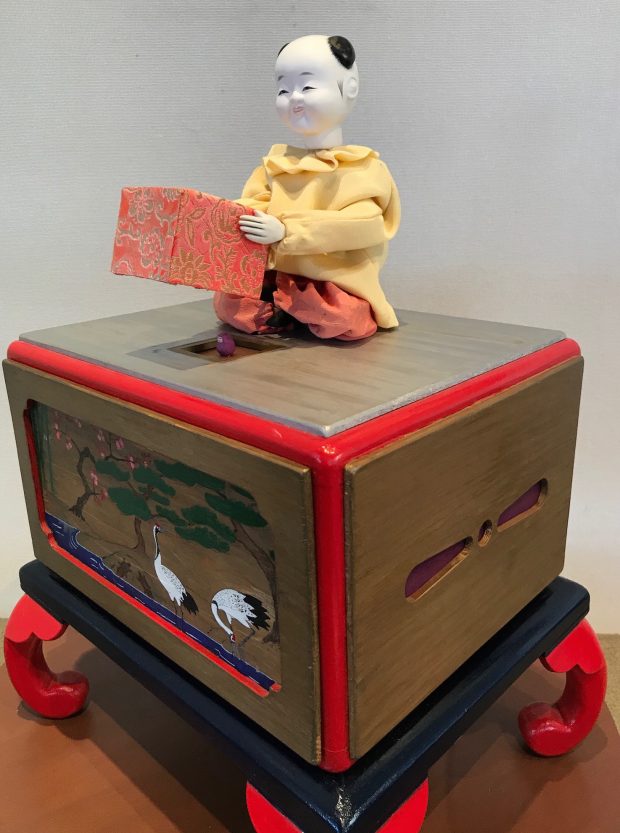
Product ball doll (reproduction) (Ohno Karakuri Memorial Museum storehouse) It is made paying attention to human movements such as raising and lowering the head every time the doll lifts or lowers the chopsticks.
When the doll lifts the coffin, some strange items appear there. If you put the chopsticks and lift it again, the placed items have changed to another. Everyone is blinded as goods change by themselves. There are, of course, seeds and tricks, but the dolls that move with a complicated spring mechanism without using electricity at all are illusions and excitement even if the structure is explained.
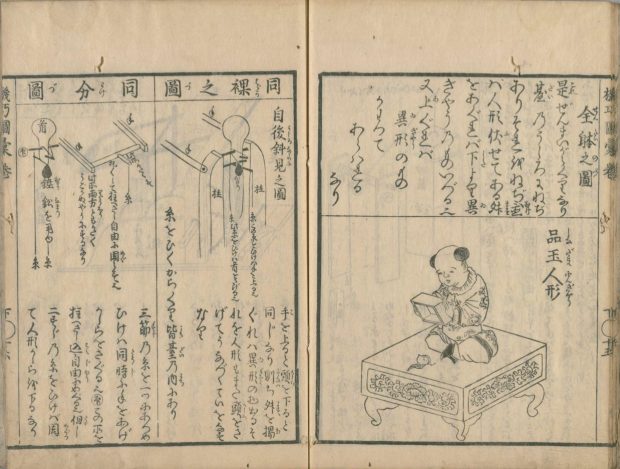
An introduction to the description and structure of a product ball doll from the "Nature Dictionary" (National Diet Library Digital Collection). (part)
The best masterpiece of "Kamakurai Aemon" and Hisashige Tanaka!曳
Hisashi Tanaka, known by the name of “Kamkuri Giyaemon”, made the “Manen Watch ” , which is evaluated at home and abroad as the highest peak of Japanese clocks. Hisashige was the end of the Edo period of the inventor who is, what is said to have created poured all of Moteru technology is the be praised as the best masterpiece of parlor trick "bow曳童Ko (Yumihiki the same)." A child sitting on a pedestal holds an arrow on a bow and shoots it, but it is only that, but the movement of the face, which changes according to the movement, is so delicate that it seems to be visible in the heart of the doll.
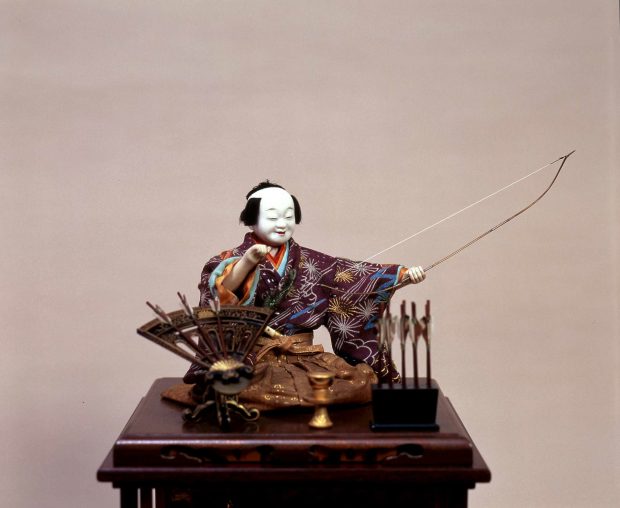
Yumiko Douko (product ・ Tanaka Hisashige) (Toyota Collection Collection)
Is imperfection just "striking"? ! The failure doll
Karakuri puppets are a popular attraction for commoners. It is important to get empathy in order to keep capturing the heart of people. That's why it is Nan, but among the puppets there were quite a few "failing dolls".
One of the “Failing Dolls ” was the “ Furkishori Dolls ”, which was popular among the people in the Edo period. The five-step doll is a mechanism that uses the movement of the center of gravity of mercury, and the doll goes down the stairs while rolling back. The audience said they watched with breath as they did not know if they would fail or succeed. The heart that enjoys failure as well is "smart" that the people of the Edo period cherished.
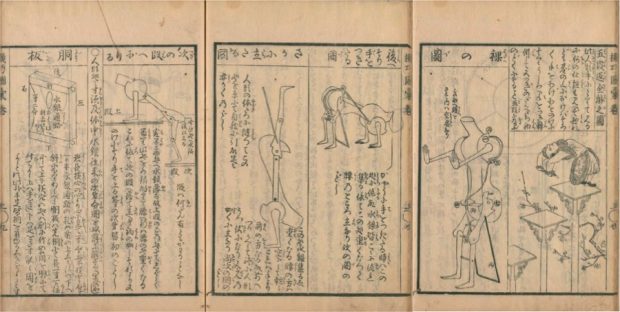
An introduction to the explanation and structure of the Five-Stage Returning Doll from the "Draft Dictionary". (part)
Today's "Manufacturing Japan" was a gift of the rich heart of the Edo period
Takeda Karakuriza, which enthusiasm ordinary people, greatly influenced the production of the later puppet theater and Kabuki. In addition, it is also during the Edo period that Kabuki's proud scene change technology, "Burning Stage", "Taraku Return", and "Gan-Bok Return", etc., were devised in the stage. The crafting technology that was born on the basis of Japanese watchmaking has evolved into a technology that satisfies the hearts of the people, and as a result has built a foundation that will continue to the modern "manufacturing powerhouse Japan". The foreword of the world's first crafting technical book, "Essential Figure Dictionary", is concluded with such sentences.
"Even if it is as good as children's play, such as a book, depending on the eyebrows of the seer, it will be an aid to the founding life."
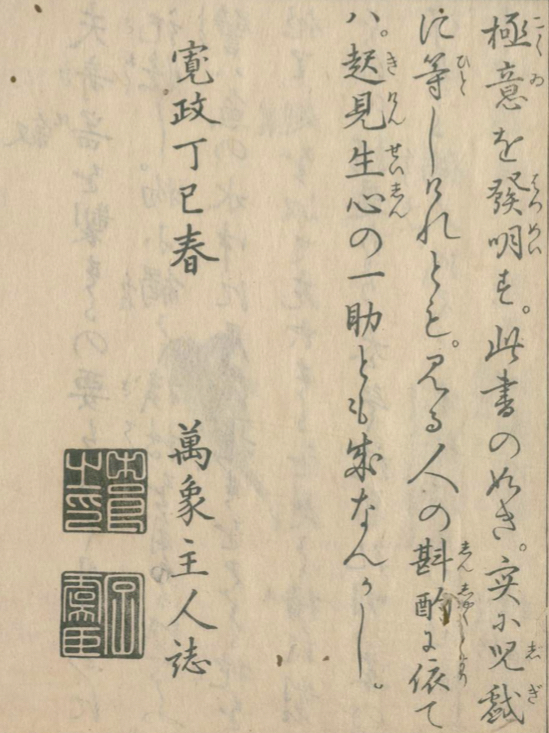
Foreword from "Takumi Utatai" (National Diet Library Digital Collections). (part)
What is listed in this book is only a play, but depending on the reader's understanding, it will give you some new ideas, which will also trigger inventions. Because there was little external stimulus in the state of secession, in the Edo period, the technology developed uniquely to make the technology born in Japan mature in the people.
Sentence / Ami Aoki
"What a great thing the hobby entertainment of the Edo era has produced" List of serialized articles ・ The first development of Ukiyoe was "making interesting calendar" in Edo? ! Until the large and small calendars become world-class Japanese art "Romee"
・ The second edition of Edo too much? Horticulture boom! Deep world of change morning glory
・ Extra edition Art crafts! Unprecedented super-skilled craftsmanship of the Edo period hidden in Japanese watches

Born in Yokohama. It is a life where you save money and go on a trip, or withdraw about a half year to write a novel or make a movie. I am deeply in love with the lightness of Edo townspeople who have no goods and no future. My hobbies are hardship, meditation and a dance party. The person who respects is Jomon. I firmly believe that the useless product created by the long peace (aka castor) of the Jomon and Edo periods is the true essence of Japanese culture.