













Shinto shrines that come in contact with the times such as the first shrine When you notice, about the shrine, about the manners of worship, how are you supposed to know? Therefore, we will introduce at a minimum the things you want to know at a minimum: "Worship" . This should bring you a good relationship with God!
◆ I heard the story ...
Author and journalist Akiyoshi Yamamura <br /> About 20 years ago, I visited shrines of about 5,000 companies across the country and interviewed about 1000 priests. We will continue our activities with the goal of "conveying Shinto, Japan's oldest ideological culture, in an easy-to-understand manner". Received the “Shinto Culture Award” in 2012 (Shinto Culture Association). He has written many books such as "Shinto and Japanese" (Shinshisha) and "Really Amazing Shinto" (Takarajima Shinshin).
Shrine version is here
Simple question about worship 10
1 Is it better to burn the first shrine at a famous shrine?
It was in the Meiji era that I came to visit famous shrines in the distance for the first visit. It is said that the railway and other transportation networks have developed, and railway companies have been actively invited to visit shrines along the route. Until then, New Year's Day for the common people greeted the old god and spent quietly at home. To decorate Kadomatsu in front of the house is also to make it the age of the god of years. The ones who oversee you most are Mrs. God and the god of birth that protects the land. Hatsugu first visits ancestors and nearby shrines.
2 What is the difference between going to a normal hall and a worship hall and praying?
Ascending to the shrine is the official method of worship, and is called "Senior worship." It is a brief statement to visit in front of the hall. It is the worship of the apostle to bring closer to God.
In formal worship, we will dedicate a "tamagashi" fee instead of a reward. The amount of money varies depending on the shrine, but on average it is 3,000 to 5,000 yen. After the ceremonial speech is performed by the priesthood, we offer an onion to God and pray. It is said that God will be pleased if you give the onion. Please have a fresh feeling of tension at the beginning of the year.
3 Is there a market price for the change?
There is no market price, and there is no demand for more if you put more. Originally, the change was rice just reaped . I thanked God for the successful harvest in autumn, wrapped the new rice in a blank sheet, and offered it as a "tweak" . I often see people throwing violently into a coin box, but it is something that is originally offered. If there are a large number of worshipers, such as Hatsumugi, and they can not get close to the change box, it should be treated as carefully as possible.
4 How are you determined?
"Eho" is a direction in which the god of age is in that year. The year in which the self is attached is the direction of the wolf, the year in which the bull is attached, the year in which the wolf is attached, and the year in which the wolf is attached・ The year with a drop is with Sarutori, and the year with a drop (じ ん) is with Ago (Like). Hijiri is visiting a shrine that is the direction of the blessing for me. During the Edo period, things that were done in parts of Kansai were gradually spread throughout the country. In 2014, the year of the noon (Kinoueuma), the direction of the boat (east-northeast) is a blessing. When you enter your home address, there are also sites and apps that show Megumi on the map.
There is also a method of moving to a place where it will be in the direction of Ehoshi and going to the shrine again if there is no Shinto shrine of Ususuna (Ubusa), but it is not necessary for me to care about it. I think so. It is more important that the New Year greetings be given to the birth god properly. 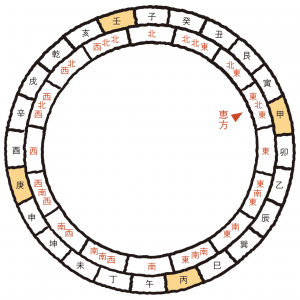 Ehime of 2014 is east northeast. The outer circle is a combination of Zoji and Zodiac. "Zodiac" comes from here. The "Ko, Samurai, Samurai, Samurai" colored in the Tensen are "Yoshikan", and the grace is determined by these. The inner circle is 16 orientations in the west.
5 Please tell me how to use hand water correctly
Japanese mythology says that Ishinagiki, who returned from the country of Yemen, says, "I fell in love with it," and said that when she took off her clothes, she dipped in the sea and made a habit. The concept of Japanese aspirations, world-class cleanliness, may start here. Originally, the simplified form of what has been soaked and cleaned in the sea and the river becomes the present hand water. Shinto is basically open to anything. You don't have to worry too much, but let's only refrain from putting a handle on the handle.
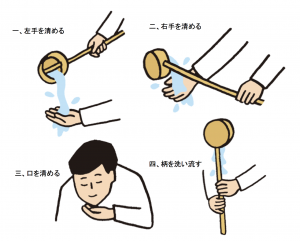 1. Take the handle with your right hand and cleanse your left hand.
2. Hold the handle on the left hand and clean the right hand.
3. Hold the handle again to the right hand, rinse the mouth with the water received on the left hand, and exhale gently.
4. After cleaning the left hand, hold the handle with both hands and make it vertical. Make the remaining water fall along the handle and clean the handle. Do this with a glass of water.
6 Why is the number of applause different depending on the shrine, such as “2 二 拍 一 礼「 「「 二 礼 拍 礼 礼 礼 礼 ”?
Four applauses at Izumo Taisha and Yahiko Shrine (Niigata Prefecture). In Ise Jinguu, he is a special applause eight times, saying that it is "Hachidachi (Yahiraha)" only for the priesthood. The salutation of each Shinto shrine, but now it has been generally simplified to two times, less applause. It is said that it is desirable to put the right hand slightly down and clap after putting the right and the left palms together once after giving thanks. Applause is also said to have the meaning of praise to God. Please clap your hands with all your heart.
7 Is it a violation of the rules to draw fortunes twice?
The Omikuji came to be released at the shrine during the Kamakura period. The role was heavy because it was often used for politics. A rebellion called the Kamifuren (Jinpuuren) happened in Kumamoto in 1869. It was a result of finally saying "should" in the third time to tell if it should be uprising, but it was suppressed for a while. I think it is more important to receive God's words deeply there than to draw it many times before a good bond is released.
8 What should I do with the old amulet or god card?
It is recommended that the god card be stored in the shrine at the end of the year, and be given a new gold card for a new year, if you ask the god shelf of the house for a year. The amulet is basically the same, but it is safe to wear it until the wish comes true. Amulet is always carried around. It is okay to have more than one. God does not fight. Don't open it with curiosity as it is the power of God.
9 Where should I put my God card in my house?
After all it is the god shelf . There are also wall hanging types and Western style rooms now, so why not prepare for the new year? It is said that "the bright and clean place in the center of the house" and "the south facing or the east facing high place" is suitable as the place. It is better to avoid sticking directly to the wall. Change the water in the Shinto shelf and join hands daily. By such customs, God watches over my family.
10 Should I not go in mourning?
It is "Yunaka" that you should not go to the shrine. Although the number of days varies from 3 days to 50 days depending on the relationship with the deceased, it is a period of time devoted to watching the deceased. It will be in mourning when the dawn is over. During mourning, it lasts for about a year, but it is a period of effort to overcome sadness and return to the original life. There is no problem in principle when visiting a shrine. During mourning, it is also a conviction that "don't go past the torii" should be avoided.
-From "Waifaki" January 1st, 2014 issue separate volume appendix "Nippon's Name: Travel to 102's Shrine"-Illustration / Shuhei Tajima