





Otsukimi (お月見) is a traditional Japanese event where we express gratitude for a bountiful harvest whilst admiring the beautiful moon floating in the autumn night sky. The custom of moon-viewing is filled with ancient beliefs and a spirit that appreciates the changing of the seasons. In this article, we will introduce the meaning, origins, and ways to enjoy Otsukimi.
When is Otsukimi?
The time of year when the moon shines at its brightest and most beautiful is the 15th day of the eighth month on the old lunar calendar. The full moon on this specific night is celebrated as Chushu no Meigetsu (中秋の名月: literally, “the mid-autumn harvest moon”), giving rise to a deeply rooted Japanese tradition known as Otsukimi—or simply, moon-viewing.
In modern times, which adopt the solar calendar, the date of Otsukimi changes every year. However, because the old lunar calendar determines dates based on the phases of the moon, the ‘Chushu no Meigetsu’ falls on the same day of the lunar year annually.
The Roots of Otsukimi
The custom of viewing the ‘Chushu no Meigetsu’ can be seen in ancient records from the Tang Dynasty in China. It is believed that the roots of Otsukimi lie in the spread of this practice among the aristocratic class around the Heian Jidai. The Heian Jidai tale Genji Monogatari (源氏物語), written by Murasaki Shikibu (紫式部), also notes that there were parties called ‘Tsuki no En’ (月の宴) where people enjoyed alcohol and music. Just like Christmas and Halloween, it is quite amusing that the Japanese tendency to adopt foreign customs and turn them into lively, enjoyable events for everyone remains unchanged from ancient times to the present!

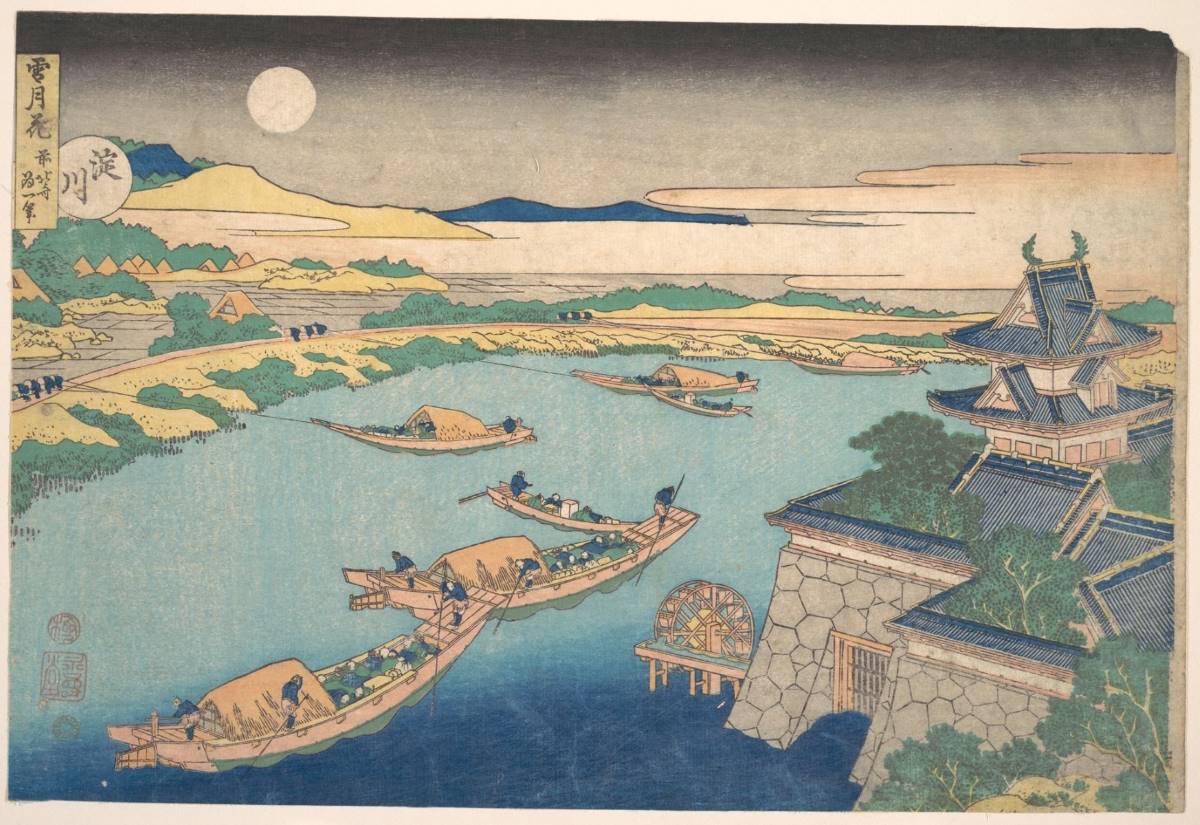
The custom of ‘Tsuki no En’ among the aristocrats gradually spread to the commoners. However, rather than simply admiring the moon, it developed with a strong emphasis on celebrating a bountiful harvest and praying for good crops, becoming known as the Jugoya Matsuri (十五夜祭り). During the Edo period, it seems that commoners also enjoyed it as a seasonal event, taking boats out to admire the moon.
Did You Know About These Otsukimi Treats and Tipples?
When we think of Otsukimi, Tsukimi Dango (月見団子) comes to mind. But did you actually know there are other sweets associated with it?
Are the Roots of Monaka in the ‘Chushu no Meigetsu’?
To begin with, ‘Chushu’ (中秋) is so named because it falls right in the middle (Monaka [最中]) of autumn (the 7th, 8th, and 9th months of the old calendar). You have probably noticed by now: the roots of the sweet we currently call Monaka lie right here! It is said that one of its origins is a waka (和歌) poem about the ‘Chushu no Meigetsu’ composed by Minamoto Shitago (源順), a Heian Jidai poet, compiler of the Shui Wakashu (拾遺和歌集), and one of the Sanjurokkasen (三十六歌仙).
Ike no omo ni teru tsuki nami o kazo fureba koyoi zo aki no monaka narikeru (池の面に照る月なみを数ふれば今宵ぞ秋の最中(もなか)なりける)
Counting the moonlit waves rippling on the pond’s surface, I realise that tonight is indeed the very middle of autumn.
It is said that a sweet served when this poem was recited at a court banquet was thin and round. Because the sweets perfectly resembled the round mid-autumn moon, they came to be known as Monaka no Tsuki (literally, “The Moon at its Peak”). Another theory suggests the name originated much later during the Edo period, when a confection made in the Yukaku pleasure district was likened to the brilliant full moon of the 15th night.
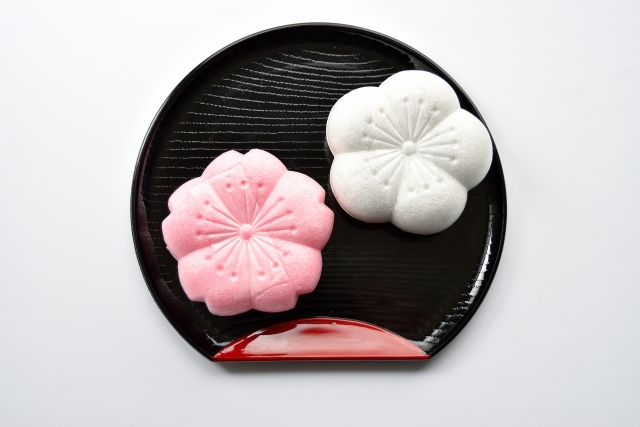
We can feel the deep affection the Japanese have for the moon in how, even today, perfectly round foods are likened to a full moon, such as the ‘Tsukimi Burger’ (月見バーガー) and ‘Tsukimi Soba’ (月見そば).
Tsukimi Dango Differs by Region
When it comes to Otsukimi, it absolutely has to be Tsukimi Dango! The way they are made and offered differs depending on the region. The shape is generally perfectly round to resemble the moon, but they come in various shapes and colours, such as oval ones wrapped in bean paste or brightly coloured ones. Regional characteristics can also be seen in the number of dumplings offered, such as 15 to match the 15th night (Jugoya) or 12 to match the number of months in a year.

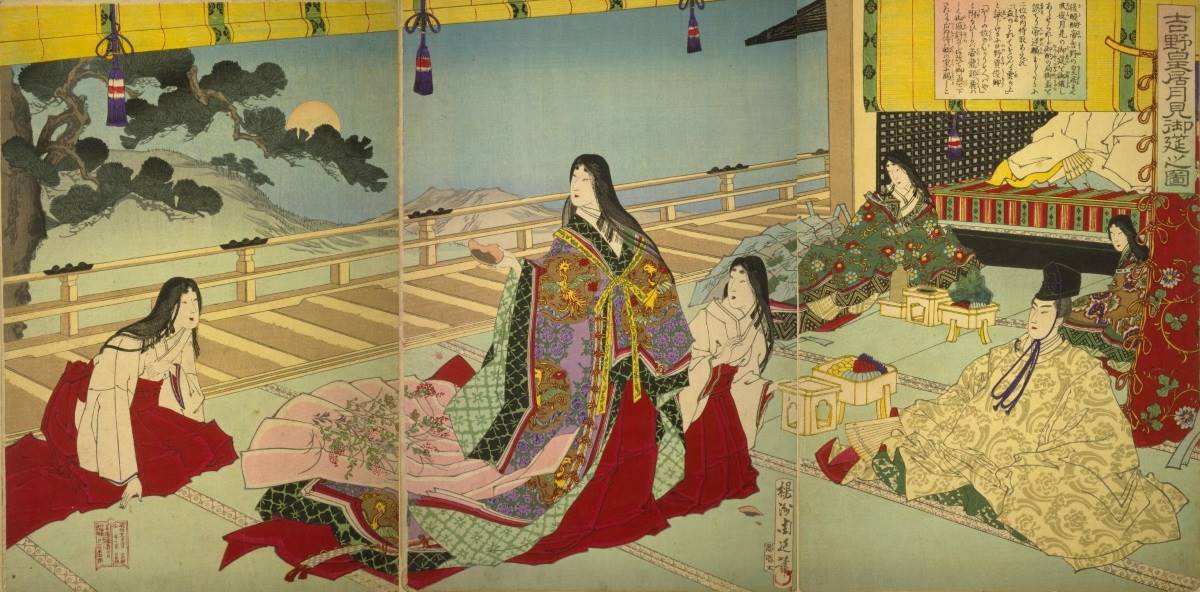
Meiji 28, Chiyoda no Ooku Tsukimi no Utage (千代田の大奥 月見之宴) by Yoshu Chikanobu
In the nationally beloved anime Sazae-san (サザエさん), because someone wanted to eat Oshiruko (お汁粉) rather than plain dumplings, it was famously offered in a bowl of Oshiruko instead. What kind of Tsukimi Dango does your family or region have?
Tsukimizake Existed in the Edo Jidai Too
Tsukimizake (月見酒) is exactly what its name suggests: drinking alcohol whilst gazing at the moon. Alcohol drunk on a beautiful moonlit night sounds many times more delicious than usual, doesn’t it?
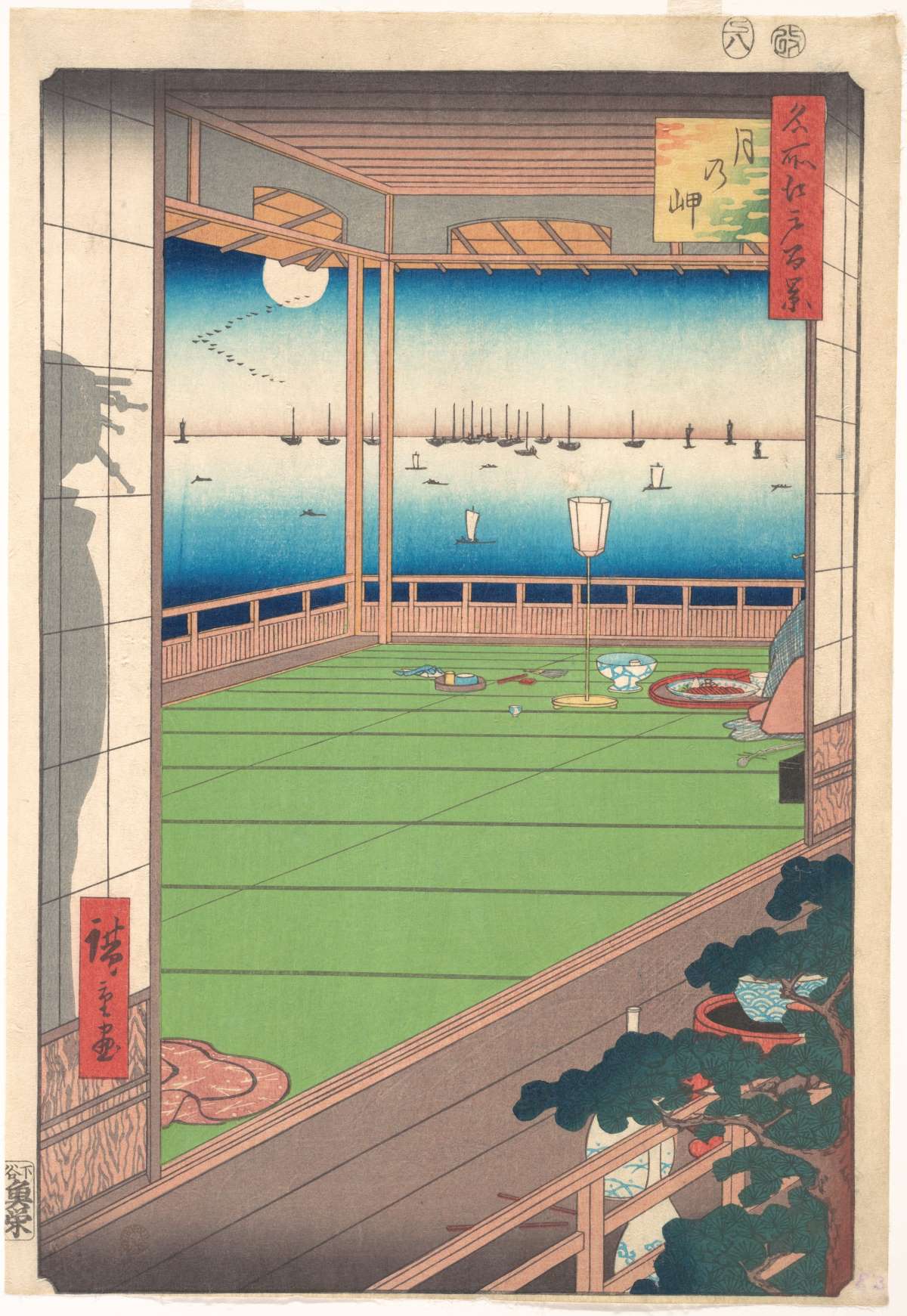
This is a piece by Utagawa Hiroshige depicting a famous Edo spot called ‘Tsuki no Misaki’ (月の岬). According to the Fuzoku Gaho (風俗画報) published on 25 January, Meiji 35, it is thought that ‘Tsuki no Misaki’ might be Isarago (伊皿子) (around modern-day Shinagawa [品川]). Scattered sake and snacks, and the silhouette of a Yujo (遊女) visible through the sliding paper doors. Are the boats floating on the moonlit sea carrying moon-viewing guests?
By not clearly depicting the figures, the beauty of the moonlit night is truly accentuated in this piece.
Poems Composed about the Moon
The moon subtly illuminates the dark night whilst changing its form. Just as Natsume Soseki (夏目漱石) is famously said to have translated “I love you” as “The moon is beautiful tonight, isn’t it?”, the moon is a presence that deeply moves the hearts of us Japanese. What sort of feelings did the Japanese of the past entrust to the moon? We can catch a glimpse of this by reading waka and haiku.
Waka poems
First, let us look at poems about the autumn moon from the Hyakunin isshu collection (百人一首).
Tsuki mireba chiji ni mono koso kanashikere waga mi hitotsu no aki ni wa aranedo (月見ればちぢにものこそ悲しけれわが身一つの秋にはあらねど) — Oe Chisato (大江千里)
When I gaze at the moon, a thousand things make me feel sorrowful, though autumn has not come for me alone.
Akikaze ni tanabiku kumo no taema yori more izuru tsuki no kage no sayakesa (秋風にたなびく雲の絶え間よりもれ出づる月の影のさやけさ) — Sakyodaibu Akisuke (左京大夫顕輔)
How clear and bright the moonlight is, leaking through the gaps of the clouds trailing in the autumn wind…
Even though they are composing poems about the same autumn moon, one feels a sense of melancholy, while the other is deeply moved by its beauty. Perhaps the moon reflects the heart of the beholder.

Surprisingly Seductive Love Poems
Tsukikusa ni koromo wa suramu asatsuyu ni nurete no nochi wa utsuroinu tomo (月草に衣はすらむ朝露に濡れての後はうつろひぬとも) — Anonymous (読み人しらず)
I shall dye my robe with the moonflower. Even though the colour may quickly fade once wet by the morning dew, I do not mind. Though your heart may change as easily as the moonflower, I love you.
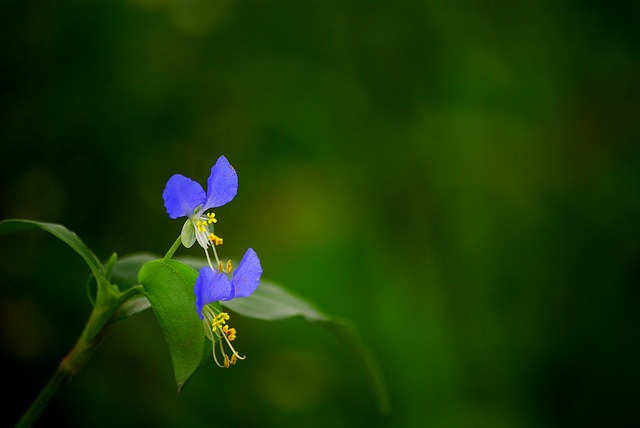
While it doesn’t focus on the moon itself, this romantic verse highlights the tsukikusa—literally “moon grass,” known today as the dayflower—which blooms in autumn. In the poetic language of the era, the phrase “wet by the morning dew” was a subtle euphemism for a couple spending the night together. Although, if you think about it… its actually pretty boldly erotic.
Shinoburedo koishiki toki wa ashihiki no yama yori tsuki no idete koso kure (忍ぶれど恋しきときはあしひきの山より月の出でてこそくれ) — Ki Tsurayuki (紀貫之)
Though I try to conceal it, when my longing for you is unbearable, I emerge and come to you just as the moon rises from the mountains.
Perhaps he composed this when he visited a woman. It is a beautiful love poem where the scenery and emotions perfectly align, making one groan in admiration, “That’s exactly what you’d expect from Tsurayuki!”
During the Heian period, the moon in romance could signal a farewell, be something gazed upon together with a loved one, or awaken sensuality by brightly illuminating bare skin. I believe that Natsume Soseki’s “The moon is beautiful tonight, isn’t it?” is also deeply connected to this kind of Heian Jidai sensibility.
Haiku
For haiku, let us introduce poems by Kobayashi Issa (小林一茶) and Matsuo Basho (松尾芭蕉).
Meigetsu o totte kurero to naku ko kana (名月をとつてくれろと泣く子かな) Kobayashi Issa
“Get it for me!” Cries the little child…The harvest moon.
Meigetsu ya ike o megurite yomosugara (名月や池をめぐりて夜もすがら) — Matsuo Basho
The harvest moon— Wandering around the pond All night long.
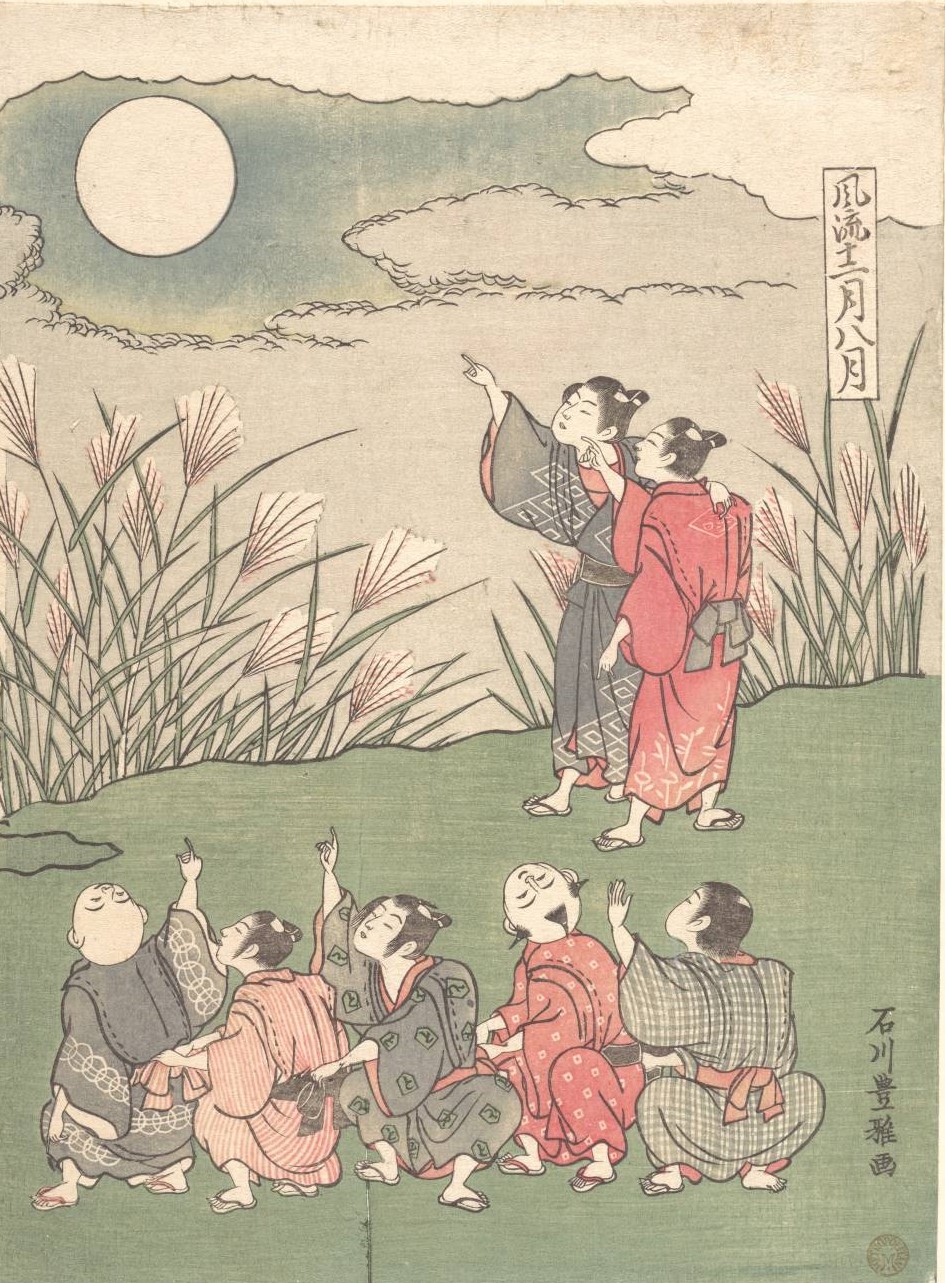
Hachigatsu (8月) by Ishikawa Toyomasa (石川豊雅). Metropolitan Museum of Art collection
The Moon that Connects People
The moon, which once captivated both adults and children alike. Nowadays, we may look up at the moon less often. However, there is only one moon in the world. When you think that you are gazing at the exact same moon as that person far away, or the poets of the Heian Jidai, doesn’t it feel rather romantic? Transcending time and place, it connects people to one another. The moon is such a presence. I would love to see us re-evaluate the custom of “viewing the moon” once again.
The main image for the new Otsukimi is a work by illustrator Sakuma Akane(@a_skm)
I asked her to draw the feeling of “Even if we are apart, I want us to look at the same moon, share the same experience, and raise a glass together.”☺️🌕— New Otsukimi (@new_otsukimi) August 10, 2021
“Even if we are apart, I want us to look at the same moon, share the same experience, and raise a glass together.” — This is exactly the sensibility that the Japanese of the past held dear!
References
Nihon Daihyakka Zensho Nipponica (日本大百科全書(ニッポニカ))
Sekai Daihyakka Jiten (世界大百科事典)
E de Tsuzuru Yasashii Kurashi Saijiki (絵でつづるやさしい暮らし歳時記) by Shintani Takanori
History and Origin of the Name Monaka, Kaiundo (開運堂)’s ‘Azumi no Fuzei’ (あづみの風情) | Kaiundo Blog
This article is translated from https://intojapanwaraku.com/rock/culture-rock/170288/