













"National treasure" which can be said to be the highest achievement point of Japanese art. 2017 is 120 years since the word "national treasure" was born. At Shogakkan, "Weekly published Nippon National Treasure 100" rediscovers its hidden beauty and cultural history On sale.
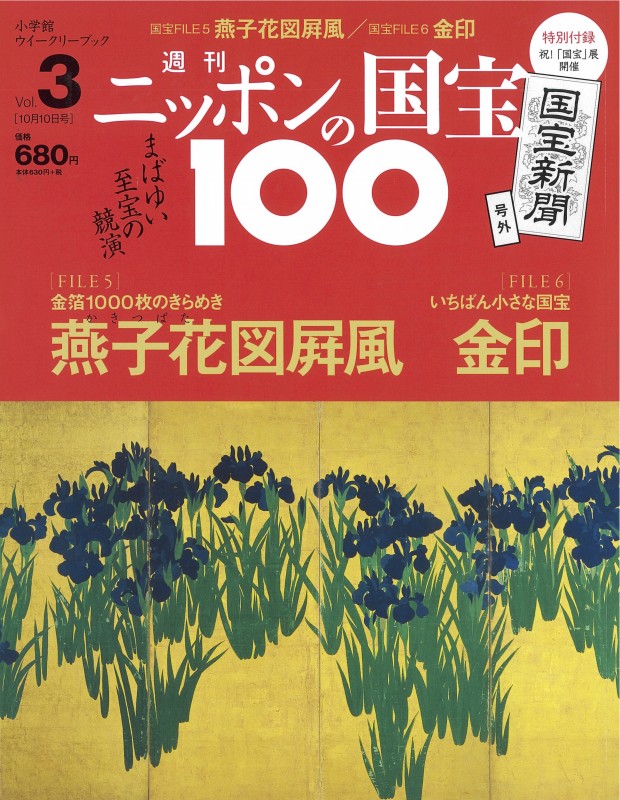
As digest of each issue, we introduce profile of famous treasure.
This time, it is the “Han Seokfu King” gold seal that decorates the beginning of the diplomatic history of Japan, and the beginning of the diplomatic history of Japan.
A golden leaf of 1000 sheets of sparkling "Yuzu flower drawing screen style"
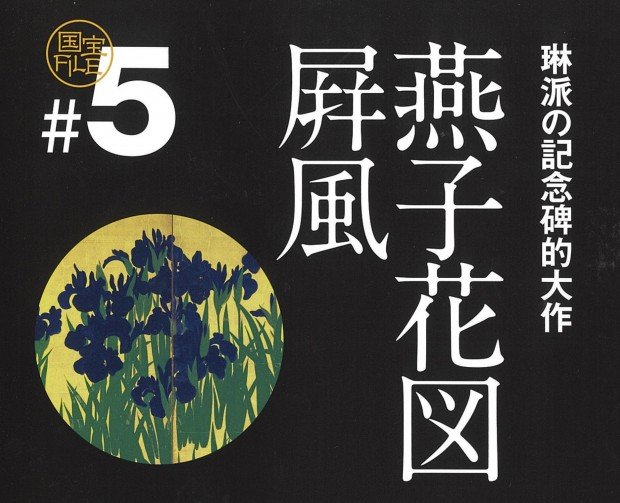
"Kotoko-ha-zu-buki-zuku" is a masterpiece of the late Edo-era painter, Ogata Kouji, who has created a decorative art called "Sakai-ha" in the later years.
It is not a simple flower drawing, but the title is considered to be the "falling east" of the ninth stage of the "Isemonogatari" in the Heian period. The poet who goes down to the east country and a group of people who live in the area are struck by a persimmon that blooms in one place in the land of Mikawa country Yabashi (currently known as Yabashi-cho, Chiryu, Aichi Prefecture). And it is a scene where the party tears down, singing a song that feels like a long journey and a wife.
However, nothing is shown in this screen-style picture that specifically shows the contents of the story, including Oppei. However, the temples and shrines of Kyoto and the people of wealthy townspeople who were the customers of Gwangjang were able to bring to light the story of "the east going down" from the flowers of the persimmon flower. For them, "Isemonogatari" was a subject that was so familiar.
First of all, Kotobi was a typical town group. Born in Kyoto, a high-class clothing and clothing retailer. He is a hobbies who is familiar with learning and arts, and he grew up familiar with Noh, tea ceremony, writing and painting. Kotoi, who continued to prosperity by inheriting his huge heritage, started his work in earnest after he passed the age of 40, when he had used up his father's heritage. Then, at the age of 44, he is deceived by the “Horohashi” (a honorable place given by the court). Soon after that, it is thought that this "Yushi flower drawing style" was drawn.
This is a light that has greatly influenced the work of the Kano school, who was the mainstream of the art, and the work of the town painter and Ashiya sects who were active in Kyoto until a little while they were born. I'm challenging an unprecedented method. While the theme is "Ise Monogatari", we will distribute only communities of oyster grass. Moreover, the same type of flower group is repeated. A large screen is composed of only ultramarine and patina in gold.
Born and raised in the Hatori clothing house, Kousuke created this work using his craftsmanship, his innovative sense of design and his keen sense of color. The “Sakaihana-zu screen style” is the first time a major work by Kousame's original style. It is a monumental work of the 琳 faction.
National Treasure Profile
Kogata Ogata "Shrimp Flower Drawing Screen"
First half of the 18th century Paper book gold color coloring Six songs one pair each 151.2 x 358.8 cm Nezu Museum of Art Tokyo
A sculptural screen drawn by the artist, Koga Ogata, who worked in Kyoto in the middle of the Edo period. It draws only oyster grass on gold ground, and symbolically expresses the ninth step "Easting Down" of "Ise Monogatari" in which Shohei Inhara is the main character. A masterpiece of light glaze that features novel decorative properties such as the placement of rhythmic flowers.
Smallest "National Treasure"
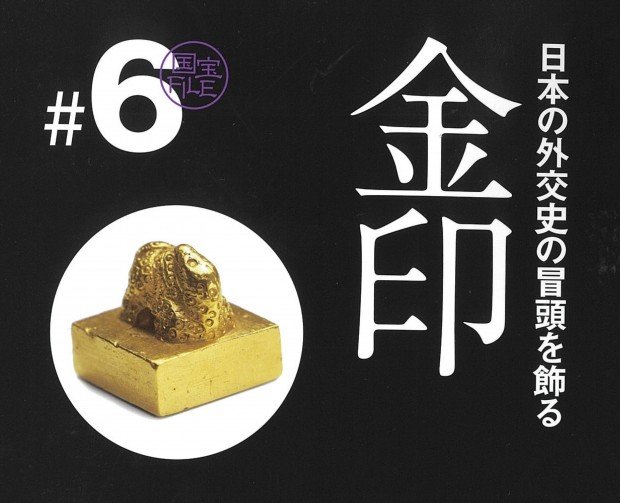
This gold-colored small national treasure was discovered in the Edo period, Tenmei 4 (1784). The place is Shikajima floating in Hakata Bay in Fukuoka Prefecture. It is reported that a farmer named “Seibei” who lives on the island discovered the ditch of the paddy field under the big stone while repairing it.
The unearthed "golden seal" was immediately submitted to Fukuoka Kamakura. Nanei Kamei, a scholar of acupuncturist who received an appraisal request, pointed out that this is the mark described in "Back Han's Toho Den". In other words, this is the mark that Gonbu Teikono (Residence 25-57), a late Han, gave it to "Jifukuni".
The character of "Han Seokhe King" clearly engraved on the seal face. There are various theories about how to read the "committee man" part from the beginning of the discovery, and it has produced various arguments. However, in the Meiji era, "the king of the commissioner" came to be read, and this theory is considered to be prevailing now. "Munkuni" is a country that is marked as "the Great Country after Shoguntai" and "Ruma" in "The Three Kingdoms". It is believed that the current Fukuoka city was in the Kasuga area.
This country sent an envoy for the morning tribe to the late Han Dynasty, and the emperor was given a "gold seal", but it was not a mere reward item. In Han Dynasty, there was a "seal system" that gave a mark as a sign of status or identity. If you compare the “gold seal” inscribed with “Han Commissioner King” with this system, you can see how Han recognized and treated Japanese envoys of that time.
The gold mark is a mark given to the kings of Han, which means that the king was regarded as equal to them. "Samurai" that hits the part of the knob is in the shape of a snake. This is the form of the seal given to the southern peoples. And the "King" engraved on the seal is the highest rank official office given to the heads of other ethnic groups in the surrounding area. In other words, it means that the Emperor Koumu was best treated as a foreign minister.
"Golden" that fascinates the viewer with the beauty of sparkling gold and the deep and sharply carved characters. It can be said that it is a testament of history that speaks eloquently between Japan and China in the late Yayoi period.
National Treasure Profile
"Han Commissioner King" Gold Seal
Excavated Shikajima, Fukuoka Prefecture Gohan (late Yayoi period first to third centuries) approx. 2.2cm high Fukuoka City Museum
Tenmei 4 years (1784) of the Edo period, the mark made of gold by casting excavated from Shika Island located at the bay entrance of Hakata Bay. The seal is engraved with the words "Han Seok Hwan King" on the seal, and it is considered to be a sign that the late Han's Gwang Bong emperor described in "Back Han's Dong-Au-den" was inferior to the King's King in 57 AD.
Wadon web editorial department. My motto is "I'm seriously stupid", and I am having fun with all sorts of dread and fun every day. https://note.mu/warakumagazine