













The popular Ukiyo-e children's collection held at the Hiroshima Prefectural Museum of Art in 2018 (hereinafter referred to as Playable Ukiyo-e Exhibition) will be held from April 28 to June 9, 2019, Nerima-ku, Tokyo It is being held at a museum (hereinafter called Nerimi).
Speaking of Ukiyo-e, the famous ones are the beauty paintings, the actors' paintings, and the landscape paintings, but many works with "children" as the leading role were also drawn. The 'Kumon Children's Ukiyo-e Museum' is famous for its 'Konmon- type', which specializes in collecting Ukiyo-e collections specialized for such children. The Ukiyoe collection dedicated to children of the Kumon Children's Ukiyo-e Museum seems to be popular with people who are familiar with Ukiyo-e, as it is very unique and extremely distinctive.
The writer who is not familiar with Ukiyo-e had the image of "a lofty thing" and "a field that an amateur can not step in" because it had the impression that it was sold at a high price and for appreciation now. This time, however, I heard that I had a Ukiyo-e display on “children” and that the theme was “playable” Ukiyo-e, and I participated in the gallery talk that took place on the first day, with a somewhat pleasant atmosphere. We will report the highlights of "Playable Ukiyo-e".
Beginners welcome! "A nice to meet you Ukiyoe"
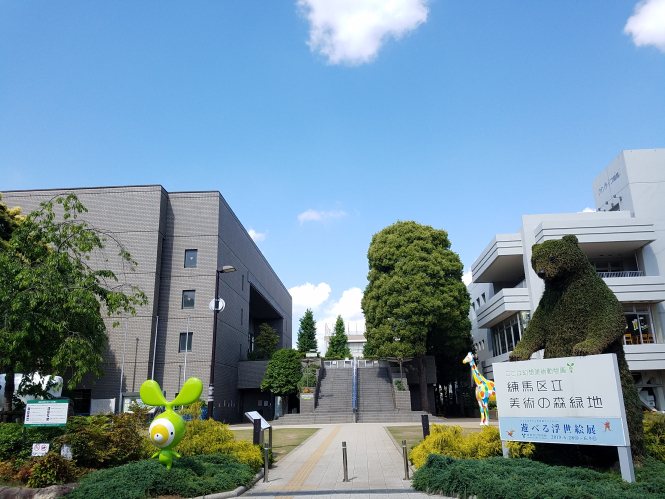
Image courtesy: Nerima Art Museum
The Kumon Education Study Group, which cooperates with the exhibition, is inspired by the study of children in medieval Europe, and has been collecting and studying ukiyo-e since 1986. Currently, it holds about 3,200 cultural historical materials mainly on children Ukiyoe. Among them, about 170 pieces of Ukiyo-e, folding screens, picture books, toys, etc. from which children play is the theme of the exhibition. It is an exhibition that adults and children can enjoy, with the theme of the lifestyle and play of the children of the Edo period.
Supervised by the exhibition is Murasaki Fujisawa, a professor of the Faculty of Literature, Kunigakuin University, and a regular director of the International Ukiyo-e Society. Fujisawa Sensei wants the title of this "Playable Ukiyoe Exhibition" to have a theme of "Welcome to Ukiyoe" and wants the first person to enjoy the ukiyoe world and enjoy the idea that adults and children want to play together I was told. " (Mr. Fujisawa's Kazuo web Petit Interview is in the second half!)
After waking up in the morning until the snack from the daily routine
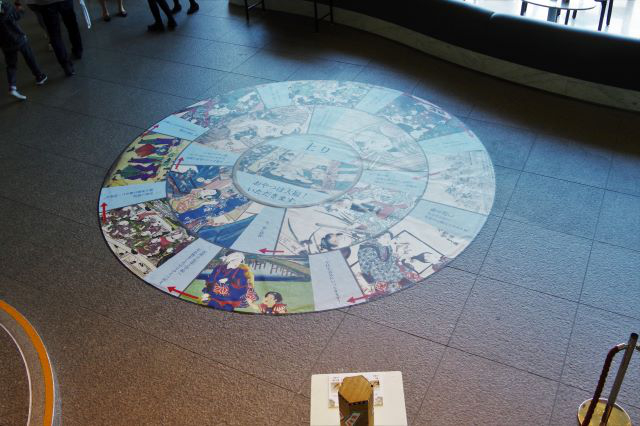
At Nerimi, a large Suguruku welcomes you in the lobby before entering the exhibition room.
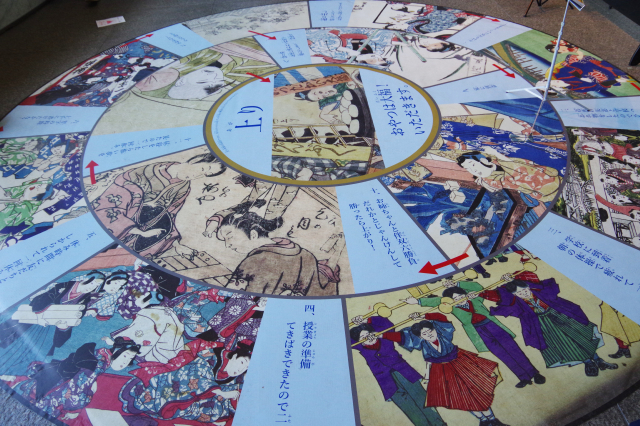
The original Sugoroku, which was created by Ms. Ms. Neri, a curator, “A lot of words are“ playable ”is attached to the title!” The collection of various Ukiyo-e works is a collection of various Ukiyo-e works that children wake up in the morning It is made on the theme of one day from eating to eating snacks. There is a story such as a piece in the morning or a picture at a school where she has her mother tossed her hair, and she can see the realistic expressions of the children of the Edo period.
Is "noisy!" "Hey! Stop" is a word common to all times?
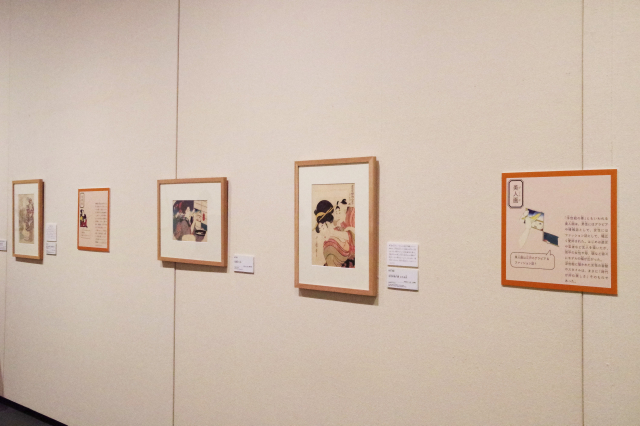
After playing in a row with a double six, it is finally to the exhibition room. First of all, it is one of the features of this exhibition that it teaches us "Ukiyo-e is Nani?" Starting from the point of knowing what Ukiyo-e is, it has become a flow of knowing what Udo's life and the transition of the seasons are drawn by children and the Ukiyo-e actually used for children's play. It seems that even shallow people can go smoothly into the Ukiyo-e World.
The prologue starts with a beautiful painting of ukiyoe.
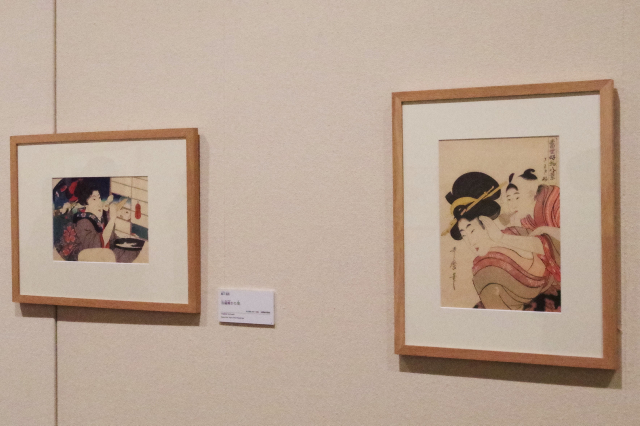
(Left) Utagawa Kuniyoshi "Omori Musume gata ki" (1844-48), (right) Kitagawa Kayo "Today favorite food eight scenics Sawaki" Kaito (1801-04)
Here, check carefully the two beautiful paintings created by Ukiyoe artists representing the Edo period, Kayo Kitagawa and Utagawa Kuniyoshi. When it comes to beauty paintings, there are often sexy images of being drawn by prostitutes and geishas. However, if only one child's figure is added to a beautiful picture, does the atmosphere look a lot different? It looks like a gentle expression of mother and sister as soon as it is drawn with a naughty child, and while listening to words such as "Hide it up!" Or "Russau!" It looks nice.
Ukiyoe, whose theme is to draw "now" rather than the past and the future, is said to have been the leading advertising media for people in the Edo period. Two works decorated here are also like mom magazine. These two pictures are drawn for about 40 years different from each other, but you can get a glimpse of the fashion of women's hairstyle at that time and the fashion of kimonos, and the fashionable hearts of the mothers were the same as now Familiarity is up.
The cute character was here too!
頃.jpg)
Around Utagawa Kuniyoshi "Hozuki Exhausted Sumafu" Hiroaki (1844-48)
This work by Utagawa Kuniyoshi belongs to a genre called "Ukiyoe". "Caricature" is a funny picture full of humor. I was puzzled for a moment by the fact that hozuki was anthropomorphized, but when I think carefully, cats, rats, monsters and monsters are as if transformed into anthropomorphic characters. "Kawaii Chara", which heals us, was popular even in this era. 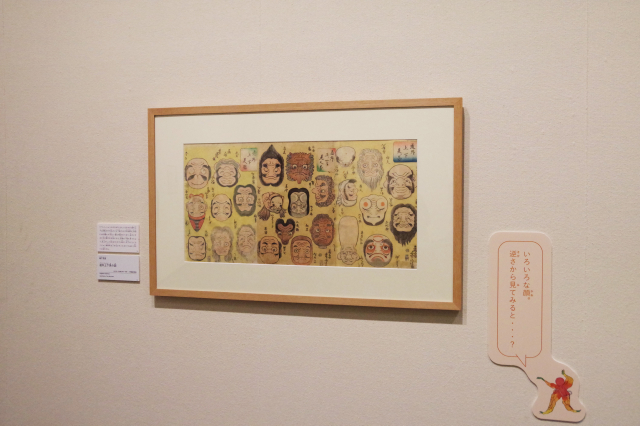
Utagawa Yoshitora "figure of Dojo ups and downs" Bunkyugen-around 2 (1861-62)
On the other hand, this work, in which many faces line up, is the one of Utagawa Yoshitora, a disciple of Utagawa Kuniyoshi who specializes in Ukiyo-e with a lot of humor. Even if you turn it over, your face, face, face ... work is actually going to be upside down in front of the picture and you want to check it. 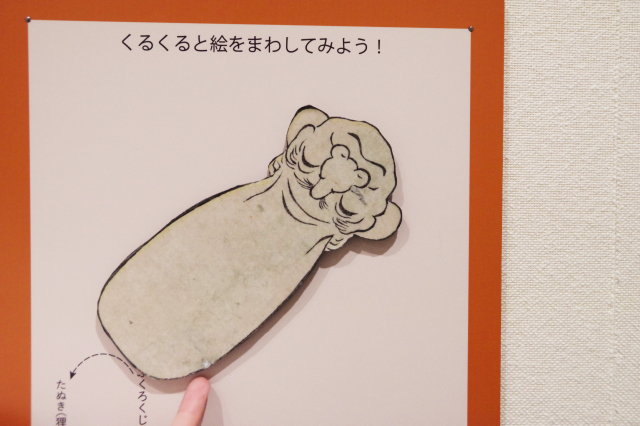
Next to the work, there is also a device that can actually be turned
People in Edo who are talented as "this is interesting!" “I can see the happy relationship between the sending side and the receiving side,” said Kato, a curator of Neremi, who taught that Ukiyo-e was loved by many Edo people. This age, in which many caricatures were drawn and widely liked, may have been a very rich age.
Because the face of the face as it is and the face of the upside are surprisingly cute, there are a lot of cute faces, so it is recommended that you look upside down or back in front of the picture ... take a close look!
Time-consuming and time-consuming technical skills
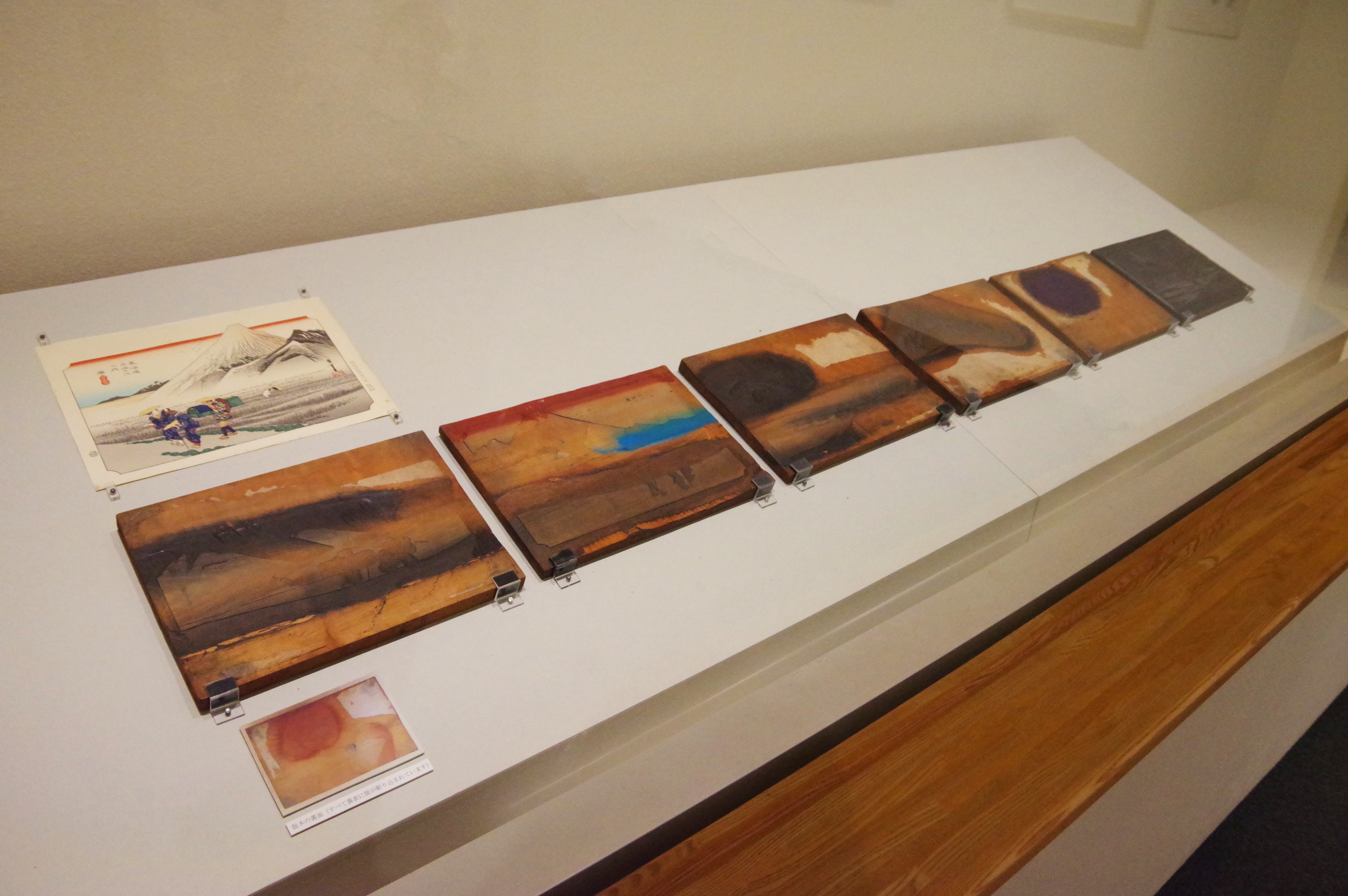
It's hard to see "bangi". Also called a woodcut, this is a board for printing essential for making ukiyo-e, and this time, the teacher, Dr. Murasaki Fujisawa, who is the supervisor, was specially provided with his own collection.
There are a main version (Omhan) for printing outlines and a color version (Irohan) that changes the printing wood depending on the color, and it is said that it is mainly used on the back and front reversible. For example, the exhibition has six blocks, so you can print 12 plates on the front and back.
If you look closely at the second block from the left, you can see that it has a red blur at the top and a blue color at the bottom. It is said that Ukiyoe woodblocks can print different colors as long as they have a width of two fingers. From this, one edition can be said to be the second edition or the third edition, and I mentioned earlier that six plates are 12 editions, but in fact it is possible to print more colors. 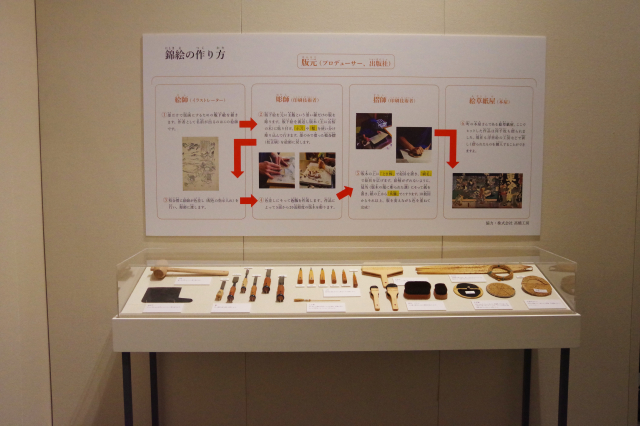
In the same room, tools for "carving" and "printing" are arranged, and the panel shows the process of making ukiyo-e. Furthermore, the area where the people who love ukiyoe such as painters, sculptors, and surimis, and the work of craftsmen who make the tools can be irritated by delusions is a point that is a pleasure for people who like handicrafts.
After having finished the introductory part of Ukiyo-e that Ukiyoe is divided roughly into what kind there is, and what kind of tools and processes are made and sold, it moves to the upper floor.
Everyday life of children who received a lot of love
頃.jpg)
Hideyama Kikukawa "Children's Seven Lucky Gods Daikoku" Culture 8 years (1811)
In the world of ukiyo-e, the warmest atmosphere is transmitted to the field which is being established as "child's picture". It is a work depicting children's cute faces, parent-child and family members, etc. It is said that members such as Suzuki Harunobu, Kitakawa Kayo, Utagawa Kunisada, and Utagawa Kuniyoshi all drew children's pictures.
In addition, it is said that in this era children still often die before they become adults, and whether they can live until the age of seven was a godlike area that could not be helped by human hands. Therefore, the state of Edo people who have brought up children carefully, given toys of heartfelt, and watched like treasures are depicted very gently.
What's interesting is that the expert's interpretation of the Ukiyo-e picture drawn by the child has recently changed significantly. For example, in "Kitakawa Kayo famous scenery scenic beauty Twelve Phases (Mother giving baby milk to children) Kyowa (1801-04)" where the mother gives milk to the baby, the leading character was the mother to the last From the matter, it is said that the interpretation that "I can show milk by giving milk to a child. I show a part of the chest by using a child." This may be related to the fact that beauty paintings were distributed instead of promenade for men.
However, recent interpretations that have been researched and educated have changed as follows: "It depicts the rough everyday life of the era when breastfeeding outside was a natural scene." .
The interpretation changes and the view of the picture changes, so everyday life looks deeper, and it seems that parents in Edo period can sympathize with the love-raising spirit of their children.
I want you to check with the real thing, "Glitter" of mica slide
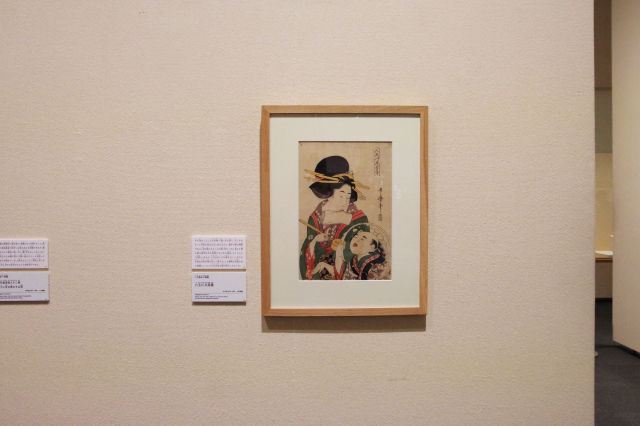
The second generation Kitagawa Kayo "Rokutamagawa Tsuki Ink" culture period (1804-18)
What is drawn in this work is a child with a somewhat suspicious movement next to a woman who comes out of the coffin and washes her hands. It is a childish work that lifts the ice that has been put in the water bath and stirs it with licking. What is used for this part of the ice is a technique called mica scrub .
It seems that in the past, it used to be more glittery than ever, with techniques such as dispersing mica powder and mixing it into paints to produce ice glitter with mica slides. Although it is difficult to see due to deterioration etc., please check your technique closely by looking carefully!
An elegant play tool is like a work of art
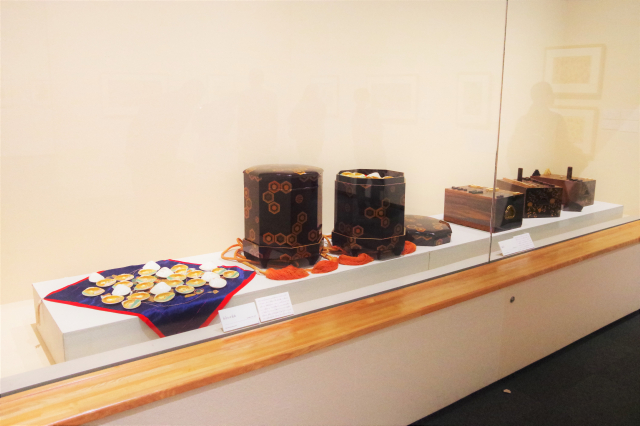
In the Edo period, shellfish combination is like a modern game of trump cards in the modern day, in which a shell and a pair of shells are turned upside down. On the inside of the shell, which is a gift for wedding ceremony, is a refined and elegant painting. On the other hand, Sugoroku has a picture soroku and a board soroku, and when a player who put all the black and white stones used as pieces into the other position wins the board, the game of so-called backgammon is a highly competitive game. is.
I have been able to see for a while the beauty of the real combination of shellfish and board doubles that exist in very good condition.
Children's love for heroes has never changed
.jpg)
Utagawa Kuniyoshi "Sakata Kidomaru" Hiroaki 2-3 years (1845-46)
Speaking of one of the heroes of the Ukiyo-e world, Kintaro is Sakata Kidomaru. Like modern-day men who are admired by ◯◯ riders and ◯◯ mans, may Kai Domaru also be the target of the year ’s boys' yearnings?
Speaking of Kuniyoshi Utagawa who played an active part at the end of the Edo period, he drew many works with a sense of humor that would have been involuntarily uttered, and seems to be popular among children and adults with flexible ideas and rich expressiveness.
When it became such a famous painter, there were many families where parents bought ukiyo-e for their children. In the late Edo period, a small-sized (33 cm x 15 cm) actor's picture, which is a small size of Ukiyo-e paper, was sold for about 160 yen, and about 60 to 120 yen when its popularity dropped. Also, it seems that there were a lot of ukiyo-e made in small size to make it easy to buy from the beginning, and that the economic and leeway to buy pictures came out to the common people, which is a feature of the time of Kuniyoshi But it is said to be.
In addition, in "Kintaro three brothers conspiracy", "Kintaro three brothers, two sons" and "Kintaro three brothers, sueko" (all are Koiwa circa 1801-04) which Kitagawa Kagura drew with three pieces, The eldest son is solid, the second son is dexterous, and the third son is depicted with the sweethearts and their respective characters. There may have been parents in the Edo period who put their children on such works and narrowed their eyes.
By the way, there is no story that Kintaro is a three brother, and it is a complete song original plan. It is said that it is not known that it is a very unique three-piece set, and it is not known to have three pieces in all but the Kudomo Ukiyoe Museum. valuable!
Origin of plastic model? ! Three-dimensional Ukiyo-e "Tachiban-ko" in the Edo Period
.jpg)
Ichibayashi Saishige "Saiko Kaigumi" Kanaga 6 years (1853)
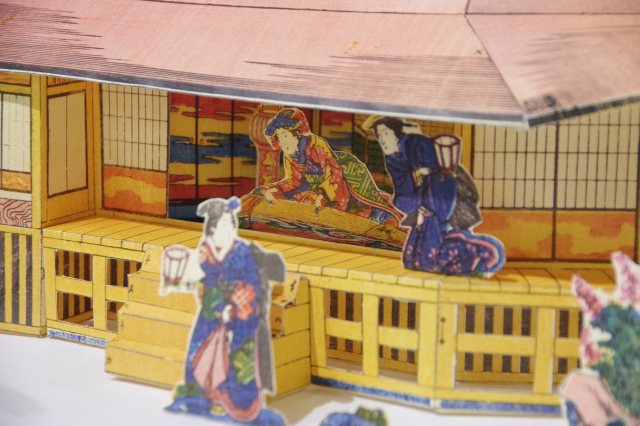
"Tatebanko" is one of the toy pictures, also known as "set up", and it is made by cutting out many parts from a piece of paper on which the design is printed. Nowadays, are they like plastic models or figures?
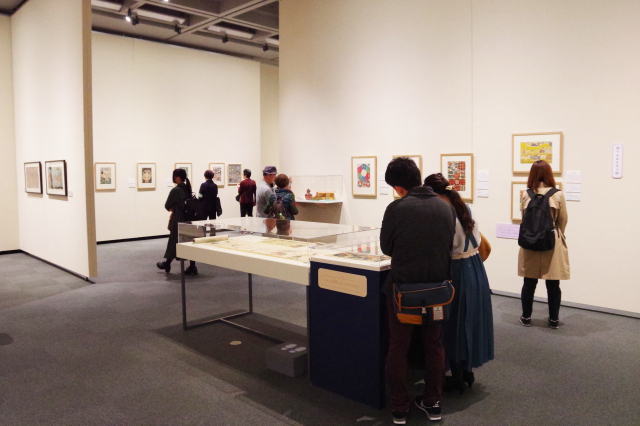
Old Tachiban displayed in the case (photograph back)
The curators printed the original version of this exhibit and actually assembled it, so something interesting happened. The parts of the ax are "two for the right arm, two for the left arm" but when I cut it out, it was "three for the right arm, one for the left arm"! The children at the time also had to build up, and it might have become “sorry ....” That was an imaginable event as well.
Do not miss a workroom where you can actually experience the old Tachiban
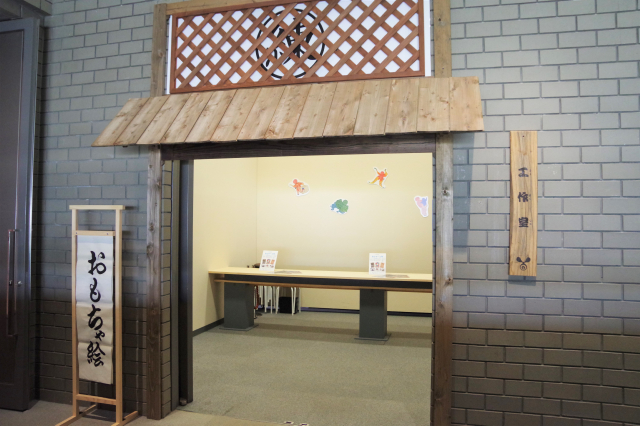
When you go around the exhibition and enter the last Terakoya style room, there are three types of work rooms where you can play in the old days. In the workroom, you can choose from three types of "painting picture", "wind mill", and "Yamato newspaper (small box)", and you can actually assemble and play.
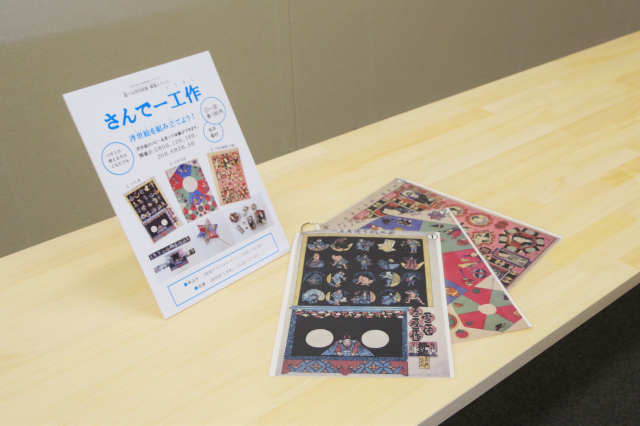
It seems to be fun to experience assembly while imagining that "Edo children are also addicted to detailed work?" "It's difficult alone, and in the end it would have been helped by my father." (※ This is an event on Sunday only as "Sande-Craft". A ticket is required for one of the exhibition rooms, so you can buy one for 100 yen and make it at the counter of the workroom. Children can participate if they can use it.)
Kazuya web interviews with Murasaki Fujisawa teacher of supervision
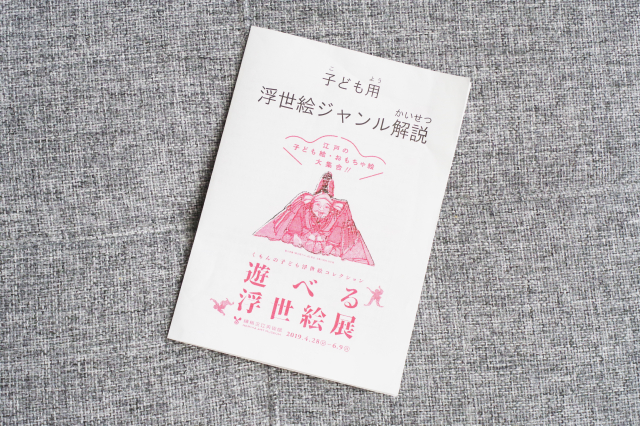
The “Ukiyoe for Children genre commentary” distributed at the exhibition carefully explains the colors of Ukiyoe and is easy for adults to understand!
We asked Dr. Murasaki Fujisawa, who was supervised at the gallery talk on the first day of the exhibition.
-I thought that Ukiyo-e was a little difficult, but I could see the exhibition as very interesting and interesting.
Fuji In this exhibition, I made the first prologue for those who came to Ukiyo-e for the first time. It's like an "invitation letter" to let you know that Ukiyo-e is like this. And the keyword "play" in the name of the exhibition, this is an adult who once was a child by all means to return to the child, I want you to feel that today's children are no different from toys to play normally, I put the phrase "play" from the thought.
Ukiyo-e is an art representing Japan, and it is widely known that many people in the world are actually interested. However, it does not become out of reach just because it became famous, but rather than saying art, I would like you to experience Ukiyo-e as a part of your life.
-It was impressive that the people being watched were looking at the smiling and looking children in the picture.
I would like you to pay attention to the variety of expressions of children drawn on Fuji Ukiyoe. For example, some Ukiyo-e children are really pretty, and some have suspicious eyes and so on. But that surreal is good again. I want you to enjoy it with an image that looks like cartoons. Also, of course, the old version of Tachiban etc., of course, was perfect when it was assembled, but it seems that it could not be sold unless it was attractive as a "one picture". Basically, Ukiyo-e is also a business, so the seriousness of that area is similar to the current publishing world, isn't it?
安政(1854-60)頃-1.jpg)
Utagawa Yoshito "new construction wind depression" (part) Ansei (1854-60) around
Fuji because of that small number of things and ukiyo-e there are fans all over the world, There is also a fact that the expensive price is attached. However, the attraction of Ukiyo-e is not something that is expensive, but it is interesting because it is rather commonplace. I would like to share the height of the design and the fun and fun with people of various generations.
Ukiyoe is a genre that is highly recognized by those who can read the Japanese-style web site, but it is good to look closely alone, or you may invite family members and friends to come together. I would like to see many people. Please do not hesitate to look at your shoulders and feel the "Edo's Esprit" in it.
Don't miss the collaborative exhibitions of nearby facilities
Ishigami Park The Furusato Culture Hall
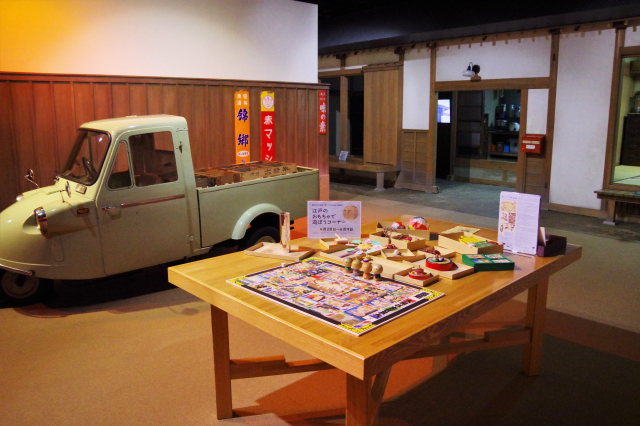
A hometown culture hall where you can enjoy the time-slip feeling at a permanent exhibition
A collaborative exhibition is also held at the Ukiyoe Exhibition. You can also experience the toy play of the Edo period at the play experience corner of the permanent exhibition room entitled “Let's play with toys in Edo” at “Kuishiya Shikujii park Furusato Cultural Museum” in the same Nerima Ward.
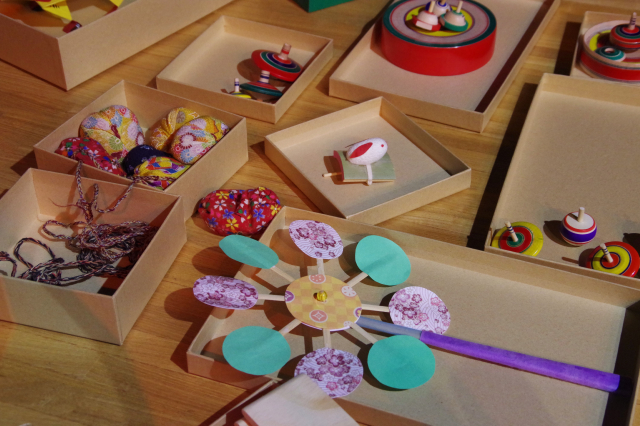
Also, during the period, "Let's make and play toys in Edo" will also be held. If you actually experience or make toys that children can get in ukiyo-e, you may deepen the sense of closeness to ukiyo-e.
[Nerima district Ishigami park oldness and culture hall]
5-12-16 Ishigami Town, Nerima-ku, Tokyo
Nerima Ward Standing Library
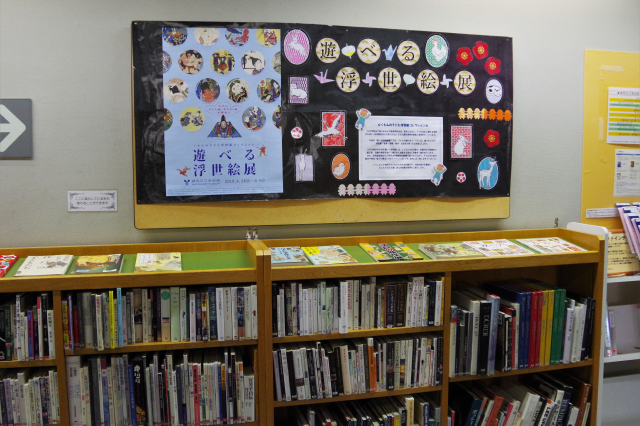
Signs of the corner are handmade by the library staff!
The Nerima Art Museum, which holds an exhibition, is a complex facility that integrates with the city's Nukui Library. The first floor is a library, and the second and third floors are museums. The Nukui Library is a library attached to an art museum and has a very rich collection of art-related materials, and a collection of books related to exhibitions and pictorial sections around exhibitions held so far Special corner will be set up.
Of course, this "playable Ukiyo-e exhibition corner" will also appear! Books on toys and pictures of children in the Edo period were arranged.
[Nerima Ward Standing Well Library]
1-36-16 Nukii, Nerima Ward, Tokyo (with Nerima Art Museum)
Ukiyoe makes people interested in Edo life and people
The prologue exhibition, which teaches the tools and processes of the production, was an interesting exhibition that made it easy for even beginners of Ukiyo-e to understand "Iroha". After going through a daunting process, I know the depths of Ukiyo-e in places that require high technology, and I can understand why people from all over the world are fascinated.
In addition, the children of the Edo period painted on Ukiyo-e were able to find lots of things in common with the children in the form of enjoying, studying, and mischiefing play. Looking at the parents' eyes, the parents of this time also loved the children in the same way as they did today, and it was possible to convey how they watched warmly, bringing the Ukiyoe world closer to the Edo period life and people I feel like that.
【Exhibition Information】
【Kumon Children Ukiyo-e Collection “Playable Ukiyo-e Exhibition”
Venue: Nerima Art Museum
Date: April 28 (Sun)-June 9 (Sun), 2019
Opening hours: 10: 00-18: 00 (until 17:30)
Closed days: Monday * However, April 29 (Mon./Congratulations)-May 6 (Mon./Walkings) will be open, May 7 (Tues.) will be closed
【Kumon Children Ukiyoe Museum】
Sentence / photo / Kamura Kimura

A native of the Iga region, where both Kansai and Chubu cultures are intermingled. Australia reaffirmed Japan's good life as a one-year wandering life. Actively relying on wide and shallow knowledge. Even if they become demons for their children, they are also called demons by their children, who hate two boys. Favorite things are tools, patterns, coffee, pudding, late-night radio.