Depicting the Sacred Peak of Mount Fuji in Ink Wash Painting: Line and Negative Space Techniques
Culture
2026.08.08
Depicting the Sacred Peak of Mount Fuji in Ink Wash Painting: Line and Negative Space Techniques
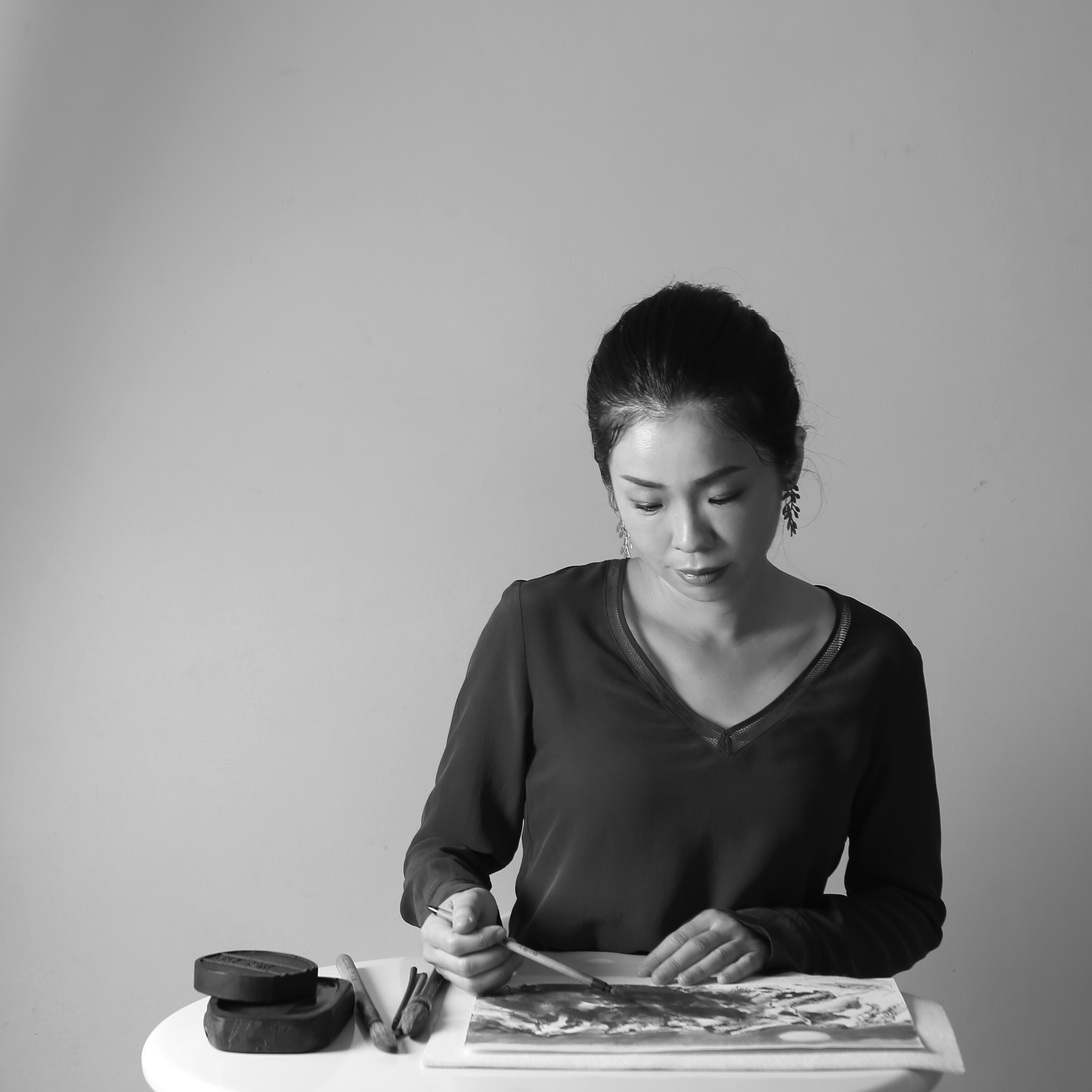
Unlike oil painting, where layers of pigment can hide a line, in suibokuga—the traditional art of ink wash painting—the fleeting second the brush sweeps across the paper is etched into the artwork forever. In this series, we present footage focusing on the hands of the suibokuga artist Samejima Tamayo (鮫島圭代), which feels just like a live performance. Please observe the unhesitating, swift brushwork, and the bleeding and blurring woven by ink and water. We invite you to see the ‘expressions of ink’ born from the intention of that specific moment and nature.
*Pressing the ▷ in the centre of the image will play the video.
*Please be mindful of the volume as music will play.
I wonder if you would be surprised to hear that the muscles of the upper arms are necessary when drawing suibokuga. This is because, in order to control the thickness and strength of the brush lines, it is necessary to keep your arm suspended in the air, hold the brush lightly, and move it nimbly over the washi paper. Particularly when depicting the shape of a mountain with lines, an exquisite adjustment of strength is required.
On the other hand, when representing the shape of a mountain by leaving the area unpainted in white, controlling the moisture content is crucial. If the brush contains too much moisture in the ink, it will bleed and spread, and conversely, if it is too little, it will scratch, making the brush lines unnaturally conspicuous.
The former technique is known as sengaki (line drawing), while the latter is called nukigaki (negative space drawing).
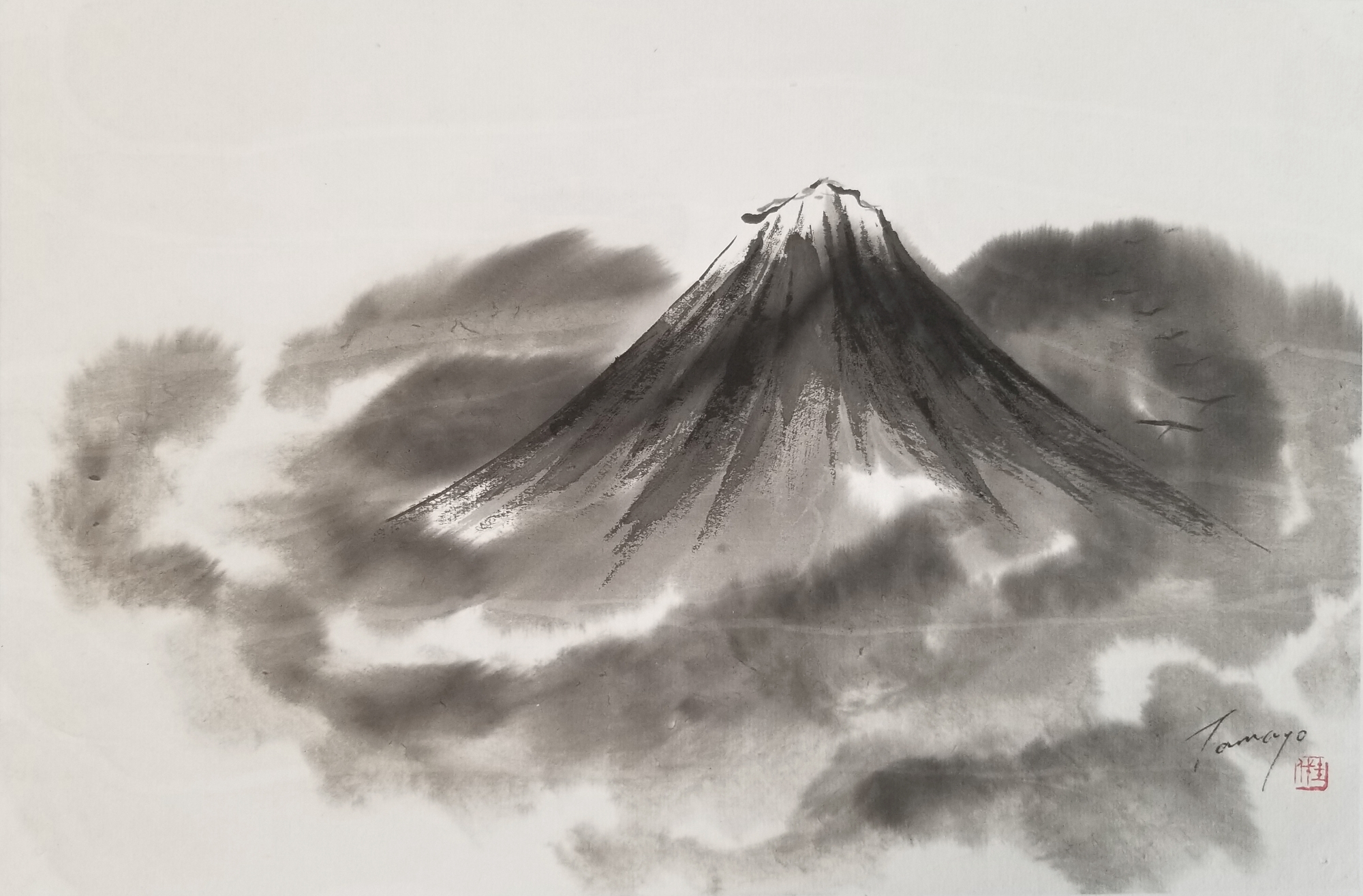
Samejima Tamayo ‘Fujisan ni Kari‘ (富士山に雁) Ink on paper 2025
In the tradition of Oriental painting, there is a concept known as ‘sha-i’ (写意), painting the essence. This is a concept contrasted with ‘sha-jitsu’ (写実)—which directly copies the shape of the subject—and rather than accurately depicting the visible shape, it attempts to express the essence and atmosphere the object possesses, as well as the artist’s thoughts and state of mind within the painting.
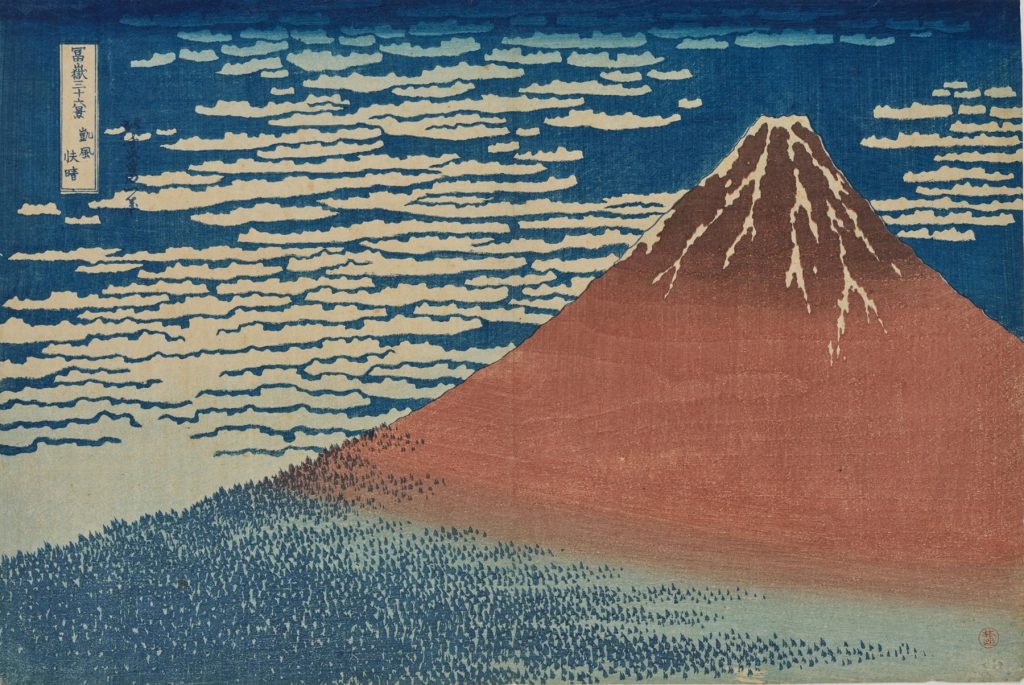
Let us compare the Mount Fuji in the nishikie (錦絵) series ‘Fugaku Sanjurokkei‘ (冨嶽三十六景) by the late Edo period ukiyoe (浮世絵) artist Katsushika Hokusai (葛飾北斎) with a photograph of the actual Mount Fuji. It is said that during the Edo period, Mount Fuji was clearly visible from the town of Edo, but Hokusai goes beyond the visible shape, depicting the figure of the sacred mountain held in his heart. This is precisely “shai”.
Katsushika Hokusai ‘Fugaku Sanjurokkei Gaifu Kaisei‘ (冨嶽三十六景 凱風快晴) Edo period, 19th century Tokyo Kokuritsu Hakubutsukan (東京国立博物館) Source: ColBase (https://colbase.nich.go.jp)
Photograph of Fujisan: Adobe Stock free material
It is a figure that towers majestically and nobly, as if piercing the clouds.
Since ancient times, Japanese people have looked up at this unique and majestic appearance—reaching an altitude of 3,776 metres and possessing long, gentle foothills—been struck by its beauty, and yearned for it. At the same time, they have felt awe towards the threat of great nature that occasionally erupts, worshipped it, and relied on it as a spiritual support. It is also known as one of the Seven Holy Mountains of the World, and has become a symbol of Japan for people overseas as well.
Countless waka (和歌) poems and paintings have been themed around Fuji, and the ‘Manyoshu‘ (万葉集)—Japan’s oldest existing anthology of waka poetry, said to have been compiled as far back as the end of the Nara period—also contains many waka poems composing about Fuji. This poem, which composes the figure of the snow embracing the summit that towers high into the sky, is one of them.
Tagonoura yu uchi idete mireba mashiro ni zo Fuji no takane ni yuki wa furikeru
( 田子の浦ゆうち出でて見れば 真白にぞ富士の高嶺に雪は降りける)
When I step out on the shore of Tago and look look out, the lofty peak of Fuji is pure white with falling snow
Yamabe no Sukune Akahito (山部宿禰赤人)
‘Manyoshu‘ Volume 3, 317
Korin, Kiitsu, Shohaku — Each Respective Sacred Mountain
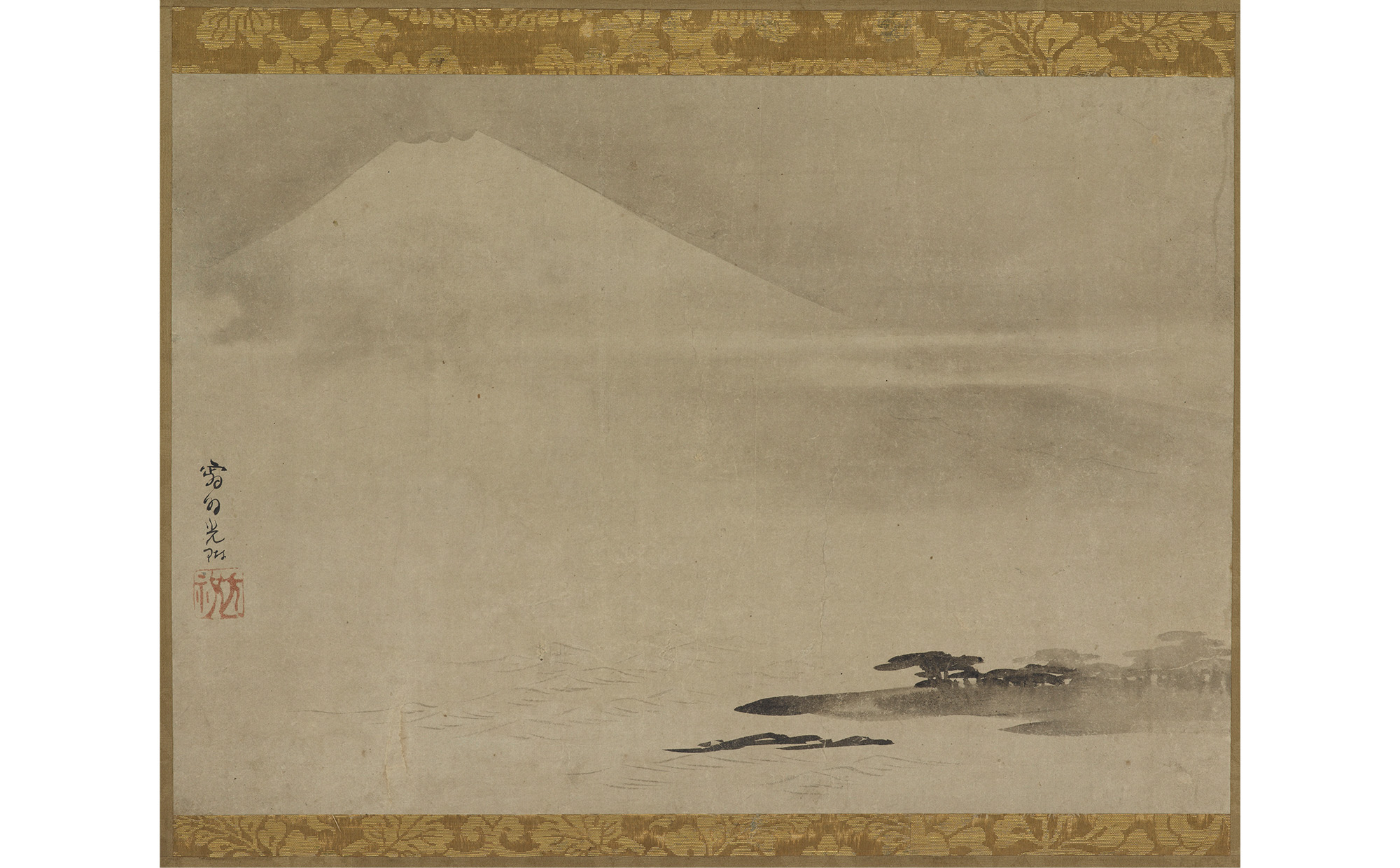
Ogata Korin ‘Fuji Miho no Matsubara zu‘ (富士三保松原図) Late 17th–18th century Ink on paper Smithsonian National Museum of Asian Art Creative Commons
Let us appreciate masterpieces of suibokuga from the Edo period that depict Mount Fuji.
First is the ‘Fuji Miho no Matsubara zu‘, attributed to Ogata Korin (尾形光琳), an artist of the Rinpa (琳派) school who fused decorative patterns with painterly expressions.
Perhaps this is the view from Nihondaira (日本平) in Shizuoka (静岡). Using nukigaki, Korin nimbly expresses the breathtakingly white, majestic figure of Fuji, and portrays its majestic appearance with the clouds trailing at its foot, the small depiction of Miho no Matsubara (三保松原), and the ripples of Surugawan (駿河湾).
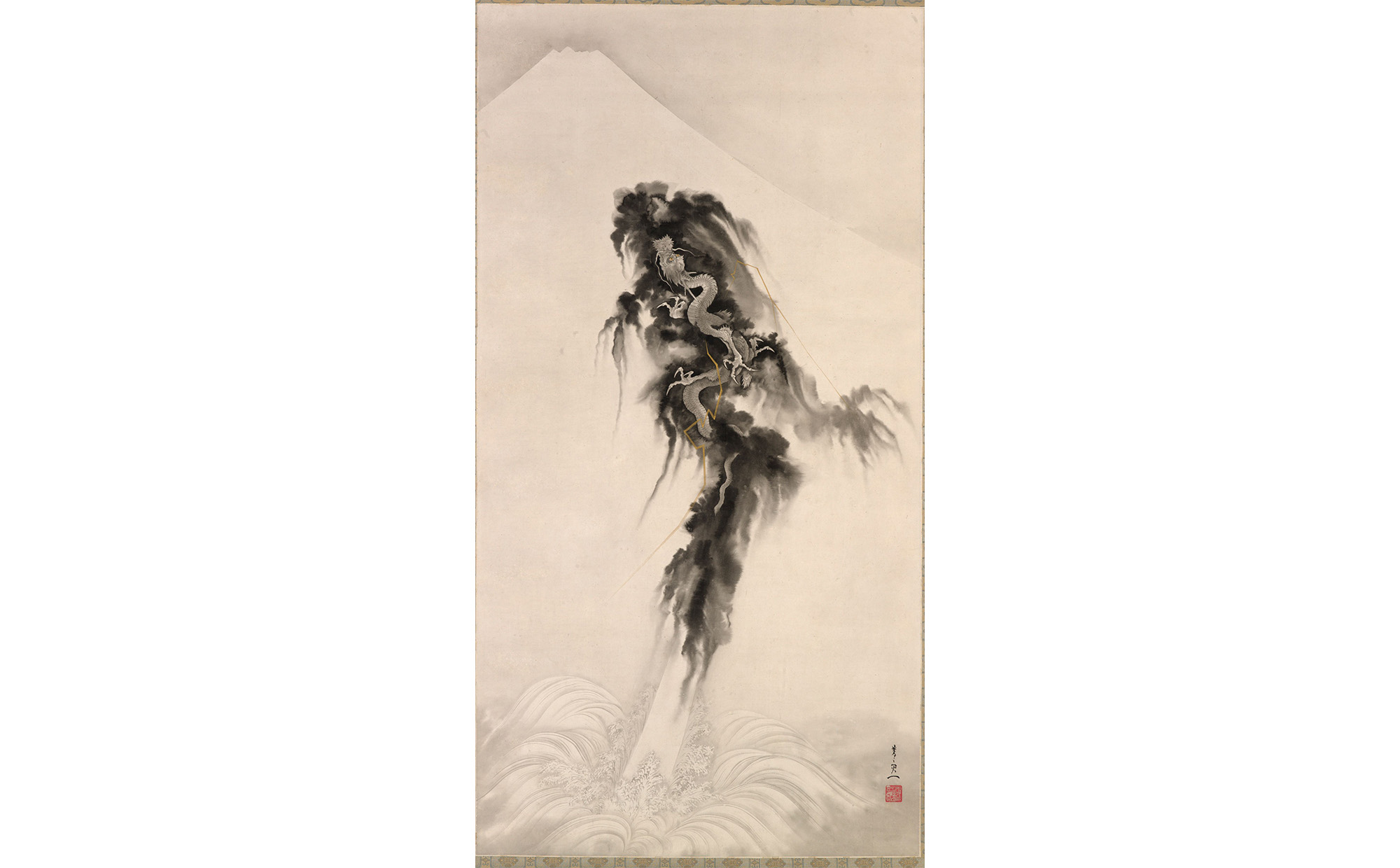
Suzuki Kiitsu ‘Fujikoshiryuzu’ 1800–1865 Ink and gold on paper Indianapolis Museum of Art (Newfields) Public Domain
The ‘Fujikoshiryuzu‘, attributed to Suzuki Kiitsu (鈴木其一), a late Edo period artist who succeeded the Rinpa lineage, is also a mountain figure (sanyo 山容) depicted through nukigaki.
The combination of Fujisan and a dragon was considered an auspicious painting subject during the Edo period, meaning “to sever misfortune”, by rewriting ‘Fuji’ (富士) as ‘fuji’ (不時 – unexpected misfortune) and ‘ryu’ (龍) as ‘tatsu’ (断つ – to sever). Many artists worked on this theme. Many of you are probably familiar with the ‘Fujikoshiryuzu‘ (富士越龍図) painted in ink by Hokusai in his final years.
Rising from the rough seas, a dragon ascends to the heavens where Fuji towers, clad in dark clouds. Powerful energy and a refined sense of design coexist, and a single streak of lightning pierces through the deep black ink.
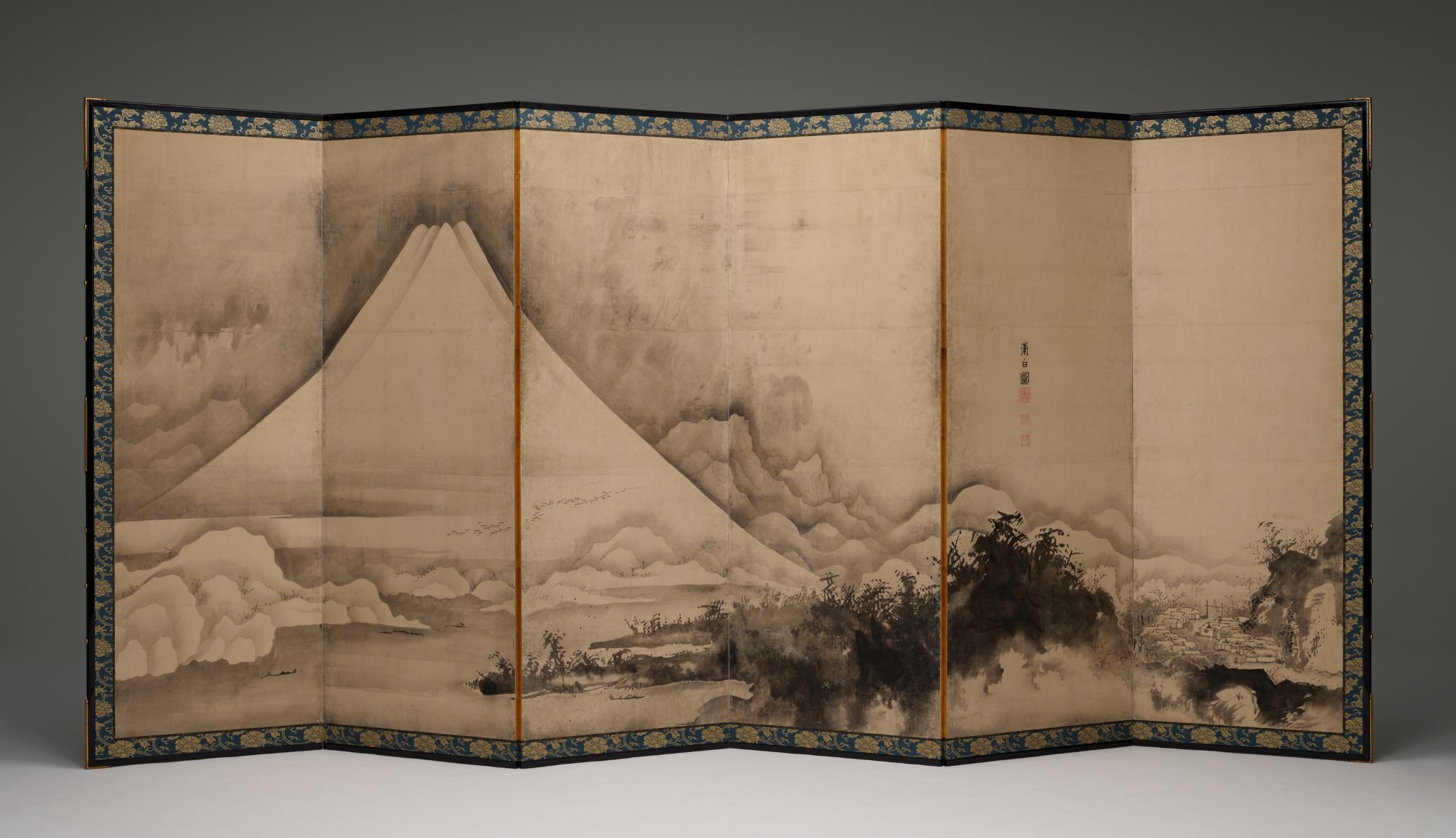
Soga Shohaku ‘Fuji Miho no Matsubara zu Byobu‘ (富士三保松原図屏風) Circa 1761–1762 Light colour and ink on paper Art Institute of Chicago Public Domain
Finally, speaking of intense impact, let us introduce the ‘Fuji Miho no Matsubara zu Byobu‘, attributed to this person, Soga Shohaku (曾我蕭白).
It is a majestic yet ominous figure of Fuji, as if it has descended upon a land of another world. The painting subject is the same as Korin’s painting earlier, but you will likely shudder at the eccentricity that makes it hard to believe so. Having lost his parents and older brother in his teens, and having continued to hold his paintbrush while wandering from place to place in the countryside over many years, is this the figure of Fuji that Shohaku held in his heart?
Many of you may have also recalled Shohaku’s ‘Fuji Mihozu Byobu‘ (富士三保図屏風) (MIHO MUSEUM, Shiga (滋賀) Prefecture), which depicts a similar figure of Fuji, Miho no Matsubara, and a large rainbow spanning the sky.
Fuji Up Close
Greeting the opening of the mountain season again this year, Mount Fuji is bustling with many climbers. Its appearance changes depending on the direction from which it is viewed. This summer, by all means, I would like to go out and gaze once again at that figure, which many painters depicted with yearning and awe.
Image Credits
Header image: Samejima Tamayo ‘Fujisan ni Kari‘ Ink on paper 2025