













When you were given the benefits of civilization's tools, or when you struggled with the life of the information society, have you ever wondered, "What did the old man do?" For example, how was the Edo period before the modernization?
From April 6, 2019, at the Shibuya Ward Matsushima Museum of Art (Shibuya, Tokyo), the planning exhibition "Women, Women, Women-Women's Life in Ukiyo-e" is being held. In this exhibition, we will explore the lifestyles of women who lived in the Edo period, focusing on Ukiyo-e. The venue consists of 10 chapters, and in addition to Ukiyo-e, the work, fashion, beauty, and sexual life of women in the Edo period are also covered by a number of historical materials such as kimono, accessories, and makeup tools.
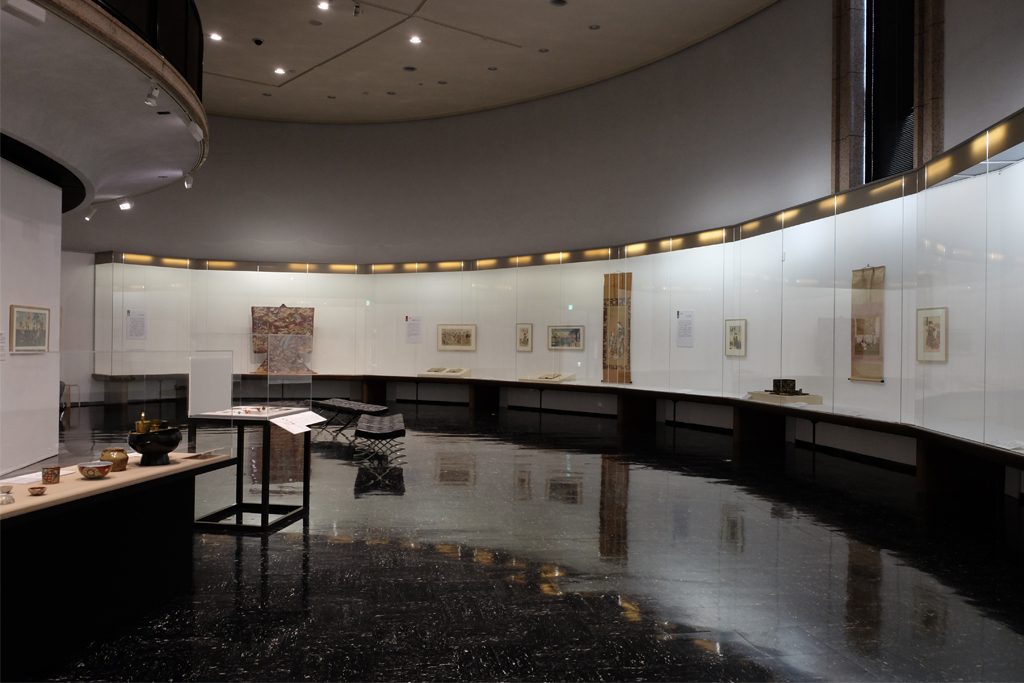
A scene from the "Woman, Onna, Onna-Woman living in Ukiyo-e" exhibition at the Shibuya Museum of Art. An exhibition space that draws a curve organically connects the themes of each chapter.
The exhibition is a full-fledged exhibition that introduces the figures of women in the Edo period, but at the beginning of the exhibition, it is determined that the contents of the exhibition are not the full picture of women's life at the time. That's because most of the Ukiyo-e that we see is the "goods" that was distributed at that time. The women depicted there are the subject of prizes, beautified, adapted, and ineffective information has been erased. It is important to keep in mind that many Ukiyo-e are fiction (even when you're covering an actual person, place, or case).
However, women who are vividly drawn in ukiyo-e shake our hearts today. And this exhibition will show us to the viewer what the essence of reality can be seen in such a beautiful woman painted in Ukiyo-e .
It is recommended that you visit the hall as it is an exhibition of complete works, but here we would like to select a few points from the exhibition works and focus on how Ukiyoe paints women think.
Are you smart? Objection to "no need to educate women"!
Kitagawa Erika (1753? -1806) 's “Lesson to Parent's Eyeglasses (Glasses)” is a series of beauty paintings depicting a variety of women, such as women with poor spirits, women with miracles, and women with mihaha. Ten figures have been confirmed, and women are depicted in situations where there is a smell of life, such as sleeping or getting drunk. The sentences written in the picture are mainly those that criticize women in a body where parents preach. (If you read it so far, it is a Ukiyoe you don't feel very well, but please be patient.)
And this time, it is adopted as the main visual of the exhibition, and it is displayed at the Matsushima Museum of Art (previous year exhibition: 4 / 6-5 / 1) is here, one figure of the series "Riguru (person)" ".
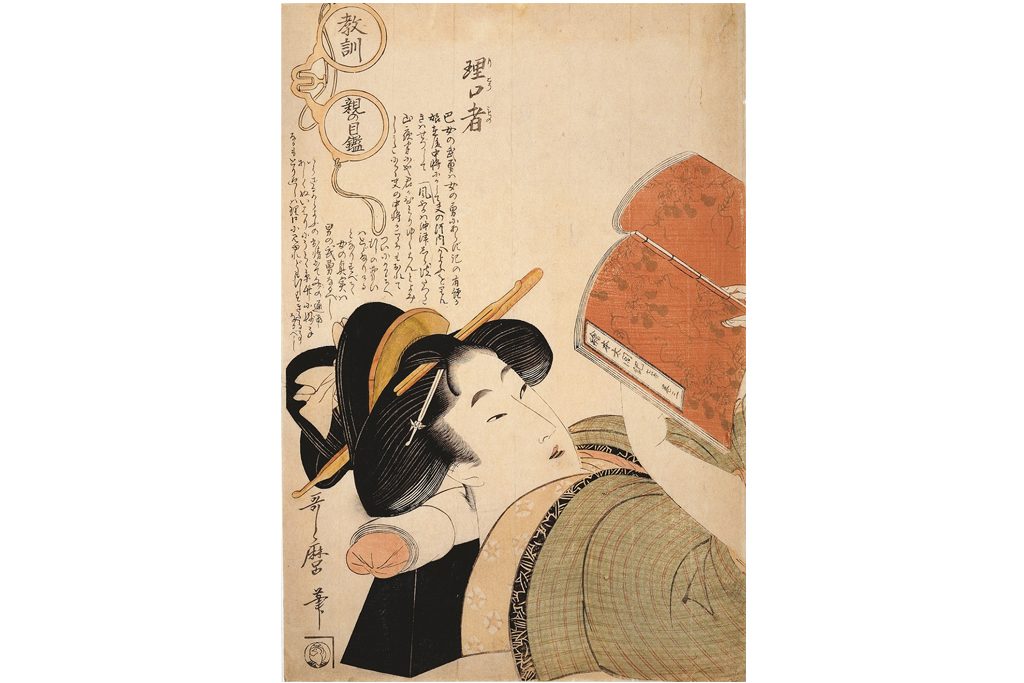 Kitakawa Kayo "Lecturebook of Lessons for Parents" 19th Century Tokyo Metropolitan Edo-Tokyo Museum 1st Half (4 / 6-5 / 1) Exhibition
Why must we be criticized for being "smart"? What is drawn is a woman who is lying down and reads a book that says "Picture Book Dakariki". From the sentences in the picture, I can see the idea that women should do housework rather than get educated. It is a rather outdated value now, but I think that at the time, such ideas were pervading society.
However, contrary to such a critical purpose, the drawn woman is very beautiful and fashionable. A kimono that has a lantern that juts out in a flexible manner, a black comb with a pair of bekko combs with shiny black hair, and a two-color grid running on a greenish ground Kurosusu, the neck seen at the neck, is probably the fashioned Arimatsu aperture at that time. The symbol on the front cover of the booklet, the Kikyo Komeji from Kuroko, is reminiscent of Hideyoshi Toyotomi and Akechi Mitsuhide, who are characters of "Daikoki".
It is a beautiful woman, has a sense of fashion, has education, and so on ... its purpose and visual contradict each other. And, as a guess, it may not have been the intention of this Ukiyo-e publication.
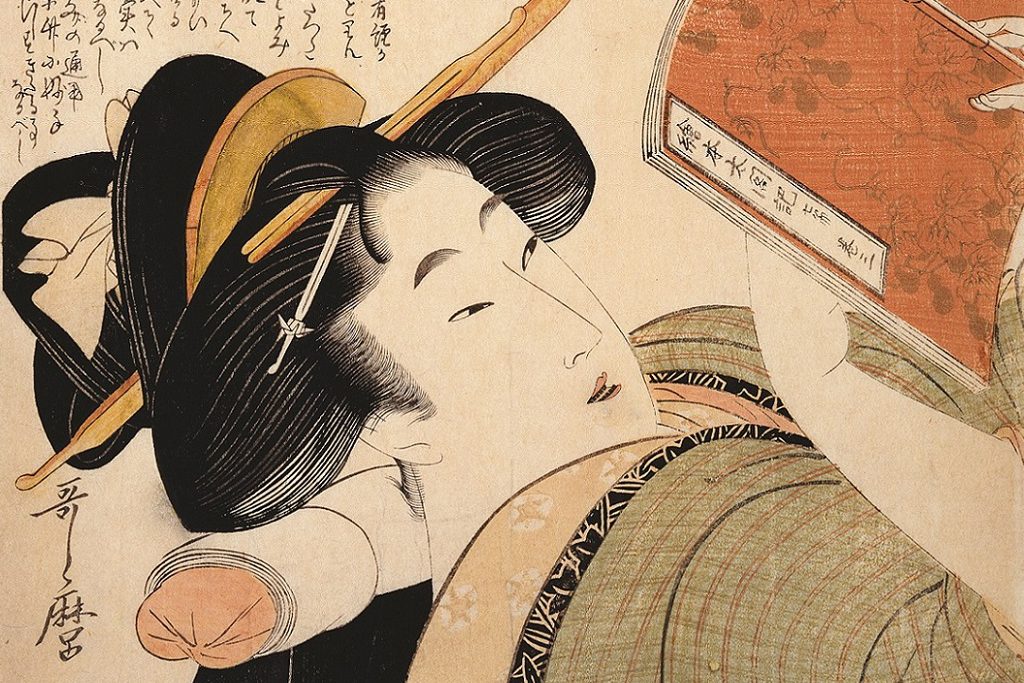
Kitagawa Kayo "Lessons of Lessons for Parents" (Part Figure) The atmosphere in which a woman is reading a book while excited is transmitted.
If you replace the setting of "Climbed to fall asleep and read" Picture Book Daikoki "" with a sense of modernity, do you feel like "a useless girl reading manga on the bed?" If you write like this, of course, "What's wrong with reading manga completely?" "I don't care what I read, but what kind of clothes do I read?" "Who did the housework decide the woman's work?" I think there are readers who think that the typology of their eyes will come from above.
Perhaps I imagine that something relatively close to the antipathy that was born here was more or less at that time. Then, "No, I would like a woman who reads this kind of" Picture Book ", and there should be a layer to buy this beautiful picture. Again, Ukiyoe is a product. Even if there is no market that can be expected, neither the publisher (Edo period publisher) nor the "Damnish woman" will be serialized in 10 figures. There were a certain number of both men and women who had doubts (albeit somewhat different from the modern idea of women's liberation), or bored people, against the old-fashioned values such as "Woman should have been" Is not it?
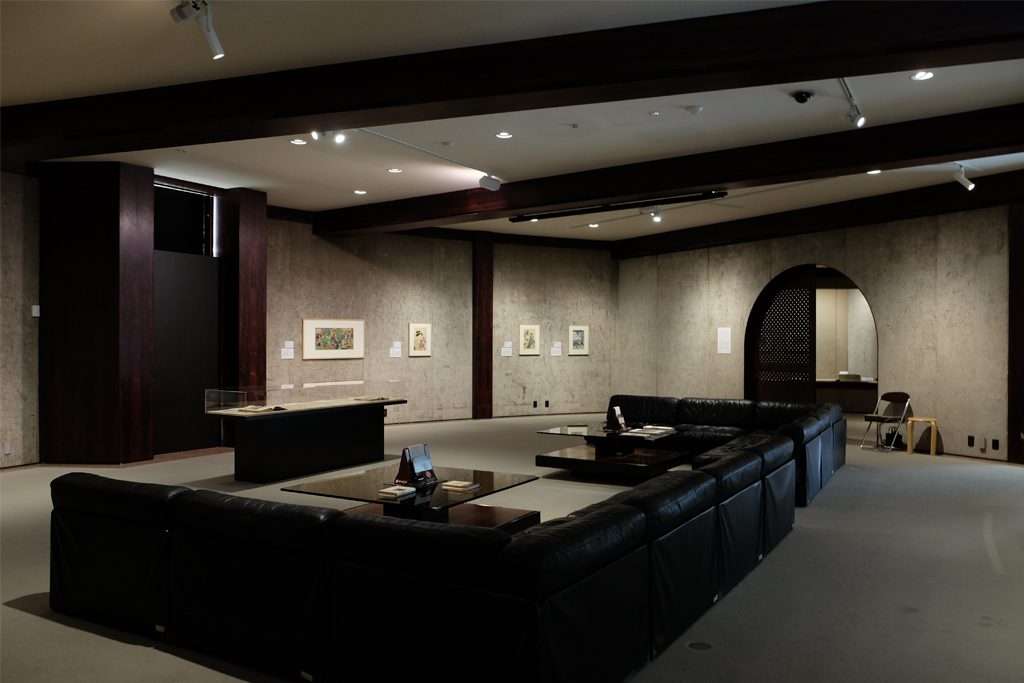
Matsushima Museum of Art designed by Yuichi Shirai. The second floor exhibition room has a relaxed and relaxed atmosphere, and can interact with works one by one.
The filter of the society such as "Woman's education is not necessary" and "Drunken woman is vulgar" is entitled "Parents eye glasses (glasses)", and in the irony of lovablely drawn "Poor", we simply I think that you must read and understand the "woman image" and "woman view" of those days that can not be grouped together. I think that is a difficult thing, but at the same time, it is also possible to discover various gender bias (social and cultural sexism) and people's feelings in the Ukiyo-e.
By the way, "Taiko-no-kimono" recorded in the life of Dazai, that is, Toyotomi Hideyoshi, is the story of the hero of the old government. This became popular with Joruri and Kabuki (like this picture, I think that the wife who got hooked with housework sorely actually was), and the authorities who felt a sense of crisis made a decision on regulation. "Ehon picture book daikonki" was banned, and for the syllabary, it is sentenced to the sentence of Ukiyoe which made Toyotomi Hideyoshi the subject, and to receive a punishment of the hand chain 50 days. Knowing such background, this one figure is more and more interesting. If you read "Wakasu web" like this, it will become a considerable "reasonable person", so please be careful.
But after all Ukiyoe is a man's dream
And, although I admired an illustration of a beautiful painting of a song from the viewpoint of the concept, the consumer may not have had much to do with the painter's or the printmaker's speculation. If the idol of a beginning gravure is lovely, consumers will buy what kind of magazine the magazine is. The important thing is the image and the impact.
In that sense, I would like to have a look at the 7th chapter of the exhibition, “Labor – Work” (previous year exhibition: 4 / 6-5 / 1) This work. (It's a song again.)
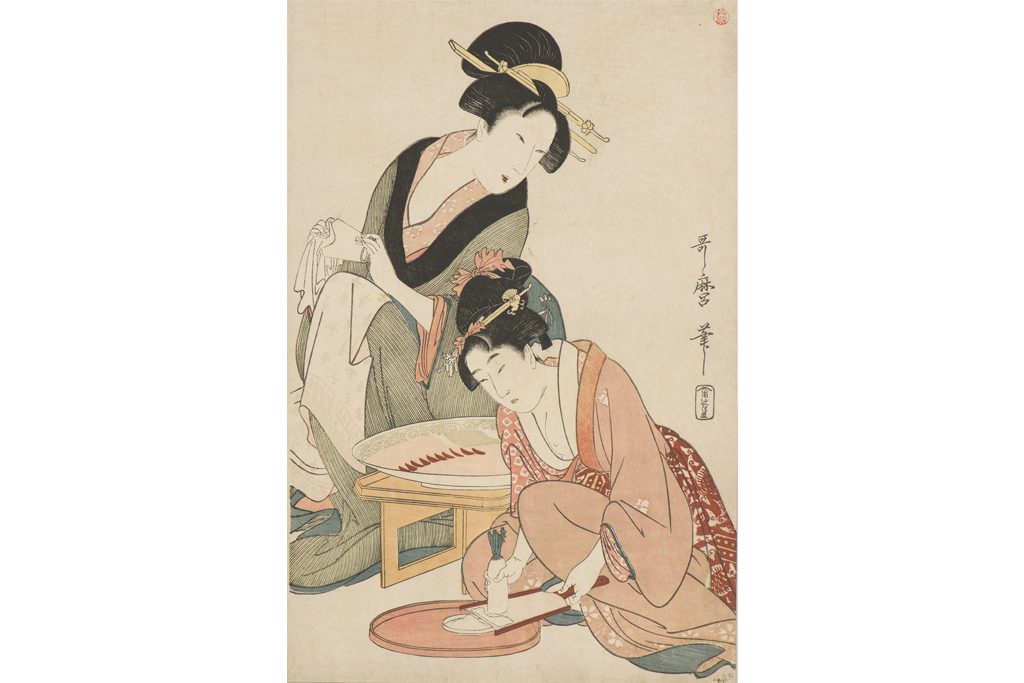
Kitakawa Kayo "Making Mother and Daughter Cooking" 18th Century Kanagawa Prefectural Museum of History 1st Half (4 / 6-5 / 1) Exhibition
It is probably a wealthy family or an act in a restaurant, inferred from the splendid platter of cypress arabesque and the beautifully arranged sashimi. A girl who looks pretty like going to another side takes off one skin and has radishes down enough to make a chest.
Yes, that's right. It is unnatural as a situation. There is not much sense of realism in the kitchen. (By the way, speaking of daikon radish is a side dish of grilled fish, but since daikon radish was a staple in sashimi during the Edo period, that point is natural.)
Kayo draws many figures of working women in her Ukiyo-e throughout her life. The women there are very energetic, moving their heads with a towel on their heads. The quiet screen of this work is clearly alienated compared to those works that seem to feel even the smell of breath and sweat.
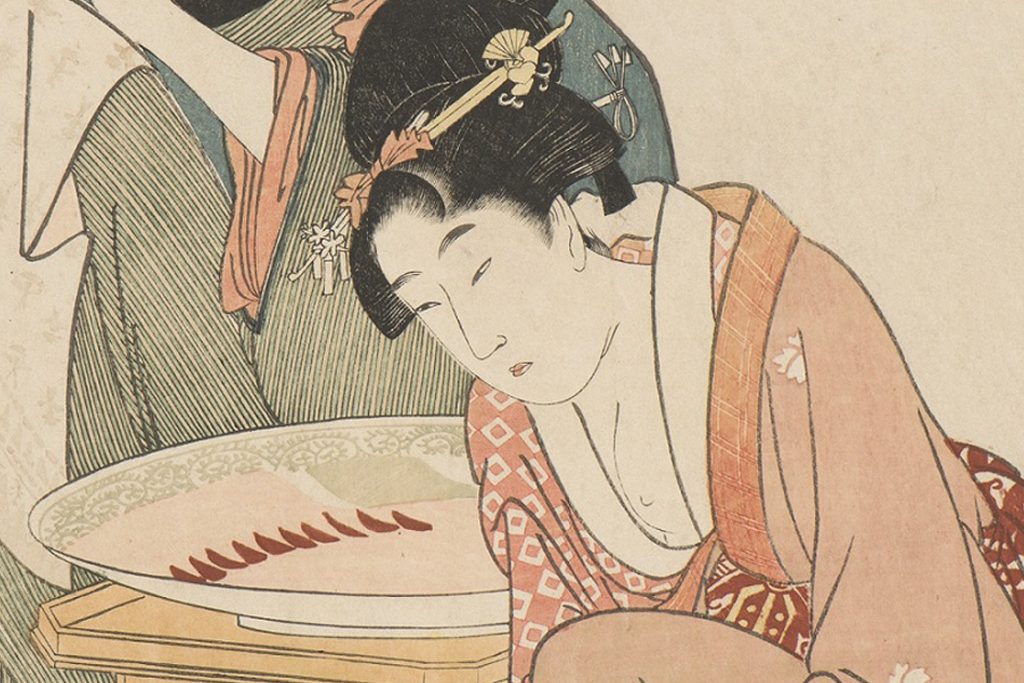
Kitagawa Kayo "Making mother and daughter to cook" (partial view) A very good-looking lady who grew up. Did there ever be a model?
I think that this work is a work that responds straightly to the desire of many men to "clean family" and the desire "I want to see Porori". Storyliness and reality are secondary. Props such as "sashimi" and "daikon radish" would have been reminiscent of the girl's translucent white-skinned image. Or maybe there was a pretty girl with a reputation at some of the restaurant at that time.
The beauty of working women was also "consumed" by the public as a major premise in Ukiyo-e. However, this work that seems to have drawn the aspirations of people, motives aside, I think that it is the result of the appearance of color in the figure of a working woman who has many songs. While drawing carefully the contrast between two women of different ages, the entire screen is very elegant and cool.
A graceful composition that arranges the heads of two people on a vertical line passing through the center of the screen, and draws the character of "people" greatly with the two bodies. In addition, the edge line of the kimono flowing on the screen is sharpened by the arc of the plate, the tray, and the straight line of the platform. The color scheme of kimono is unsurprisingly different in various textures of subjects such as women's skin, kimono, porcelain and lacquer basin, sashimi and daikon radish, and so on, and it is amazing that the woodcut is wonderfully expressed is.
In order to simply say that the erotic elements have been consumed, the perfection as a single picture is very high. As a result, we can find beauty that can not be consumed. Since this work has been scraped in different colors, it is probably popular and reprinted.
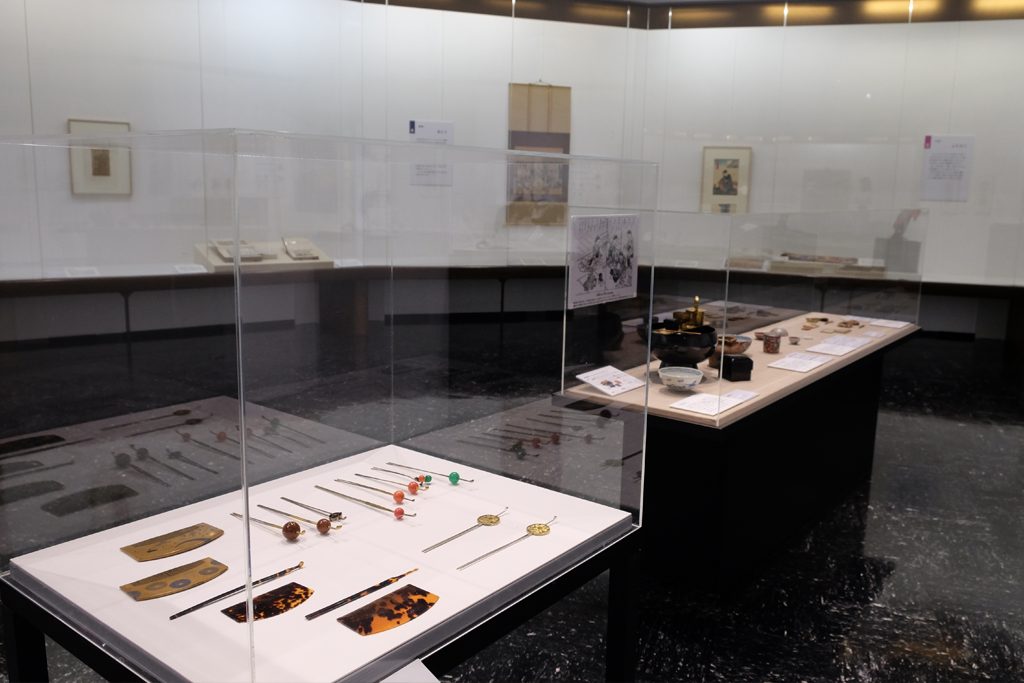
The exhibition hall also displays accessories such as combs and kanzaza, and cosmetic tools used to put on your teeth black and red.
The "Wa-Win" wa is a laugh! Edo's spring paintings of masculine and tolerance
The last chapter of the exhibition, Chapter 10 is "Color Love-Fun." Harumaki are exhibited in this corner (Parents under 18 must be accompanied by a guardian). For the title of this last chapter, it was originally suggested that there was a "secret". However, " Women who are expressed in Harukan not only follow men in love but also enjoy the same sex as their counterparts, and are often depicted as being loose and open " ("Woman, Onna, Onna-Ukiyoe From the "life of the woman who sees in" exhibition official catalogs, it seems to be "fun".
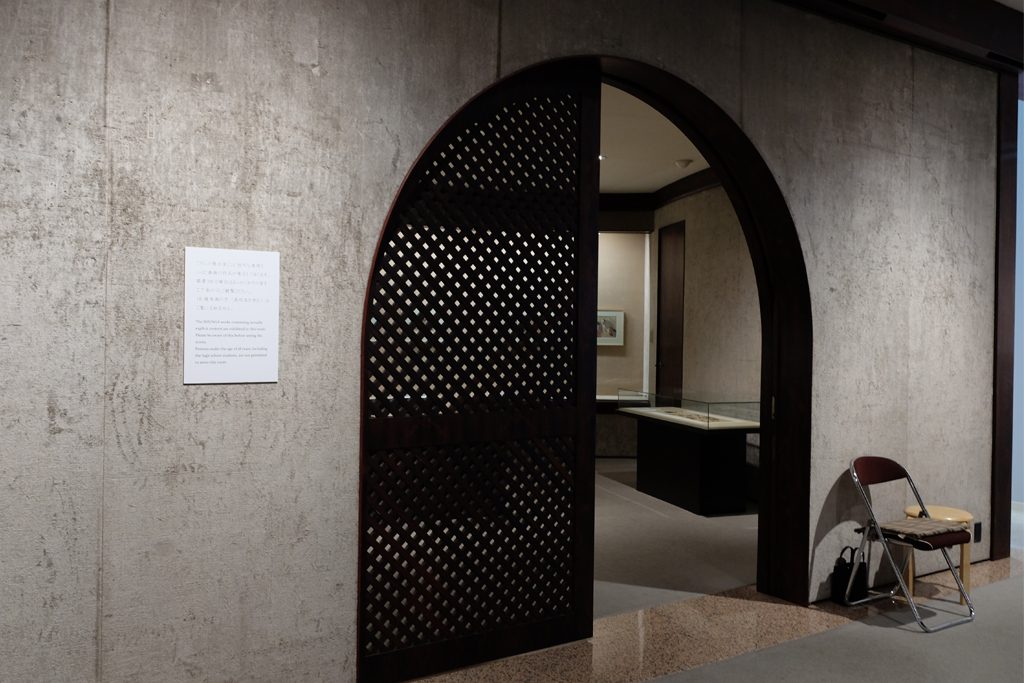
Chapter 10 of the "Woman, Onna, Onna-A Woman's Life in Ukiyo-e" Exhibition is in this room. Is this door the entrance to adults? (Parents under 18 must be accompanied by a guardian)
Recently I almost stopped hearing, but in the Showa generations, there are still people who call adult books "Wa-jiru". This stems from the fact that Haru-ga is called "laughing" and is a secret word used for nearly 150 years (or longer?). As Harukaga was an unofficial censorship publication, it seems that words have become muddy before the public.
However, as it is called "laughing picture", there is also a view that laughter is linked to Edo's sexual expression, and it may not have been as sloppy as it is nowadays. They smile at the sweet exchanges of men and women, sometimes wry up with their bitter memories, laugh at voices over extreme exaggerations and impossible situations. It can be said that in the Edo period, the content of sexually collectable content was broad.
In Chapter 10 of the "Woman, Onna, Woman's Life in Ukiyo-e" Exhibition, Suzuki Harunobu (1725?-70), Torii Seicho (1752-1815), Katsushika Hokusai (1760-1849), Utagawa Kunio Introducing the spring paintings of Ukiyo-e painters of different era and style different from the first generation 1786 – 1864) and Kensai Kawanabe (1831 – 89). The two people depicted (though not always) are really different in age, status and relationship. The breadth of variation is also the breadth of the audience.
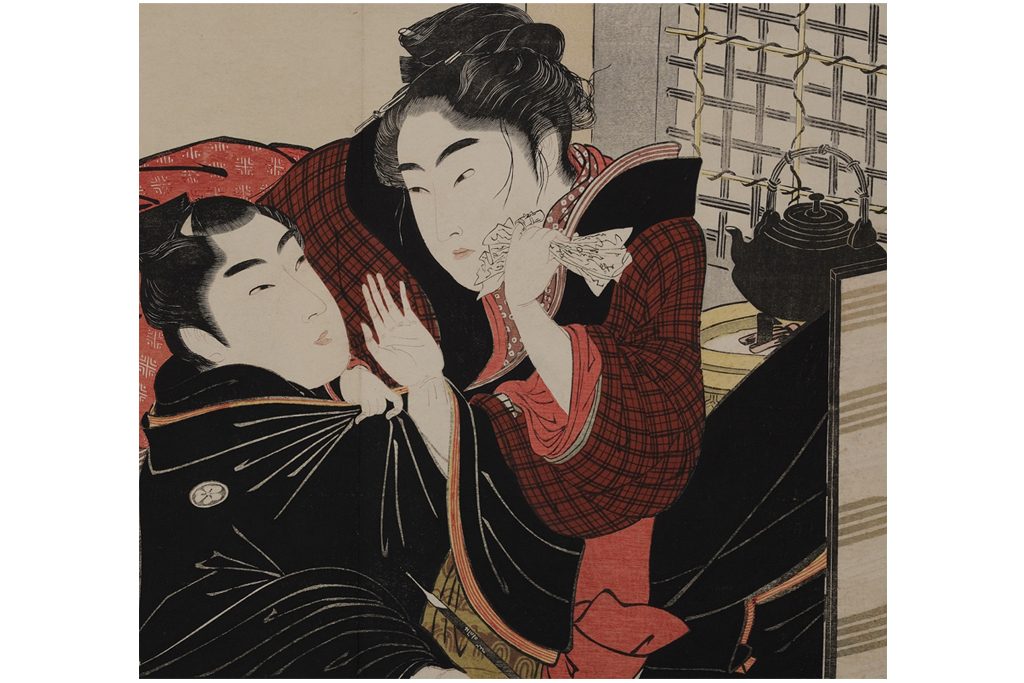
Kitagawa Kayo "Uta Makura" (part) 1788 Mana Urakami Phase B (4 / 24-5 / 9) Exhibition A men's and women's place where suspicion of cheating appeared. Although it may be said that it is a spring painting, this may be a little laughable.
It may be somewhat misleading, but in the case of Haruma, a kind of laughter like "man is really stupid-(lol)" is a men's brutal laughter and a woman's tolerant laughter It seems to be made up of laughing from both sides. This spirit that wraps up the sex of people who don't give up with laughter may be familiar with Edo Rakugo etc.
In fact, I think women were facing various difficulties in a world where there were more social differences than today. Also in the love of color love, social pressure may have been applied, or it could have been exposed to dangerous situations from the viewpoint of medical hygiene. Even so, the Edo people call "the blue world" "Ukiyoe", and both sex troubles and apologies also get rid of "laughs". So we are attracted to the brilliance of those who have lived as "women".
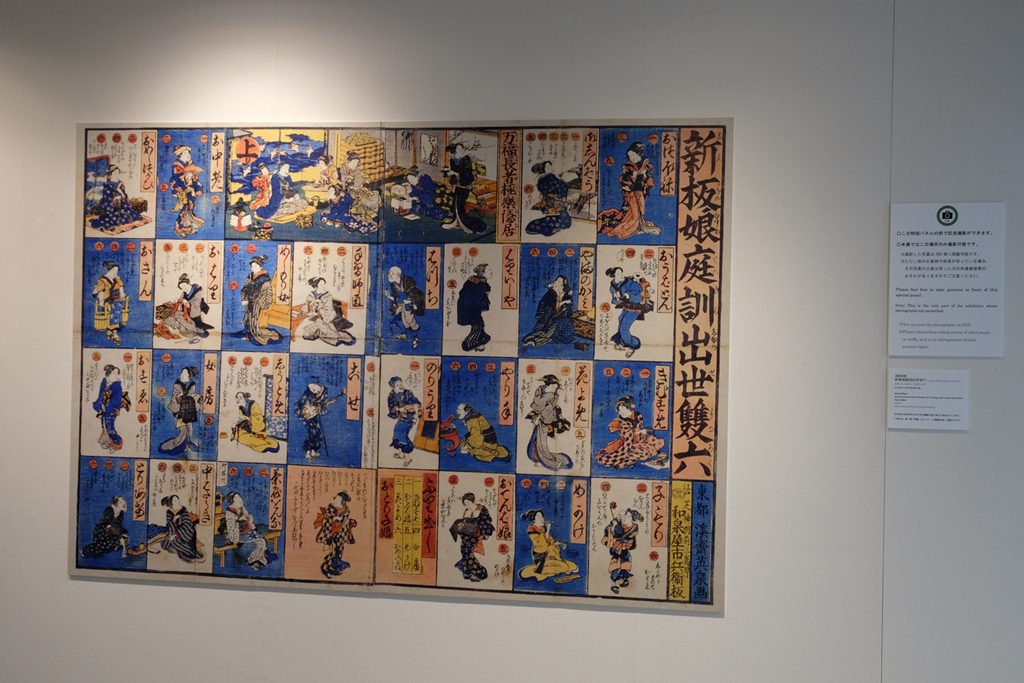
Edo period women's version life game raised in the shooting possible area. Don't get lost in money surrounded by children and grandchildren The goal of a happy life in old age?
"Woman, Onna, Onna-Woman's Life in Ukiyo-e" Exhibition Information
Through the dreaming device of Ukiyo-e, we, nowadays, can now touch one of the realities of such a woman in the Edo period. And from there you will surely be able to receive universal human positive power over time.
It is an exhibition that contains many messages that many people want to see. "Woman, Onna, Onna-A woman's living in Ukiyo-e" is until May 26 (display changes during the show). Gallery talks and workshops will also be held by curators during the show. Check out the event information on the museum's official site, and go out by all means.
◆ A woman, a girl, a woman ~ A living society of a woman who sees in Ukiyoe April 6-May 26, 2019 Venue Shibuya Ward Matsushima Museum of Art Museum (2-14-14 Matsushima, Shibuya-ku, Tokyo)
Closed on Monday (but open on April 29th and May 6th), April 23rd, May 2nd and 7th, from 10:00 to 18:00 (30 minutes before closing) * Friday Until 20:00
Official site
Shooting / Matsuzaki Miyu
I want to read together
What's Shun-ga [Thorough commentary] It is true that both Hokusai and Hakushin were drawn.