












A "butterfly" that dramatically transforms from a larva to a pupa and into a splendid appearance. It has fascinated people all over the world since ancient times as a symbol of "resurrection" and "immortality". Even in Japanese art, the auspicious motif "butterfly" was taken up in crafts such as lacquer work and the subject of paintings such as the Rinpa school, and was indispensable.
[Series] Japanese Art and High Jewelery A Beautiful Miracle Encounter 4th Van Cleef & Arpels
On the other hand, in the West, the "butterfly" motif is said to bring "luck". France's top jeweler "Van Cleef & Arpels" has long been making jewelry with a "butterfly" motif. With the cooperation of the Freer Gallery of Art in the United States, which is touted as the world's number one Japanese art hall of fame, the high jewelry is a masterpiece of Suzuki Kiitsu, a genius who has been receiving a lot of attention as a painter of the Edo Rinpa school in recent years. And "a miracle encounter".
The traditional "butterfly" motif is novel in contrast to the design
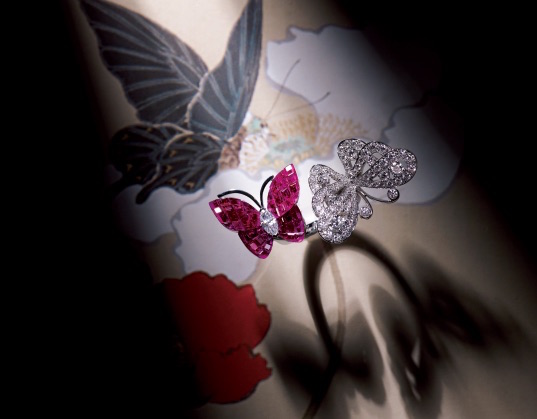 "Flying Butterfly Entrere Door Ring" [Ruby total 4.21ct x Diamond total 1.83ct x WG x RG] Reference price ¥ 26,600,000 (Van Cleef & Arpels) WG in the text stands for white gold, RG stands for red gold, and ct stands for carat. Masu
The "butterfly", which is often depicted with flowers in Edo period paintings, is a symbol of "luck" in the West, and it is one of the traditional motifs for "Van Cleef & Arpels". The ring in which two kinds of butterflies dance dare to contrast different designs to express the diverse beauty of butterflies. The crimson butterfly is made by making full use of advanced jewelery technology called "mystery set" where the claws of the stone clasp cannot be seen.
Light and dynamic asymmetrical design
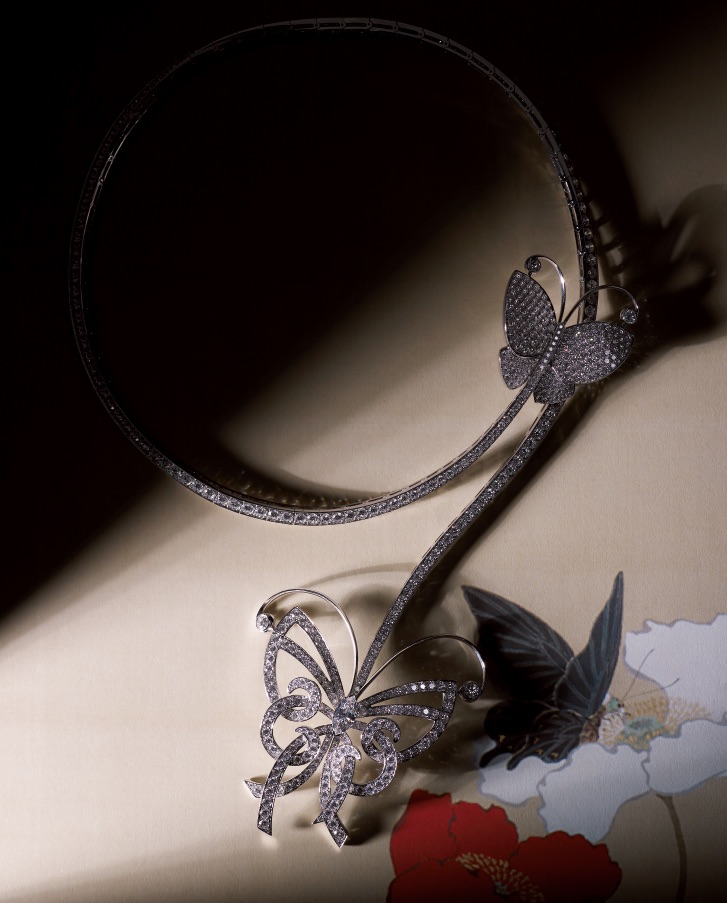 "Flying Butterfly Necklace" [Diamond total 27.58ct x WG] Reference price ¥ 52,500,000 (Van Cleef & Arpels)
A necklace that is a modern sublimation of the asymmetrical style that inherits the tradition of French jewelry. Despite its simple design, the innovative composition accentuates the magnificent "butterfly" motif. It is reminiscent of the butterflies drawn by Suzuki Kiitsu, who was called a genius for his outstanding descriptive power and color sense among Rinpa painters.
Shine that is particular about the slight difference in pursuit of the beauty of nature
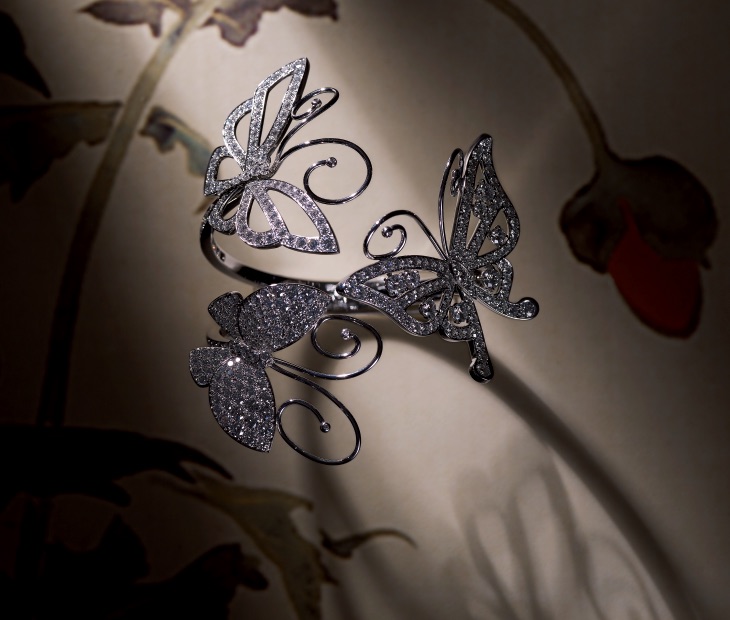 "Flying butterfly bracelet" [Diamond total 11.53ct x WG] Reference price ¥ 17,100,000 (Van Cleef & Arpels)
The bracelet, in which "butterflies" fly around even the smallest differences, is unique to "Van Cleef & Arpels", which has continued to make jewelry inspired by the flora and fauna of nature. The brilliance of its attention to detail perfectly corresponds to the world of the Japanese art style "Rinpa", which is good at reconstructing and designing rather than simply copying nature.
The beauty of fantastic and elaborate work woven by the beautiful brilliance
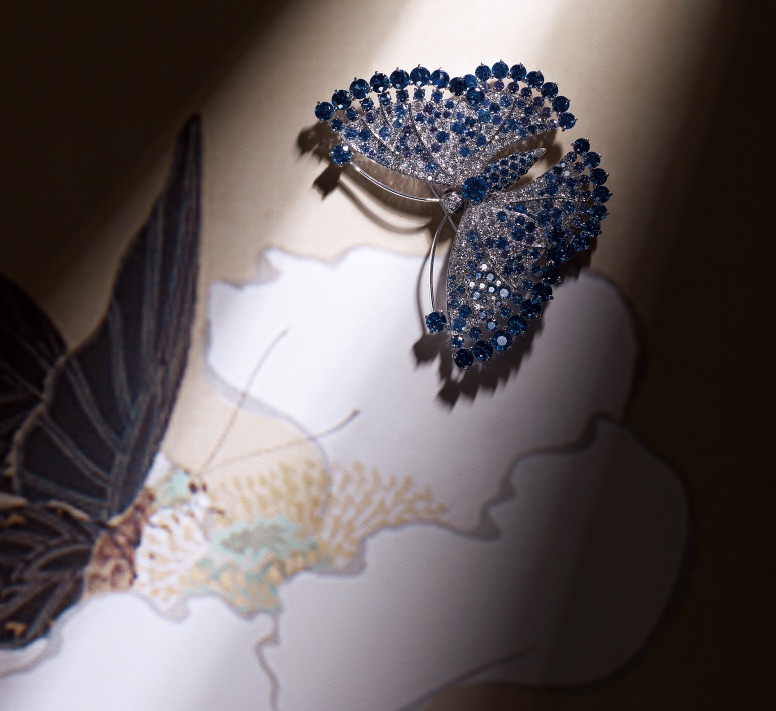 "Doris Butterfly Clip" [Sapphire total 17.07ct x Diamond total 3.00ct x WG] Price undecided (Van Cleef & Arpels)
"Kuroagehacho", which brings reality and vitality to a quiet flower pattern, is a motif drawn by the genius painter Suzuki Kiitsu. A clip (brooch) with a "butterfly" motif that is as good as its mysterious beauty is one of the jewelery that can be said to be the true value of "Van Cleef & Arpels". Sapphire and diamonds with delicate setting technology give off a delicate shine like lace.
◆ Van Cleef & Arpels official website
The mysterious "butterfly" that fascinates both the Rinpa genius and the prestigious jeweler in Paris
"Butterflies" have inspired Japanese art painters and top European jewelers. Its existence continues to fascinate the world.
Butterflies that fly around the world and connect even different cultures across the east and west of the ocean
Suzuki Kiitsu, a genius painter who has been attracting attention in recent years for his descriptive power, novel composition, and color sense that can be said to be unique in the history of Japanese art.
The first is a painter born in Edo in 1796 (Kansei 8) at the end of the Edo period, and became a disciple of Sakai Hoitsu, the founder of the Edo Rinpa school, but it is said that his style changed completely after his death. .. While retaining the characteristics of the Rinpa school, such as the technique of brewing, the vivid colors and the overly bold composition have kept the name of the genius as desired. The genius is unfortunately demonstrated in the "Tsubaki-zu Ryofu" in the Freer Gallery of Art and the "Natsuaki Keiryu-zu-Byobu" in the Nezu Museum.
On the other hand, this "Butterfly Poppy Figure" is a typical Rinpa school in the first work, such as drawing the leaves with the technique of squeezing leaves. However, it can be said that the fact that the poppy, a flower that is not popular as the subject of Edo period paintings, is selected is one of them.
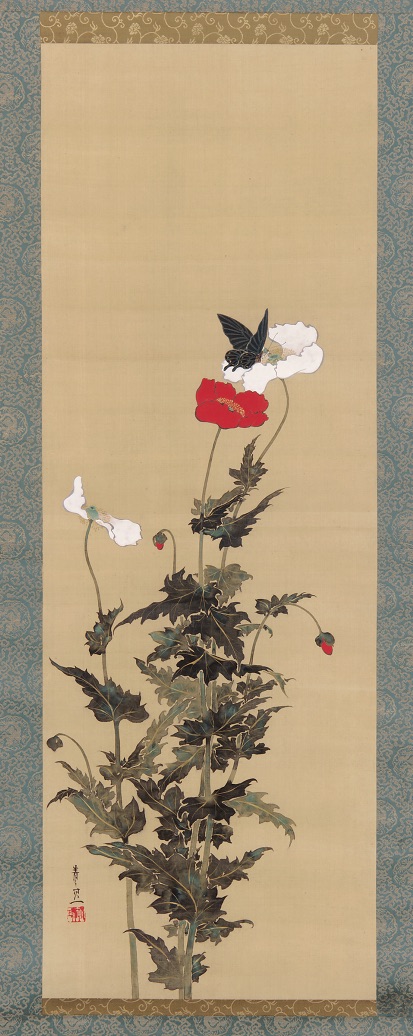
Maruyama Okyo, the founder of the realist school, drew a "hundred butterfly figure" in which butterflies danced all over, and Sakai Hoitsu drew butterflies with lustrous flowers such as peony. Speaking of the first, the black fried feathers are used as "butterflies and cherry blossoms" and "butterflies and peony", and one of the masterpieces, "spring and autumn plants and trees," is a pretty crested white butterfly. I'm drawing a crest yellow butterfly.
The butterfly, which means "regeneration and resurrection" and has fascinated the world with its mysterious beauty, was an inspiration for top brands as well. The long-established jeweler "Van Cleef & Arpels", founded in 1906, is no exception. In 2004, he created the "Papillon = Butterfly" collection using Japanese lacquer art and attracted attention.
What is the Freer Gallery of Art? Freer and Rinpa masterpieces ──. Encounter guided by that fate
Charles Lang Freer, the founder of the Freer Gallery of Art, first visited Japan in 1895 at the recommendation of his friend painter James McNeill Whistler. There, I came into contact with the works of Kenzan Ogata from early on, and in the process of collecting them, I encountered many works of the Rinpa school. Among them were many valuable masterpieces such as Tawaraya Sotatsu's "Matsushima Zuhoufu" and "Unryuzubyobu", which are said to have been national treasures in Japan.
The Rinpa genre is special to the museum, which boasts the world's largest collection of Japanese art, because the story of the encounter between the founder and the Rinpa has been handed down to this day. ..
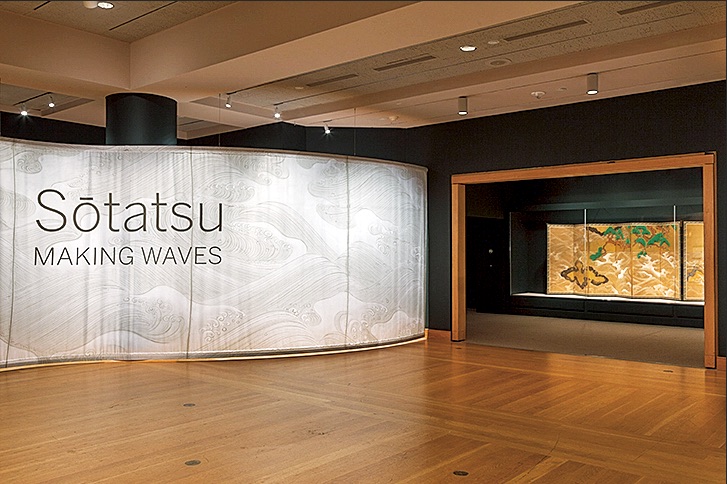
In 2015, the "Soutatsu" exhibition was held to showcase the museum's precious collection, which attracted the attention of the US media. The museum was also the first museum to comprehensively introduce Tawaraya Sotatsu to the Western world.
◆ Freer Gallery of Art Address: 1050 Independence Ave SW, Washington, DC 20560, USA
Official site
-From the August / September 2018 issue of Waku- * All product prices are as of the time of publication and are subject to change. Notation is the main unit (excluding tax) price.
* The listed products may not be available for purchase at this time.
Sentence / Ryoko Fukuda (Gem-A FGA)
Cooperation / Freer Gallery of Art photography / Mitsuya Karasawa