






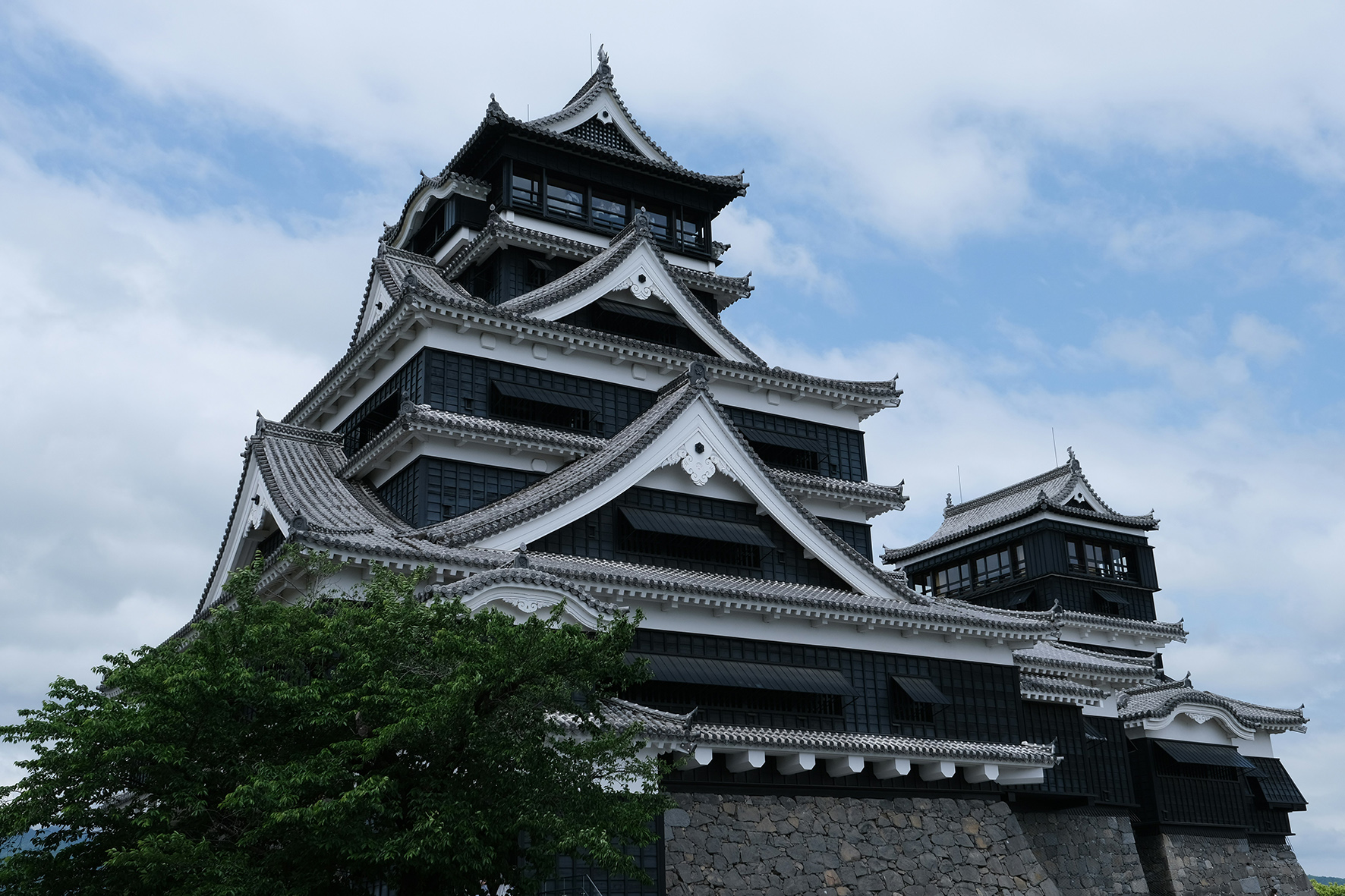
The history of Kumamotojo
Kumamotojo was completed around 1607 by Kato Kiyomasa (加藤清正), a military commander renowned as a master castle builder. Its robust structure, hailed as impregnable, was the culmination of Kiyomasa’s outstanding castle-building techniques; it was subsequently passed down to the Hosokawake (細川家), the later lords of the Kumamoto domain, and remained a crucial stronghold in Kyushu (九州) throughout the Edo period.
During the Seinan Senso (西南戦争) in 1877, it suffered immense damage, with many buildings, including the castle keep, being destroyed by fire. However, the keep was reconstructed with reinforced concrete in 1960. As there are many ginkgo trees within the castle grounds, it is also known by the affectionate nickname of Ginnanjo (銀杏城), and it continues to be loved as the symbol of Kumamoto.
In April 2016, the Kumamoto earthquakes occurred, bringing devastating damage to the castle keep, turrets, and stone walls. All 33 buildings, including 13 Nationally Designated Important Cultural Properties, were damaged, and approximately 30% of the stone wall sections suffered collapses or bulging, meaning that the restoration would require many years and an enormous amount of labour.
The Choice for “Restoration on Display”
At Kumamotojo, rather than restricting entry until the restoration is completely finished, a policy of “Restoration on Display”—opening the construction process itself to the public—has been adopted. This was a decision made to deepen understanding of the restoration of Kumamotojo, which is both a regional identity and a tourism resource, whilst continuing to promote its charm.
The restoration of the castle keep was completed in 2021, and the interior is now open to the public as a space that fuses the latest seismic technology with historical exhibitions. From the observation floor on the top level, a breathtaking view stretching across the streets of Kumamoto City to Asosan (阿蘇山) unfolds. By using the AR function of a smartphone application, you can also enjoy superimposing old photographs from the Meiji era onto the present scenery.
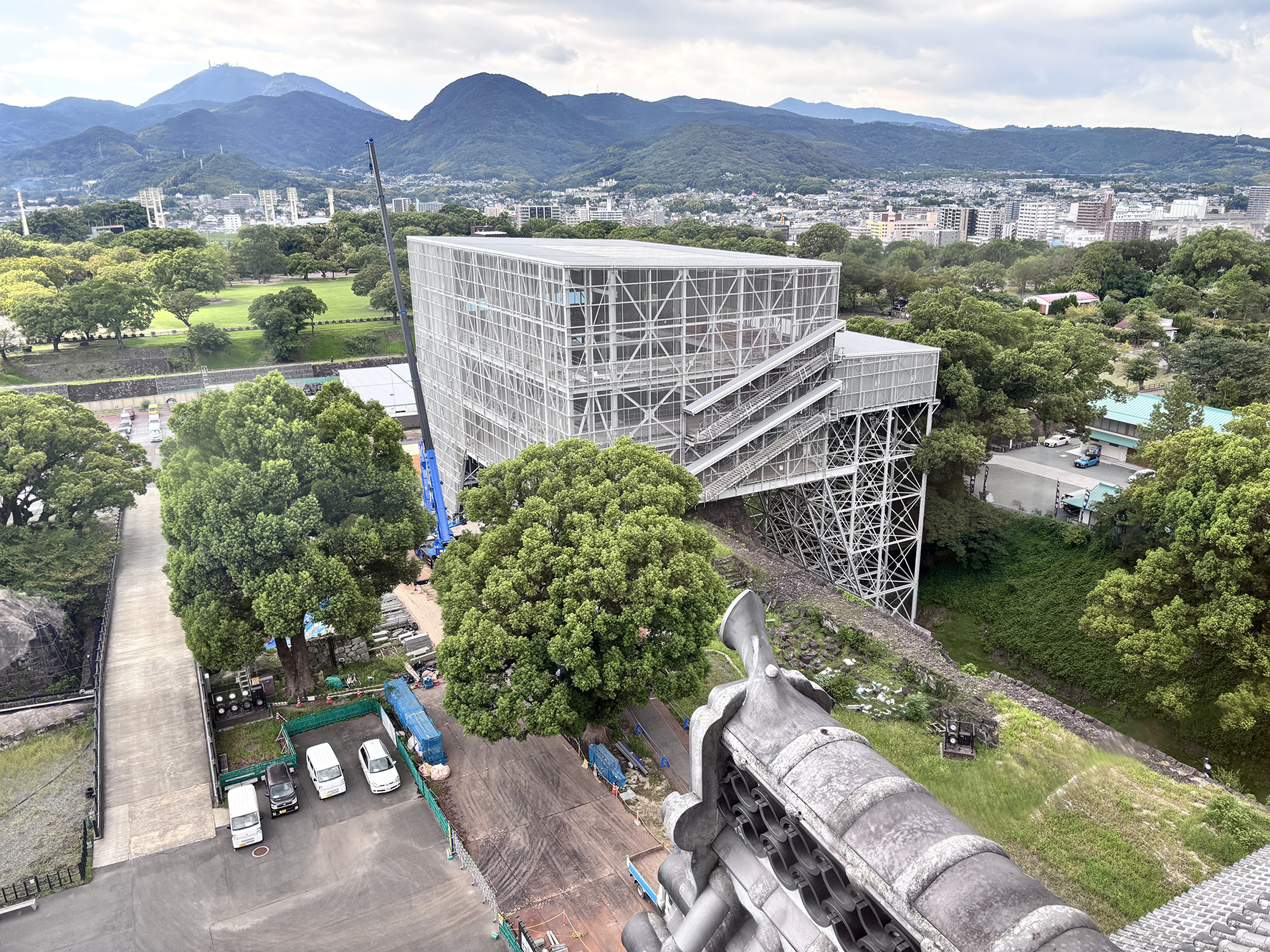
At the end of 2025, ‘The path of restoration’ (fukkou no michi) an elevated viewing walkway approximately 800 metres in length, was fully opened. From this walkway, situated at a height of about 6 metres above the ground, you can closely observe the ongoing restoration work on the stone walls and turrets across the entire castle grounds. The restoration works for the stone walls of Iidamaru Gokai Yagura (飯田丸五階櫓), known as the ‘Kiseki no Ippon Ishigaki’ (奇跡の一本石垣), and Uto Yagura (宇土櫓), the only surviving multi-storey turret from the time of the castle’s original construction, are also respectively underway.
Furthermore, Kumamotojo has established a ‘Fukko Joshu’ (復興城主) sponsorship system to support its recovery and restoration. By making a donation, anyone can become anyone can join as a ‘castle owner’ and receive benefits like a personal certificate and an entry in the online donor registry. The appeal lies not only in visiting for sightseeing but also in being able to personally engage in the future of Kumamotojo as a supporter.
Click here for the Kumamotojo Fukko Joshu system
A sight that can only be seen now
The target for the complete restoration of the entirety of Kumamotojo is the 2052 financial year, meaning a long journey still lies ahead. However, the sight of the stone walls being carefully piled up one stone at a time, and the Important Cultural Properties gradually regaining their form whilst surrounded by scaffolding, are precious scenes unique to “this very moment”, which can never be seen again once the complete restoration is achieved.
Beyond its value as a historical structure, the very sight of people striving to rise from the damage caused by a massive earthquake imparts a profound sense of emotion to the travellers visiting Kumamotojo.
Kumamotojo Facility Overview
(* Please note that due to the impact of the Reiwa Hachinen Kumamoto Jishin, the following details may be subject to change. Please check the official website or similar sources for the latest information.)
Opening Hours: 9:00 am – 5:00 pm (Last admission at 4:30 pm)
Closed: 29th December – 31st December
Admission Fee: (Individuals)
Senior High School Students and above: 800 yen
Primary and Secondary School Students: 300 yen
*Pre-school children: Free
Access to Kumamotojo
Accessing Kumamotojo via public transport is convenient.
Approximately a 10-minute walk from the ‘Kumamotojo Shiyakushomae’ (熊本城・市役所前) tram stop on the Kumamoto Shiden (熊本市電).
Approximately 15 minutes by Kumamoto Shiden from JR Kumamoto Eki (JR熊本駅).
Approximately a 10-minute walk from Kumamoto Sakuramachi Bus Terminal (熊本桜町バスターミナル).
As it is located in the centre of Kumamoto City, it is highly accessible for visiting in conjunction with sightseeing within the city.
By Car
Approximately 30 minutes from the Kumamoto IC (熊本IC) on the Kyushu Jidoshado (九州自動車道).
Paid car parks for visitors (such as Ninomaru Chushajo (二の丸駐車場), Sannomaru Daiichi Chushajo (三の丸第一駐車場), and Sannomaru Daini Chushajo (三の丸第二駐車場)) are available within the castle grounds. During busy periods, using the paid car parks in the surrounding area is recommended.
Addendum: Impact of the Kumamoto Eearthquake 2026
Whilst we were preparing to publish this article, the Reiwa Hachinen Kumamoto Jishin occurred.
There have been reports that multiple sections of the stone walls have collapsed again due to tremors measuring a seismic intensity of 7, so the information above may differ from the current situation.
Additionally, as of 5th August 2026, Kumamotojo is “temporarily closed until safety can be confirmed”.
Regarding ‘Saigai Furusato Nozei’ to support the disaster-stricken areas
As a means of providing direct support to the affected local authorities, disaster relief donations are being accepted via ‘Furusato Nozei’ (ふるさと納税). Not only can the full amount be delivered to the disaster-stricken areas without any handling fees from as little as 1,000 yen, but it is also particularly noteworthy that a ‘proxy donation’ (代理寄付) system is being utilised to reduce the administrative burden on the affected areas.
What is a ‘proxy donation’?
It is a system whereby local authorities that have not been affected by the disaster handle the administrative tasks to accept donations on their behalf, and subsequently deliver the donated funds to the affected local authorities. This allows the affected local authorities to reduce their administrative burden and dedicate themselves to the immediate recovery efforts in front of them. (* The donation receipt certificate will be issued under the name of the local authority that acted as the proxy.)
Disaster Relief Support Portals
This article is translated from https://intojapanwaraku.com/special/311901/