






A sense of tension never experienced before
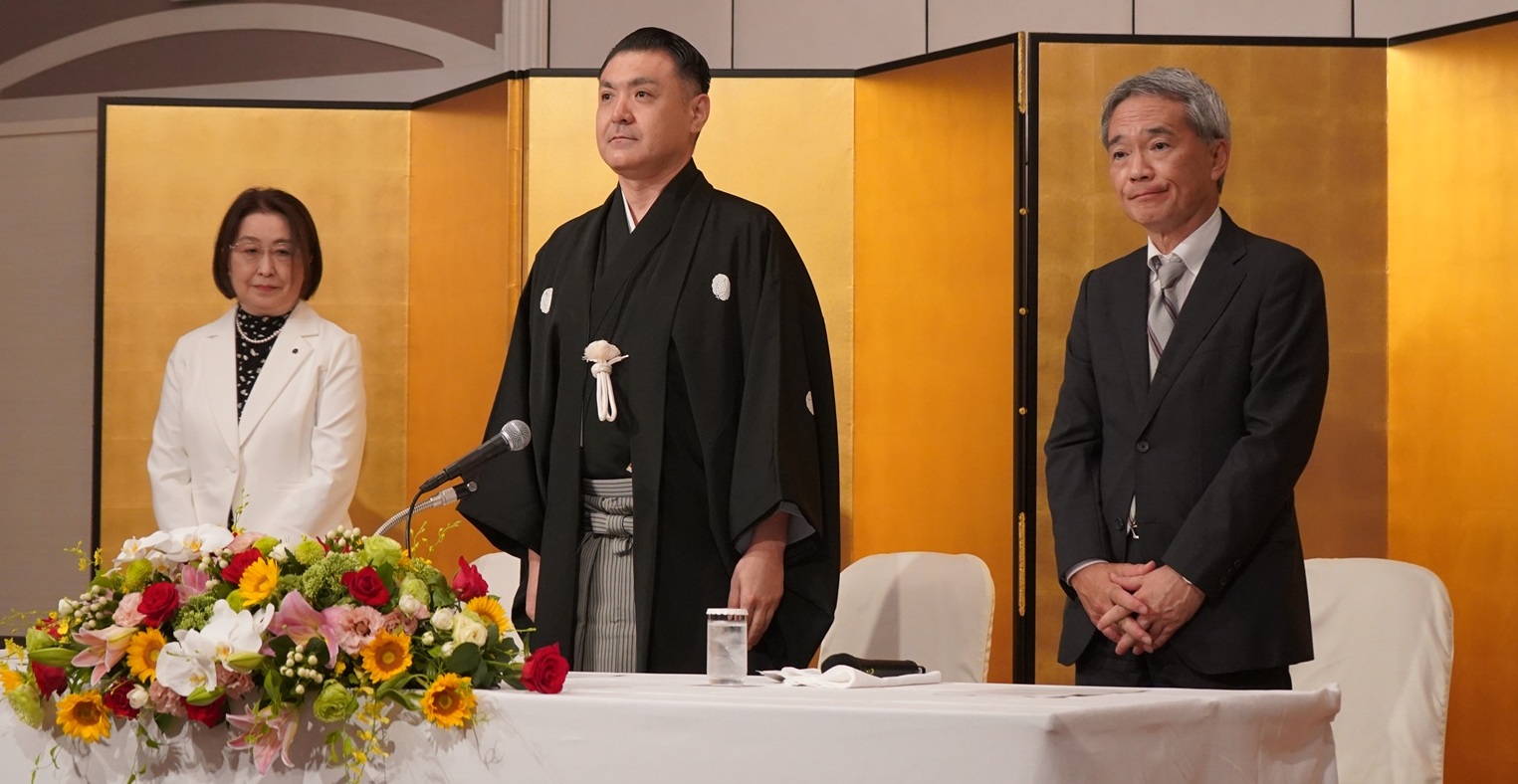
To open the press conference, Yasuhisa Shimizu, Executive Director of the Bunraku Association (公益財団法人文楽協会) explained, “The title of Takemoto Tsunatayu is one of the most distinguished stage names in the jōruri (*1) world, passed down over 260 years since the mid-Edo period.” Next, Hiroko Kirikae, Board Member of the Japan Arts Council (独立行政法人日本芸術文化振興会), addressed the journalists in attendance: “We hope for your continued support as the new Tsunatayu takes on this title, stepping up—in both name and talent—to become a pillar of Bunraku puppet theater.”
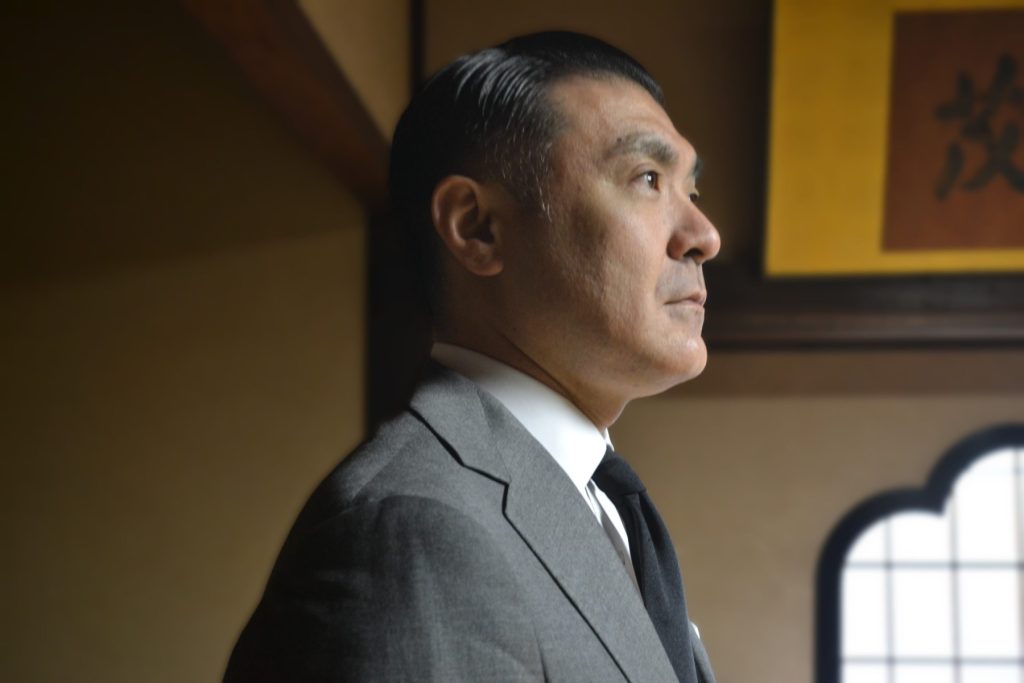
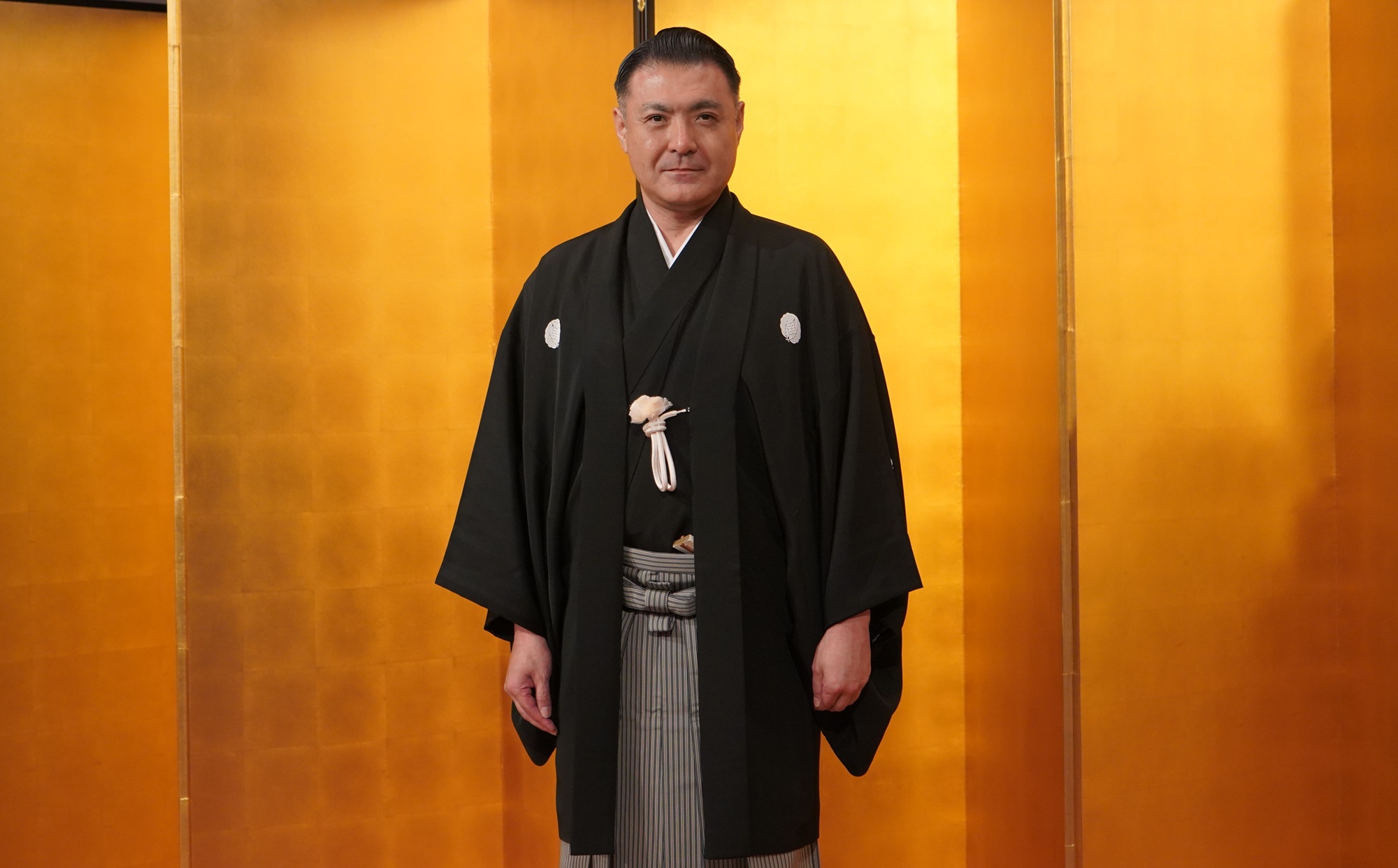
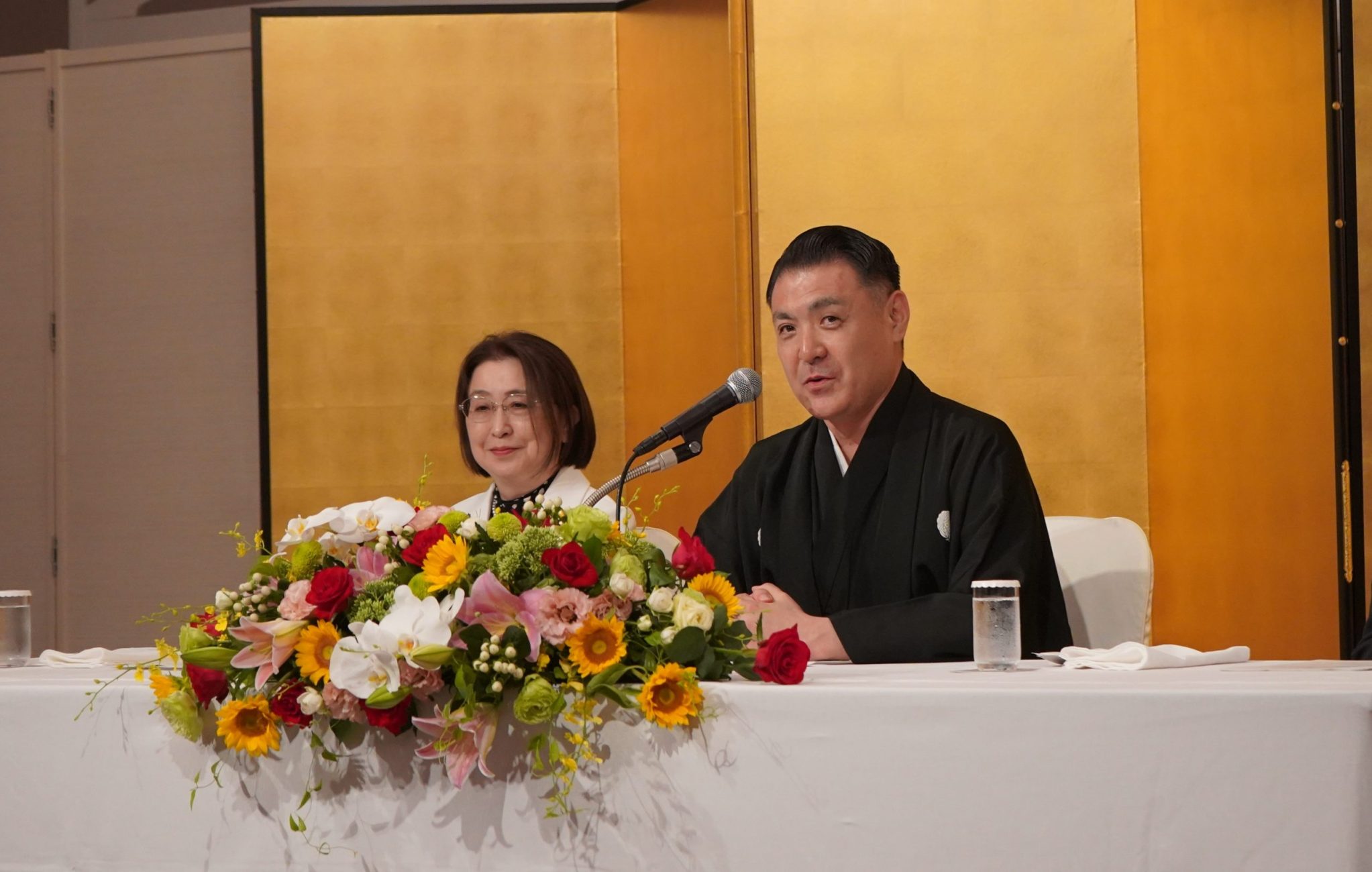
“This is a monumental name,” Oritayu says candidly. “This morning, I woke up wrapped in a weight of gravity unlike anything I’ve ever known.” Born in Osaka City, Oritayu’s grandfather was the Bunraku Shamisen master, Tsuruzawa Dohachi II (二代目鶴澤道八). While those around him expected him to pursue the path of a Shamisen player, he gradually came to hold feelings of admiration for the Tayu (太夫) who narrated beside his grandfather’s Shamisen. His wish came true when, at the age of eight, he became a pupil of Toyotake Sakitayu (豊竹咲太夫) (who passed away in 2024)—a Ningenkokuho (人間国宝) whose father was the Tsunatayu VIII(八代目綱太夫)—and started his life as a Tayu taking the name Toyotake Sakihotayu (豊竹咲甫太夫).
The path to succession entrusted by his late master
Firstly, regarding the name Takemoto Tsunatayu, Oritayu narrated his memories with Master Sakitayu. “When the Tsunatayu VIIII (九代目綱太夫) assumed the name, he and his wife held a discussion with the bereaved family of the Tsunatayu VIII. I was only 20 years old at the time, but Master said, ‘What we talk about today will carry on to future generations,’ and called me in. I bought a 120-minute cassette tape for recording and went to my master’s house. As soon as I entered the entryway, Master suddenly asked me, ‘Which do you want to succeed to—Sakitayu or Tsunadayu?’ Caught completely off guard, my body froze, and I stood there petrified.”
Oritayu’s episode related to the succession continues. “Then my master said, ‘Right, I will make it so you can succeed to Tsunatayu,’ and went to the place of discussion. True to my master’s words, when the 9th master assumed his family name, Takemoto Gentayu (竹本源太夫), he paid a return visit to the Tsunatayu VIII family, and a few years later, my succession to Oritayu VI (六代目織太夫) was decided.” It seems these matters are also written about in ‘Bunraku no ie‘ (文楽の家) authored by Takemoto Gentayu and Tsuruzawa Tozo (鶴澤藤蔵), and ‘Tsunatayu shiki‘ (綱大夫四季) authored by Yamakawa Shizuo (山川静夫).
Due to such a background, Master Sakitayu himself did not assume a new name, spending his entire life as Sakitayu. And it is said he repeatedly pleaded with his beloved pupil to succeed to Oritayu, the previous name of the great name Tsunatayu. “I refused twice, trying to request the succession of other names, but the third time, I felt my master’s parental affection and accepted. I am grateful for it now.” Having been 8 years since assuming the name as Oritayu VI, he reportedly noticed that the Tsunatayu VIII’s period as Oritayu was 10 years. He said he resolved that Reiwa 10 (2028), which exactly marks 10 years since assuming the name Oritayu, would be the perfect timing to succeed as the Takemoto Tsunatayu X.
Successive Tsunatayus were accomplished in their art and versatile
The first Tsunatayu was the figure who revived the Takemoto-za puppet theatre as the theater manager (Zamoto) of the revived Takemoto Gidayu-za theatre, in front of Amidaike Wako-ji Temple. This had been after the original Takemoto-za in Dotonbori closed its 80-plus-year history in 1768 (Meiwa 5). “In modern terms, he was a playing manager. He was a virtuoso known as a ‘master of technique’ (waza-shiri), and his popularity was described as being ‘like a magnet attracting iron,’” Oritayu shared.
The second Tsunatayu significantly revised the “Gappō Sumika no Dan” (The Scene at Gappō’s Dwelling) section of Sesshū Gappō ga Tsuji (The Crossroads of Gappō in Settsu Province) *3, which had ceased being performed since its premiere, this creating the form that is staged today. Oritayu narrated ‘Sesshu gappogatsuji ‘, which relates to his own artistic lineage, at his Oritayu name succession performance.
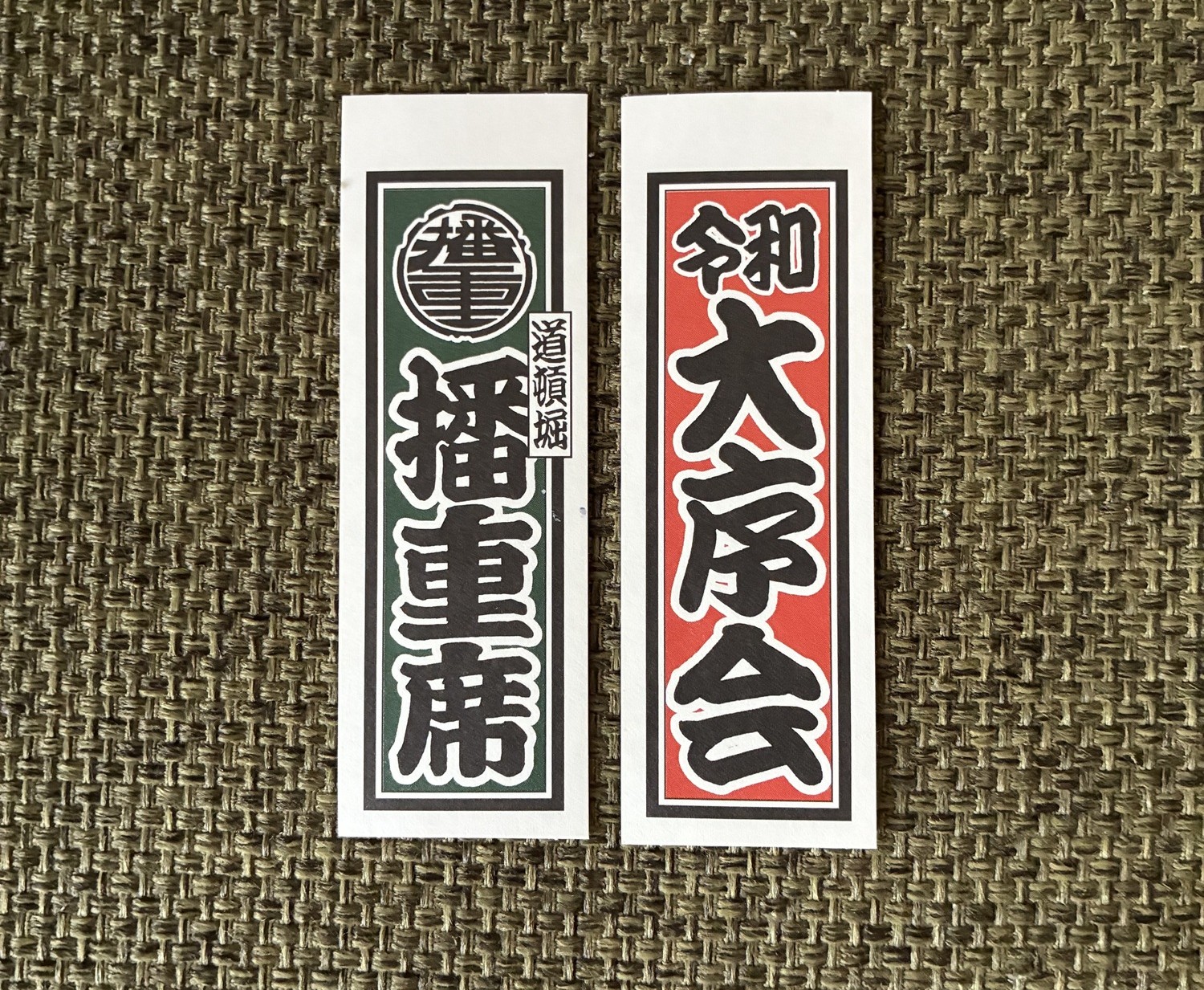
“My revered master, Tsunatayu VIII, premiered the ‘Tenmayanodan’ (天満屋の段) of ‘The Love Suicides at Sonezaki‘ (Sonezaki shinju / 曾根崎心中) and composed and premiered the ‘Teshimaya aburamise no dan’ (豊島屋油店の段) of ‘The Woman-Killer and the Hell of Oil ‘ (Onna goroshi abura no jigoku / 女殺油地獄). Now, Sewamono (世話物) *4 are performed in Bunraku and Kabuki (歌舞伎), and I believe that is the fruit of of my Master’s efforts in establishing the genre of Chikamatsumono (近松物) that symbolises post-war Bunraku.” Tsunatayu VIII, who was deeply dedicated to training future generations, revived Daijokai—a specialized recital performance—as a platform to nurture his apprentices and younger artists. Following his example, Oritayu has brought back these showcase performances at the historic Hariju venue in Dotonbori, continuing to host Daijokai events where his junior performers and students take the stage.
Honouring the principles of the Tsunatayu lineage and expanding out circle of patrons
The Tsunatayu VIII wrote in his book ‘Dendenmushi‘ (でんでん虫) that “looking seriously at life, and earnestly pursuing the human way of living” is exactly the goal of the Tsunatayu lineage, generation after generation. “It is a sentence that summarises the way of living I myself am seeking in narrating Joruri. I would like to continue to devote myself so that I can unify life and art,” he spoke of his determination.
What Oritayu aims for does not stop at the improvement of art alone. He hopes to revive the past popularity of Joruri once again. “About 100 years ago from now, there were two bookshops within Osaka City that published Yukahon (床本) *5. I hear that 20,000 to 30,000 copies were sold there every year. There were people humming them at the public baths; that means the Joruri population was that widespread. In order to resurrect the past popularity of Joruri, I want to cultivate patrons and customers.”
While there are programmes in Kamigata rakugo (上方落語) that feature Joruri as a theme, it is said that in Osaka in the late Edo period, there were as many as 500 practice houses, known as keikoya to learn Joruri. There were 20,000 amateur Joruri narrators, and Joryugidayu (女流義太夫) were also active. There is also a history that amateur pupils went to learn from those Joryu gidayu, and Joruri spread. “With the current situation of there being only about 20 Tayu in the Bunraku–za (文楽座), it is quite difficult to secure the resources to give lessons directly to amateurs. We will give lessons to the females. And then the females will give lessons to amateur Bunraku enthusiasts—I want to create this kind of virtuous cycle,” he says, and support for Joryugidayu also appears to be included in Oritayu’s vision.
Making ‘Yoshitsune and the Thousand Cherry Trees‘, for which he served as his master’s sudden understudy, the name succession play
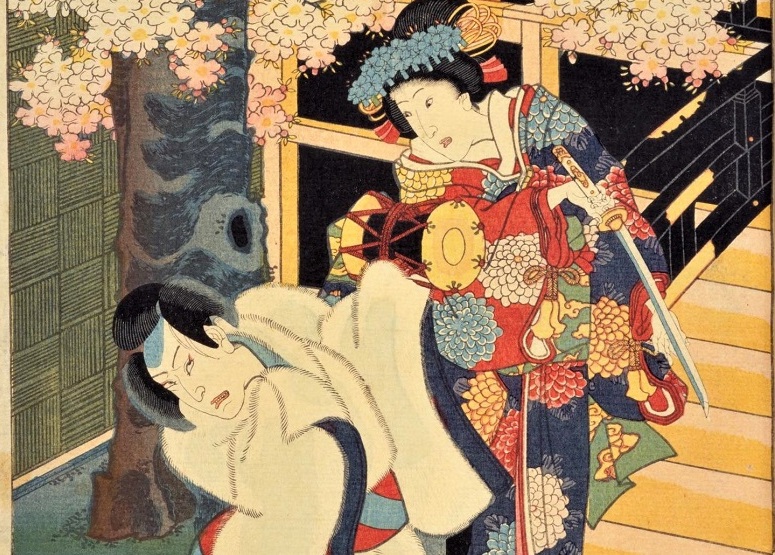
The commemorative name succession performance to be performed at the Early spring Bunraku event in 2028 Spring Bunraku Performance in Reiwa 10 was announced as the ‘Michiyuki hatsune no tabi’ (道行初音旅) and ‘Kawatsura hogen yakata no dan’ (河連法眼館の段) of ‘Yoshitsune and the Thousand Cherry Trees‘ (Yoshitsune senbonzakura / 義経千本桜). This work holds an unforgettable memory for Oritayu. “The programme for Master Sakitayu’s Bunkakorosha (文化功労者) recognition commemorative performance in April of Reiwa 4 was also ‘Shinokiri’ (四の切) (‘Kawatsura hogen yakata no dan’). He had been performing safely from the first day until the 17th, but he fell ill and subsequently withdrew from the stage, and I urgently ended up serving as his understudy.”
Oritayu’s story continues. “It was a television recording day on this day, so my master was saying, ‘I will go on even if I have to crawl.’ After I narrated Tadanobu (忠信) in ‘Michiyuki hatsune no tabi’ and came off the stage, I was informed of the understudy role right there and then. Because there was no spare time to change my kimono, I was only able to change my kataginu vest. I was incredibly nervous,” he reflects on that time.
I happened to be watching the stage of that sudden understudy, and it remains as a vivid memory even now. Despite there being no notice in the lobby informing of an understudy, I was surprised that Oritayu, who had only just finished narrating a moment ago, appeared. ‘Kawatsura hogen yakata no dan’ is performed following ‘Michiyuki hatsune no tabi’, and Master Sakitayu was scheduled to appear in the Kiri (切) *6 of ‘Kawatsura hogen yakata no dan’. Oritayu, who was told of the understudy role just beforehand, had readied his preparations within the mere 20 minutes of the first half.
Because it was a seat close to the Yuka (床) *7, his tense expression was also deeply conveyed. As I watched over him with a pounding heart, he entered the usual mode of Oritayu, narrating the Shisho (詞章) in a voice that carries well, and I was gradually invited into the inside of the story. I also remember that at the fall of the curtain, tremendous applause was sent from the audience towards the Yuka.
It was a full house day after day at the Tokyo performances as well, and Oritayu served as the understudy right up until the Senshuraku (千穐楽). “This experience became a great confidence within my stage life.” One also feels fate in the episode that Tsubametayu (つばめ太夫) hurriedly served as the understudy for the Kotsubotayu II (二代目古靱太夫). Furthermore, ‘Michiyuk ihatsune no tabi’ was also performed as the presentation play for his grandfather’s succession to the Dohachi II (二代目道八), and was performed when his uncle, Tsuruzawa Seiji (鶴澤清治), held his Bunkakorosha commemorative performance as well.
Spreading joy to the audience through the power of art
“I believe that it is only the power of art that bridges the gap in historical perspectives and the differences with modern times,” says Oritayu. “It is the power of art that bridges the sense of ‘It’s a story from the Edo period, isn’t it? Children being sacrificed for their parents is unbelievable.’ Therefore, I intend to thoroughly instil technique into my pupils now as well,” he narrates powerfully. While lamenting that it has become an era where one must carefully explain ‘Chushingura‘ (Kana dehon chushingura / 仮名手本忠臣蔵) and ‘Yoshitsune and the Thousand Cherry Trees’, he repeats that nevertheless, what conveys the appeal of the works is indeed the power of art.
“It is the same with films and theatre, isn’t it? Depending on the technical capabilities of the people performing, there are cases where they do not become masterpieces. It comes down to how we as artists honour the material. All we can do is relentlessly refine our craft—I believe that if we do, the audience will genuinely enjoy it and appreciate what we bring to the stage.”
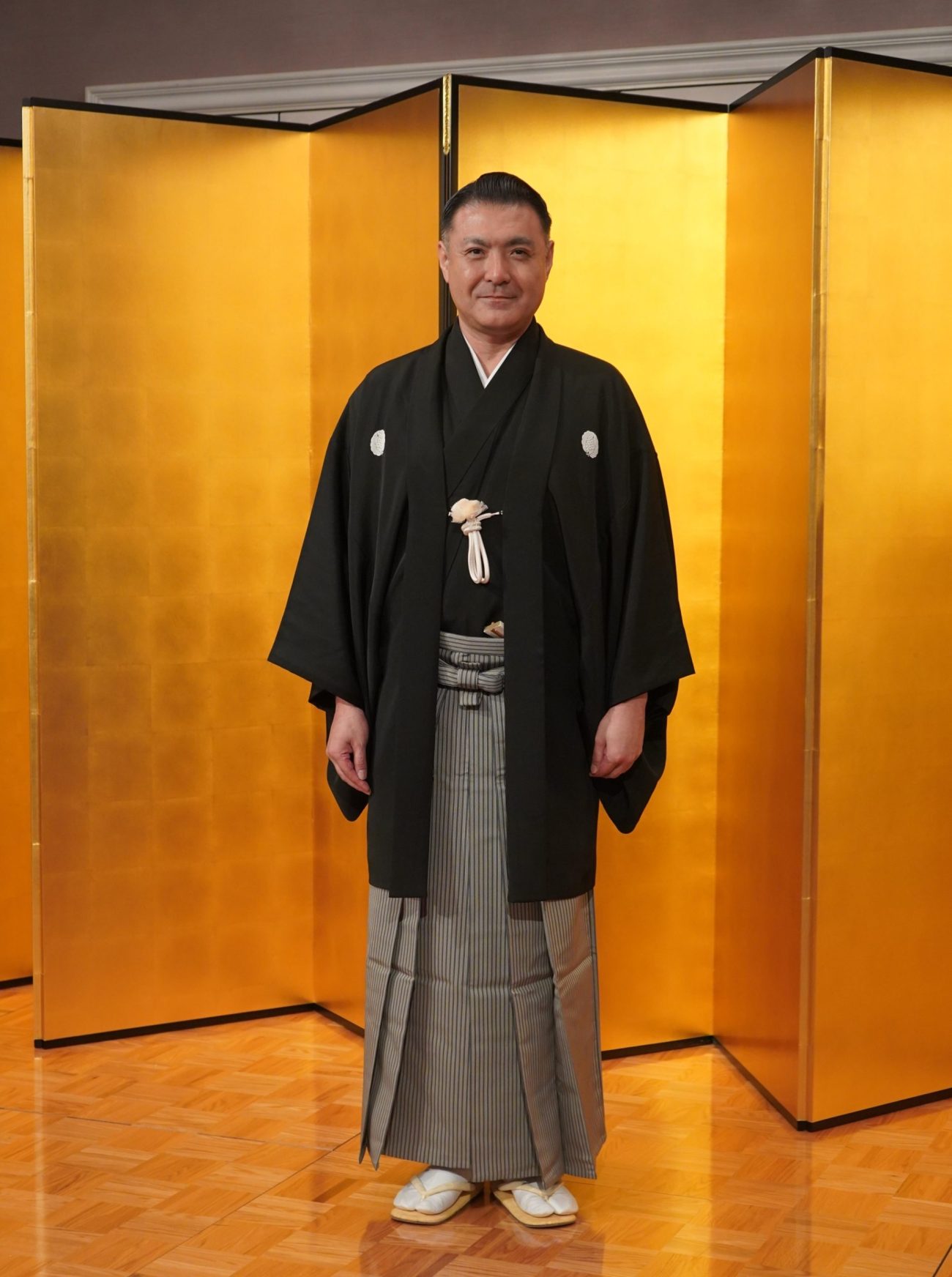
Photography / Kawaratani Tokiko (瓦谷登貴子)
Reference Books: Dendenmushi (でんでん虫) by Takemoto Tsunatayu VIII, Nunoi Shobo (布井書房); Business Person no tame no Bunraku no Susume (ビジネスパーソンのための文楽のすゝめ) supervised by Takemoto Oritayu, Jitsugyo no Nihon Sha (実業之日本社)
Spotify podcast “bunraku no susume: Ori mo Ori tote (文楽のすゝめ オリもオリとて)”
X Bunraku no susume (文楽のすゝめ) official
This article is translated from https://intojapanwaraku.com/culture/313716/