







With temperatures currently exceeding the normal body temperature of a Homosapiens, even the editorial department are slightly losing their minds. The only thing coming out of our mouths anymore is “atsui” (hot), like some sort of default animal cry.
Why Atsui Is the Hottest Word in Town
You’ll find 276 hits for “atsui” in the dictionary. But of course, this includes duplicate words and translations into various languages, so I’ll filter through the noise as we go along.
Atsu (渥)
Surprisingly, this was the very first thing to pop up on the default setting. The kanji character for ‘atsu’ (渥).
Apparently, it is a character meaning ‘to moisten’, ‘courteous’, or ‘thick’ (edited excerpt from the ‘Shinsen Kanwa Jiten Web Ban‘ (新選漢和辞典 Web版)).
Although it is read as ‘atsu’ in names for famous Japanese actors like Atsumi Kiyoshi, for anything other than people’s names, it’s read as “aku”.
There is even a word pronounced “akubi” using the same kanji as the actor who played Tora-san (寅さん). If you just heard the sound, you might think, “Are they bored?” (as akubi also means yawn), but it actually means “glossy and beautiful”—the complete opposite of boredom. How strangely amusing.
Atsui (厚い)
It has meanings such as: an object being thick; being plump; having a very high degree of emotion or action; being wealthy; being brazen; growing thickly together; having many people undertaking a specific role; or music being composed of many sounds.
The meaning of the word itself is dense!
Atsui (篤い)
The degree of receiving or giving favour, happiness, or affection is very high. It also means the degree of action expressing those feelings is high; being enthusiastic; being sincere; or an illness being serious.
By the way, although there is a certain degree of distinction in how they are used, quite a few dictionaries had both “atsui” (厚い) and “atsui” (篤い) listed under the same entry.
Atsui (熱い)
Something being incredibly high in temperature; emotions running high; being enthusiastic; people showing keen interest; or being driven into a corner and in trouble.
Well I never, that’s the first time I’ve learned it has a meaning of being driven into a corner and in trouble.
Atsui (暑い)
The air temperature being incredibly high.
Nowadays it is exclusively used for “air temperature”, but its original etymology is the same as “atsui” (熱い), and it is said that during the Jodai (上代) and Chuko (中古) periods (roughly the Asuka (飛鳥), Nara (奈良), and Heian (平安) periods), no clear distinction was made between them.
Which means saying things like “It’s ‘atsui’ (熱い – object is hot) today” or “This tinned tea is too ‘atsui’ (暑い – weather is hot) to hold” wouldn’t have been wrong.
Come to think of it, up until the Edo (江戸) period, apparently even proper nouns were written using multiple types of kanji to show off by saying, “Look at all the characters I know!” (well, I’m not sure if I can state it quite that categorically). So, the idea of “You won’t get any marks unless it’s this exact character or this exact method…” might not have existed in the first place. That easy-going attitude of “As long as you get the gist, it’s fine, isn’t it~” is highly agreeable.
Regarding the multiple spellings of proper nouns, to give a famous example (at least in my own head), there’s Shinsengumi (新選組) and Shinsengumi (新撰組). Since even the members themselves apparently used both, it blows any logic about the literal meanings out of the water; it really doesn’t matter which one you use anymore. Oh, as for Shinsengumi (真選組) and Shinsengumi (新鮮組), they are completely different groups, so make no mistake there.
Atsui (圧威)
This was somewhat unexpected, but a two-character idiom also popped up. This is also read as “atsui”.
The meaning is the power to pin someone down and coerce them.
It’s rather unpleasant, isn’t it? I can smell a hint of power harassment. And just as I thought that, the example sentences provided were exactly in that sort of context.
The word atsui was way cooler than I thought
Quite a few other kanji used for people’s names and such came up, but I’ll skip over those.
So, that concludes my independent research on “atsui”.
By the way, the ‘Nihon Hogen Daijiten‘ (日本方言大辞典) (Shogakukan), which is included by the great master Japan Knowledge, also lists dialects from all over Japan. It was quite fascinating to see that identical dialects exist in regions separated by considerable geographical distances.
People say things like “The heat and cold only last until the equinox” and “Clear your mind and even fire will feel cool,” but all the logic in the world won’t change the fact that right now, what is hot is hot.
Please, everyone, put yourselves first. Bearing in mind that the anecdote about “Clear your mind…” is actually a tragedy where the person was subsequently engulfed by the flames and passed on to the next world, let’s use our air conditioning sensibly whilst eagerly awaiting the fruitful autumn that is (supposedly) on its way.
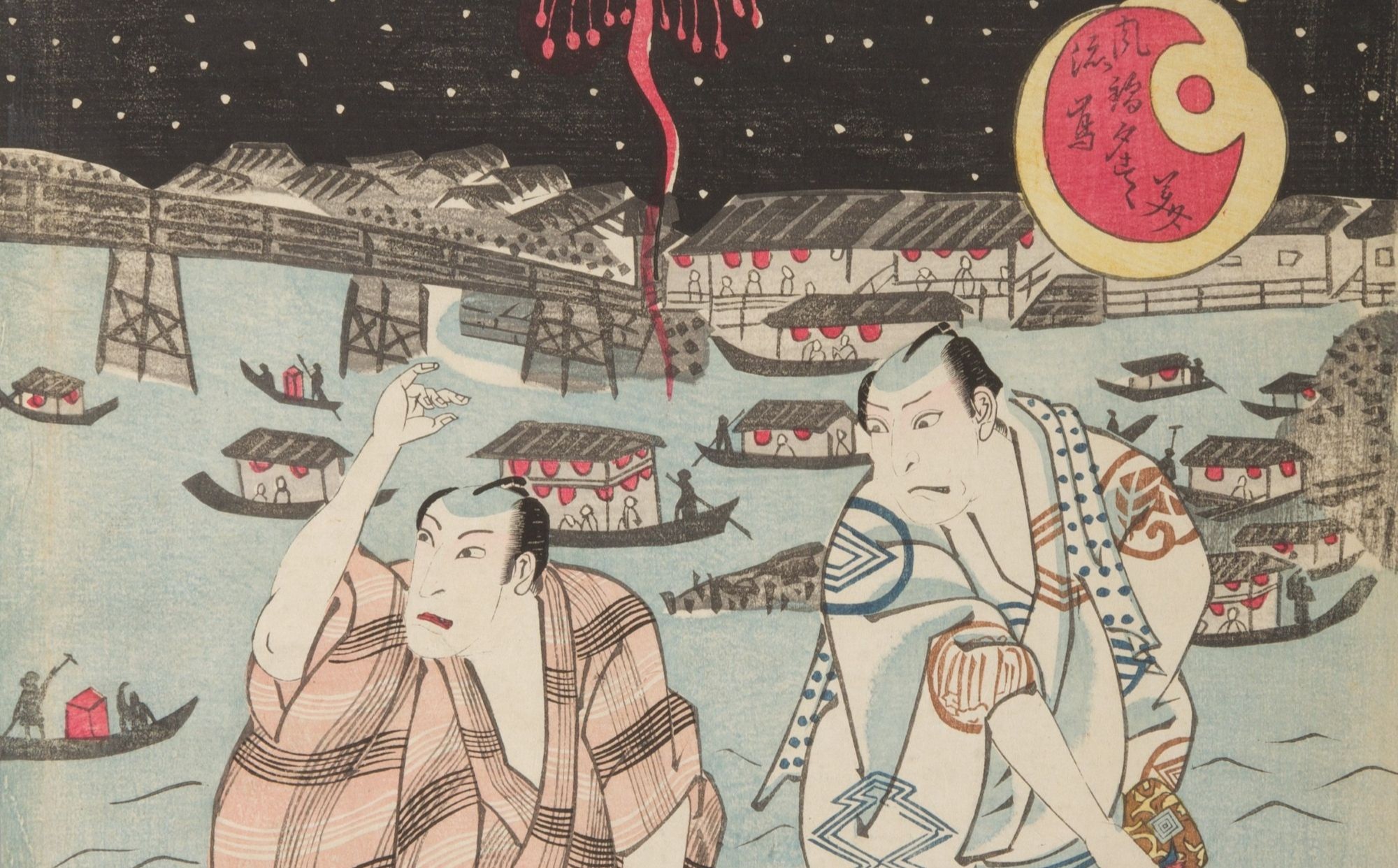
Header image: ‘Furyu Nabeshima Yususumi‘ (風流鍋島夕すゞみ) by Juyodo Toshikuni (壽陽堂歳国), from The Metropolitan Museum of Art (メトロポリタン美術館).
This article is translated from https://intojapanwaraku.com/culture/281903/