












Shinto shrines that come in contact with the times such as the first shrine. When you notice, about the shrine, about the manners of worship, how are you supposed to know? In the first place, about God, I do not really understand well .... So, this time, we will introduce at a minimum the things we want to know at the same time, “Shinja Edition” . This should bring you a good relationship with God!
◆ I heard the story ...
Author and journalist Akiyoshi Yamamura <br /> About 20 years ago, I visited shrines of about 5,000 companies across the country and interviewed about 1000 priests. We will continue our activities with the goal of "conveying Shinto, Japan's oldest ideological culture, in an easy-to-understand manner". Received the “Shinto Culture Award” in 2012 (Shinto Culture Association). He has written many books such as "Shinto and Japanese" (Shinshisha) and "Really Amazing Shinto" (Takarajima Shinshin).
The worship section is here
Simple question about the shrine 14
1 I say "eight million gods", but how long does God really come?
I have counted God's name before. Shinto gods such as Susano no Omichi and Ohku Ninushi no Kami, as well as the shrines of the whole country, as well as Ameterasu Omikami appearing in "Kojiki" and "Nippon Shoki" The god of For example, the gods that the houses give in their own words, the birth gods who are the guardian gods of the land, and the dozens of gods. At that time, it was a little over ten thousand that I was counted up.
However, the idea that "God dwells in all things" has been the concept Japanese have had since ancient times. I felt a god whose name is unknown from things such as roadside stones and flowers, clothes and daily necessities, hair and so on, to techniques and air. There is also a story that God of three gods, such as Ameno Akaminakashinkami, is actually close to the work of Higgs particle. If there are also gods in elementary particles, you can't do it with only eight million.
2 What is the purpose of Torii?
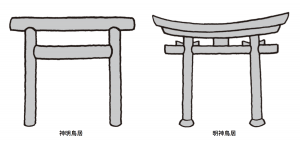
It has a role like a gate, a mark saying "From here it is a sanctuary." There are various theories as to why the torii was made, and why it is torii in the first place, I do not know exactly ....
As for the origin of the word, it is said that "Because the place where the bird that is the angel of God can stop" and "Because people go in". The oldest form is the Shinmei Torii, the Taisha Torii, and then the Meishin Torii. From there, we diversified into Yahata Torii, Kasuga Torii, Sumiyoshi Torii, Sanno Torii, and so on. Currently, the most frequent is Myojin Torii. There are no restrictions on materials and colors, though there are shrines that are unified with Ise Jingu Shiraki and Inari Shrine red, but there is basically no restriction on the shape, color and material. In addition, it is entrusted to the intention of the shrine side and the donor. Just because you donate to Kasuga Taisha, there is no rule that you have to make it to Kasuga Torii.
3 Where can I walk in the precincts?
In the precincts that are the sanctuaries, places that are surrounded by water pike (water gigantic) and where a long line of ropes (Shimenawa) is stretched are "further gods." It is a place where you should not enter. Since also the center of the approach is a way to become your street God to say that "the median (median)," Let us refrain. On the bridge in Ise Jingu, such as Uji Bridge, a plate is placed in the central part so that people can not walk.
Also, when going through the torii, I stopped and took off my hat, and at first I thanked him. When going back, it is desirable to turn to the main hall after having passed through the torii, and to have a hail. In Shinto, there is a ritual called "advancement left regression (Sinzaita Yu) · Kiorazaza left" (Ki Yuzasa). When going towards God from the left foot, when going down from the right foot. When sitting in a hall, etc., it means from the right foot when standing up and from the left foot when sitting down . If you make a mistake, you won't be complimented, but if you go to the next visit, crossing the torii with your left foot will be more likely to be approached by God.
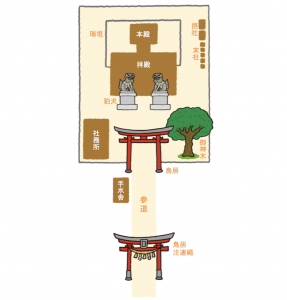 At the entrance of the approach is "One Torii". From there, the number of "two torii" and "three torii" increases. The torii also has a long standing rope. It also indicates "the sanctuary". In front of the hall there is a dog waiting for God.
4 What is the oldest shrine in Japan?
There are many shrines that have been recorded since 2000, such as Oogami Shrine (Nara Prefecture) and Sumiyoshi Shrine (Fukuoka Prefecture), but the answer varies depending on the definition of “Shinja”. Since ancient times, Japanese who find a god in all things have joined hands as mountains or the sea, large trees and rocks, waterfalls, etc., as gods themselves or as a generation (or later). Even though there was no torii or shrine, it was a sanctuary, a place to pray.
The fact that the shrine was built in the first place is said to have been influenced by the fact that Buddhism was introduced in the 6th century and a splendid temple was built. God didn't need a shrine because God doesn't have an entity like a Buddha statue. When performing the deity, it was in the form of creating a ritual facility such as Shinroku (ひ も ろ 磐 磐 磐 さ 磐 磐 (Isaka)) and welcoming it there. The remains are also excavated from the Sannai Maruyama ruins (Aomori Prefecture) about 4,000 years ago and the Makimu ruins (Nara prefecture) around the 3rd to 4th century BC. There has been at least a "shrine" since that time.
5 Why are the Shiba Inu placed in pairs?
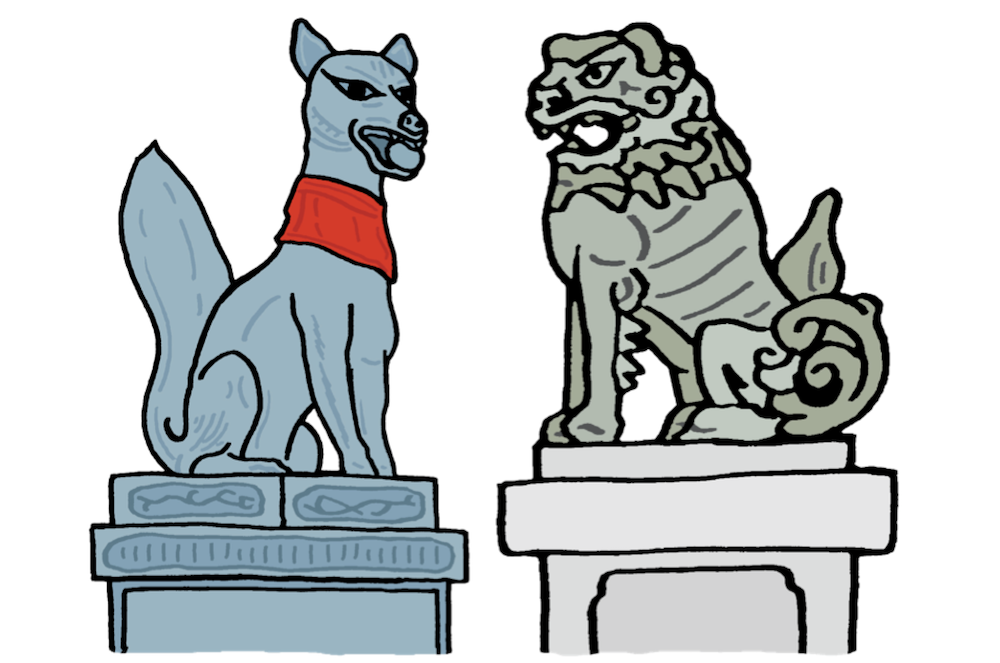
One theory is said to represent men and women. The right is male and the left is female. It is Yin and Yang's philosophy that two different things are combined and completed. It is transmitted from the continent to Japan, as the Shiba Inu dog sometimes writes as "Korii Dog". The form of "A" with an open mouth and "Um" = "Ama" with a closed mouth is unique to Japan and is considered to be the influence of the Buddhist statue of Nioh. Shiba Inu is a spirit beast that protects God from outside enemies. The temples at Inari Shrine, the monkeys at Sanno Shrine, the deer at Kasuga Taisha Shrine, etc. are Kenshi (Kansuku) and the angels of God.
6 What is the difference between the worship hall and the main hall?
The hall is for people who pray and the main hall is for the gods who are being reposes. The priest also enters the main hall with gratitude. Just as Ise Jingu is only a shrine (the main hall), and even now the priests are performing rituals in the form of sitting on the ground in front of them, there was no worship hall as old. It was also for people to be able to create a shrine, such as not getting wet in the rain. I think that Japanese people's feelings for God appear in places where God and human beings are not together.
7 Please tell me the meaning of putting a long line
"Ama no Iwato" myth, when Amaterasu Okami was brought out of Iwato, "ahead to return again," a tailed Kume line (Shirikume Nawa) placed at the entrance is a long line It is said that the beginning of "Shin Mene". A permanent rope is a sign that it is a sacred area from here on, which represents a barrier. It is common to have a bow drop. There are other items such as radish rooted canyon and burdock rooted cannon, but there is no difference in usage. Also, the current rope is made of rice straw. The paper hanging down there represents lightning. Lightning was thought to bring about the harvest of rice. 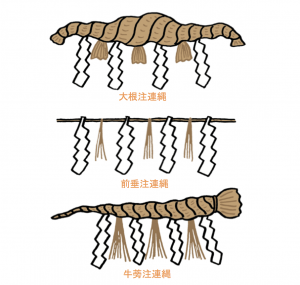
8 Why are there many large trees besides Kamiki?
Since ancient times, God has been thought to come down from the top of the sky to a tall tree. The tree that is a sacred tree is the god's generation. People planted various trees around them in order to protect their precious reliance, and eventually they became encumbered forests. The forest is also called "杜" and it is also a word that represents the shrine itself. The Meiji-jinguno-mori, where the greenery of the city is unbelievably dark, was also built from scratch after the Meiji Emperor was destroyed. For Japanese people, shrines and chapel forests are inseparable.
What does the tree on top of the 9 companies mean?
The part that extends to the sky is called "Chiki", and the side-by-side cylindrical wood is called "Tochigi". Since ancient times, it is a decoration allowed only to the palace and shrine of the Emperor. Chiki has the practicality of avoiding wind and Tochigi having the weight of a roof, but Chiki has a deity who says "an antenna for God to come down" . If the tip of the tree is perpendicular to the ground, it is called "outside cutting" (Tochigi is odd) and there are many male gods , and parallel "inside cutting" (Tochigi is even) is more in the goddess . 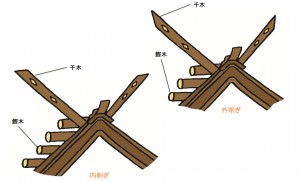
10 Why is the bell attached to the shrine?
There are also theories that the sound of the bell sounds, the theory of telling God that they have come to worship, and the signal that they hear from God. It is the first to put in the change, the first to ring the bell ... and that the order of worship differs depending on the shrine. But what's more important than order is to be quiet and silent. Bells are important things that connect you and God.
11 What is a divine body?
In 2013, Izumo Taisha, the sacred shrine of Ise Jingu Shrine, a god body that has been completely relegated to a new palace. The columns of Togyou wrapped in darkness and kinuki (giraffe) made the mystery more and more. There are many mirrors, swords, balls, etc. just as the Goddess of Ise Jingu Shrine is a mirror of Yahata that Amaterasu Ogami is entrusted with "think this as my soul and worship". Ne. It is basically God's generation, a sacred thing that should hide what it is.
12 Why are there many small companies in the grounds?
Small companies (Yashiro) are called "Sessha" and "Satsusha". Setsha sings about God who is connected to the shrine and the deity. Suesha is a solicitation from another shrine. During the Edo period, 180,000 shrines nationwide were reduced to 120,000 by the policy of the Meiji government, and further reduced after the war, and now about 80,000. Suesha worships the god who lost the shrine, but there is no change to the god who has long been believed in that land.
13 Why are the same deities worshiped in various shrines?
Dividing the Spirit like God's selfish art is called " Ministry. " The minute spirit means that the god's godly spreads widely. It was considered a good thing. Since ancient times, Japanese people who have treasured Mr. God have always split the spirit of God and moved to that land when they move to a new land. It is said that Hachiman-jin, where Minamoto Yoritomo believed, has more than 20,000 companies throughout the country, and the Tenjin Shrine (Tenmangu Shrine), which worships Doshin Sugawara, is astounding to 12,000.
14 What is the difference between “○○ Jingu” and “○○ Taisha”?
The final name of the company name, such as Jingu, Taisha, and Shinto shrines, is called "Company Name " , so that the company name and history of the shrine can be understood.
The pre-war Jingu is a place where the emperor received a profound connection to the emperor, or the god who did great work in the founding nation as a deity. Ise Jingu and Meiji Jingu are the former, Kashima Jingu and Katori Jingu are the latter. First of all, "Jingu" was a word that refers to Ise Jingu.
It is generally said that Taisha are mostly hailed of the god “Kuni Tsushin”, who was originally there, including the great god of Izumo Taisha. Jingu Shrine is a shrine with a high corporate rating. There is no big difference between other shrines, shrines and shrines. After the war, there were more Shinto shrines called Odaijingu and Ojingu, but there is no direct relationship with Shingu and even if it is "large", it is not the case.
-From "Waifaki" January 1st, 2014 issue separate volume appendix "Nippon's Name: Travel to 102's Shrine"-Illustration / Shuhei Tajima