








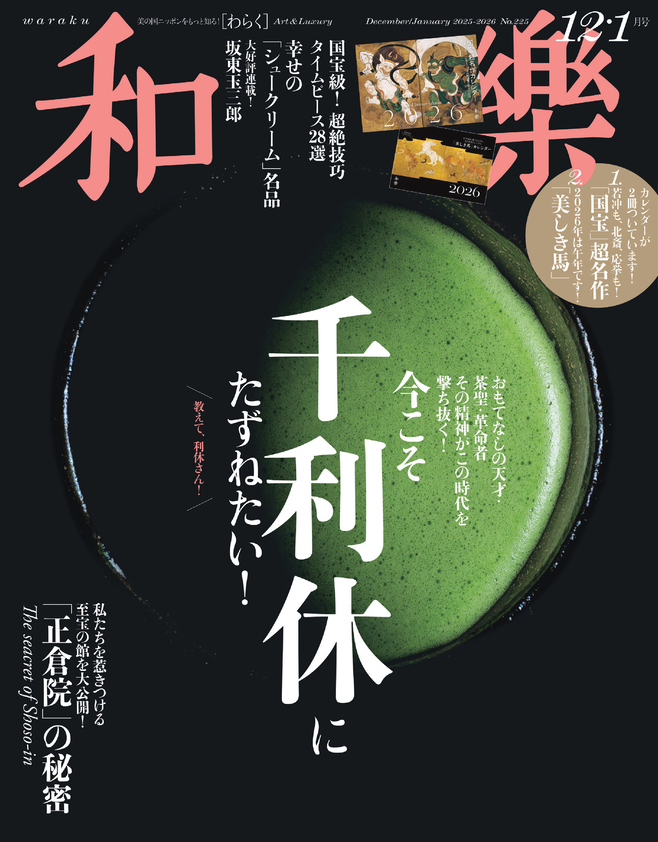




A long-awaited long-awaited exhibition for Japanese art enthusiasts and tea fans, special exhibition “Daitokuji Ryukokuin National Treasure 変 変 破 破 破 (あ い あ い あ い あ い 展 展 展 展 展 展 展 展 展 MI MI 展 展 展 展 展 展 展 MI I went to.
This exhibition, an on parade of invaluable goods! Even the photos of magazines and books can not be seen easily.
Ryukoku-in is one of the famous temples of Rinzai-mune, Kyoto, and the head of Daitokuji. It seems that it was originally built in 1606 in order to receive the Bodhisattva of Kuroda Yosui, the first founder of Fukuoka, the owner of Fukuoka.
The real founder of this burial mound, Ryuko-in II, Egetsu Sogan, is a great monk and is said to have been restored by many strong people from its highly educated and excellent scriptures. You In addition, since he was a participant in the famous Shii case that appears in textbooks of Japanese history, in the early Edo period, Kohori Enshu and many other cultural people were present under Kazuhisa Egetsu. It seems to have gathered.
Etsuki Sogan Kazuho was one of the three masters of Tenka, along with Senrikyu, Ima Sokun, and the second son of Tennoujiya and Tsuda Sogyu. Therefore, some of the precious tea tools held by Tennojiya were donated to Ryuko-in.
For this reason, Daitokuji Ryuko-in holds a large number of valuable cultural assets and tea tools, including national treasures and important cultural properties, and this is a unique opportunity to see them. Yes.
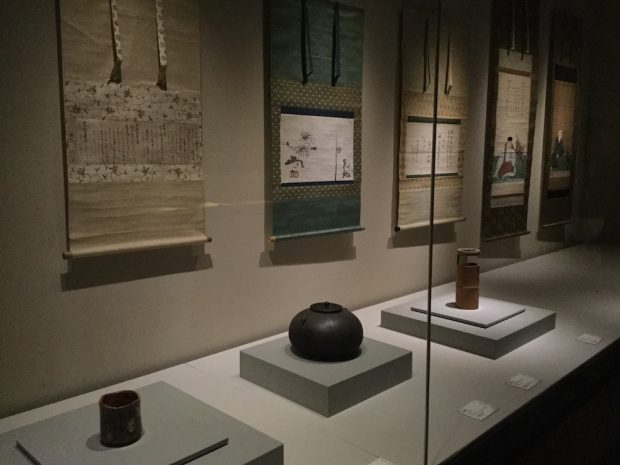 The back is "Takeichi Shigeru Hanamei Chisen no Koe", the round pot in the middle is Nishimura Koubei's "Sakaidan pot", the front is "Akagetsukan tea bowl Meinage 萬", and the central item is "Umekiku Figure" (4/21 Up to display)
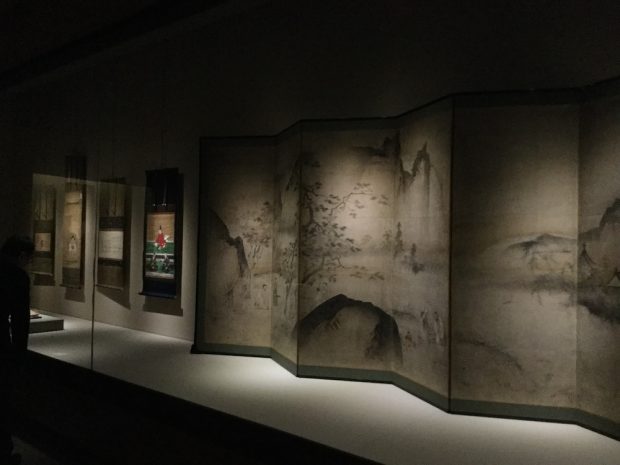 The front side of the screen is the “琴棋” screen (displays up to 4/21 of the important cultural property)
The secret temple treasure that has been closed to the general public is now revealed
More importantly, the Daitokuji Ryukoin is a privately-owned tower that does not accept tourist visits. In other words, ordinary people can not enter or see precious structures such as the National Treasure Shoin in Ryuko-in and the Important Cultural Property Shodo. In addition, it was rare for precious cultural properties in the collection to be made public.
that is! This time in one go! And in large quantities! Even longer! It will be on display so you can see why this exhibition is a must-see.
Perhaps, if you miss this time, you should think that only things that can not be seen with the actual eye will appear again.
By the way, the introduction has become very long, but here are the highlights of the exhibition.
If you pass through the first and second half, you can not miss any of the total of more than 200 appearances, but I will introduce 5 works that I personally impressed and I do not want to miss.
The reason for the great change of the day of the Ryukoku-in
First of all, the national treasure "the day change heavenly eyes". The inner side, such as looking at space, is a mysterious blue. Its complex and beautiful, sparkling and sparkling colors are something that happens accidentally in the production process. And none of this wonderful day change heaven that was born miraculously remains in China that has been created, and only Mitaka in Japan (the other two are in the Seijido Bunko Art Museum Collection and the Fujita Art Museum Collection) is the only one. It is an extant one in the world.
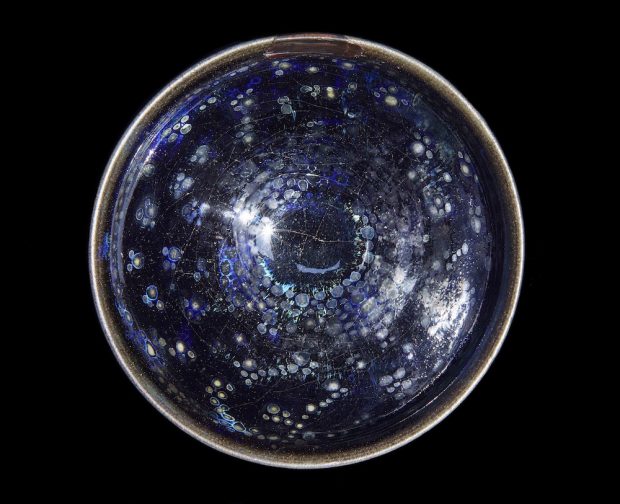 National Treasures Otoyo Tenmoku (Prospective) Southern Zen Period 12th to 13th Century Daitokuji Ryukoin
Among the three samurais, unlike the other two samurais, the Yukoin's doctrine, which is being presented this time, is the same as the other two samurais, and since it has been donated from Tennojiya to Ryokkoin from “Tennoujiya” "I did not leave from" "(explanation at the press briefing session of Kumao Kikuo MIHO MUSEUM director) things. Very rare, very rare rare tea bowl!
I have also seen the other two whales several times, but this was the first time I saw the weird weather of Ryuko-in.
Such precious day-to-day heavens are unveiled for about two months. If I miss this opportunity, I think I can not see you again, I think it is not a big deal at all.
A 5-step appreciation method to fully enjoy the miraculous day change heaven
By the way, it is a way of seeing this strange strange heaven, but because it is such a masterpiece, I would like to see it slowly and slowly.
When you enter the special exhibition hall of MIHO MUSEUM, first of all the wooden statue of Etsuki Sogan Kazunao welcomes us. And if you go forward with the thankful wooden house on your right, you will see the display case of the extraordinary day. First of all, let's move forward with excitement in the sense of expectation that the display case is approaching.
Probably around the display case should be the crowd of Kuroyama. During that time ...
STEP 1, When you come to the front of the display case, first let's get an overview of the famous tea bowl of this miracle from the front. Then turn left around the display case clockwise.
STEP2, Once you lie to the left, once squatting, a beautiful form from the side, a slightly sunken shape called the Tengu tea bowl, or a small and elegant feature characteristic of the day-changing sky of Ryuko-in Carefully check the shape of the hills and so on.
STEP3, If you move clockwise again and you are behind you, you can see the details that follow the edge of the teacup, so look carefully to the details.
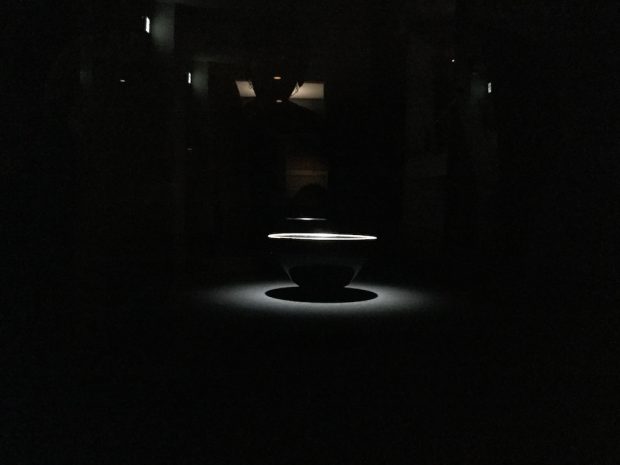 In front of the display case of the day-to-day heavenly eyes, I want to squash and check the figure just beside. A funnel-shaped form, a so-called "Supponguchi" warp, an elegant hilltop without glaze. Features of Tenmoku teacup are condensed.
STEP4, The person who brought the monocular comes here of the monocular! The view from here is the best, and you can see the fascinating vermilion that is unique to the day-to-day weather.
STEP5, and move to the left again clockwise, and finally squat again to check the overall shape of the funnel from the side. I am satisfied with this!
The beauty of the day-to-day heavenly eyes is the inside of the rose and the bright amber color. How do you convey that blue glow? Mr. Sho Nakahata, Director of the School of MIHO MUSEUM, who was in charge of the exhibition, spoke in a press briefing on the preview that he put his effort into it.
When photographing pictorial record, I received the special permission of the temple and photographed it under the sun rays. I succeeded in bringing the blue glow to the catalog. Also, the lighting in the exhibition room has become the current lighting method as a result of various studies. Please check the miracle brilliance of the miracle in the exhibition room under the light that has reached the end of your hardship.
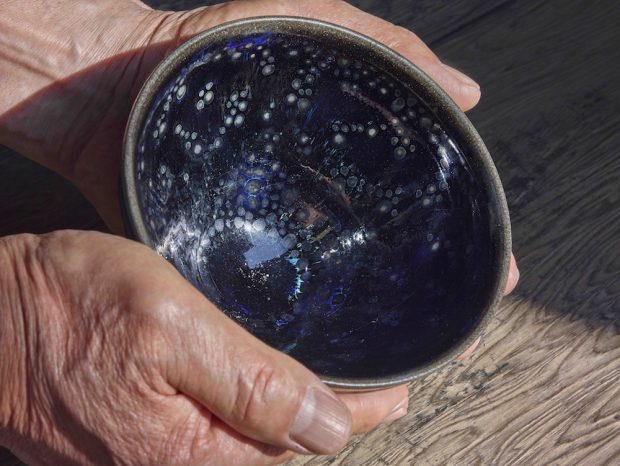 When exposed to sunlight, the amber glow is more blue and beautiful
Another superstar Tenmoku that is also like a Nordic design
This is an exhibition where topics tend to be concentrated on a day-to-day change, but I am most moved and delighted at this time by the one of the important cultural property, “Oil Drops Heaven”. I have seen it in photographs many times before, but it is the first time to see the real thing.
Small little tea bowl than I thought. There are innumerable silver spots in the ebony on the outside and inside, like a galactic universe. In the exhibition pictorial record, it is described as "reddish purple," but under the lighting of the exhibition it looks more like a chocolate, and even feels modern like Western pottery.
It is said to have been donated to Ryukoku-in since then, as with the Otoyo Tenmei, the famous treasure of Tennoji-ya possessed by Tsuda Sounori.
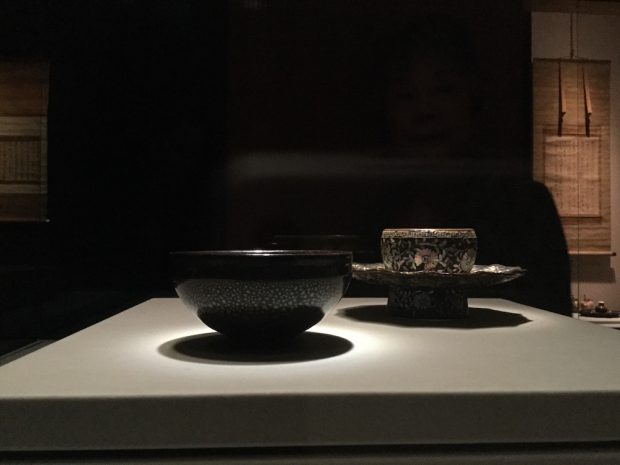 Toward the left, oil drops Tenmokus, right, Mochi arabesque Tenmokudai, important cultural property
The Tenmoku tea bowl is used on the Tenmoku stand, and the oil drop heaven is accompanied by a beautiful, spiraled Tenmoku stand, "Red Tora-ga-bun Tenmoku stand", and is displayed together. And this Tenmoku stand is also beautiful, especially! What a lovely and fascinating thing the pattern was made with Ryukyu Spiral!
It seems that oil drops are from the 11th and 12th centuries of the Chinese Golden Dynasty, and Tenmoku is from the 16th and 17th centuries of the Ryukyu Dynasty.
Anyway, it's a small, pretty bowl that you want to bring to your palm because it's fine once.
Other than that, the loveliness of tango maru tea bowl (Munei Maru), the cuteness of long tea bowl with a shoulder squeeze by Nonomura Hitoshi, and the loose appearance of a special large well tea bowl (Ryukoin well), etc. I just get caught. Even if there is time for a teacup fan, it will not be enough.
I'm overwhelmed by the exhibition, Tsuda Muneaki, and the wonderful tea utensils from Tennojiya, but what I should not forget at the same time is the portraits of the many sumo wrestlers and temples that convey the teachings of Zen. )is.
A lot of sumo wrestlers who can realize the depth of Shinshu
Above all, it goes without saying that you can not miss the national treasure 's secret 庵 咸 蹟 名 (special product). The tea table of the national treasure = the sumi (mitung) seat is the origin of the name, and it is believed that the Chinese monk Mitang kanjie shows a summary of the moxibustion. It is one of the most famous of the Chinese Buddhist monks in the South China period, which is transmitted to Japan. Because the contents are written about the general practice of Shinshu, the value in the Rinzai sect is enormous, and it is explained in the catalog. It is an essential cultural asset to know the Zen culture. (Because it is the exhibition until April 7)
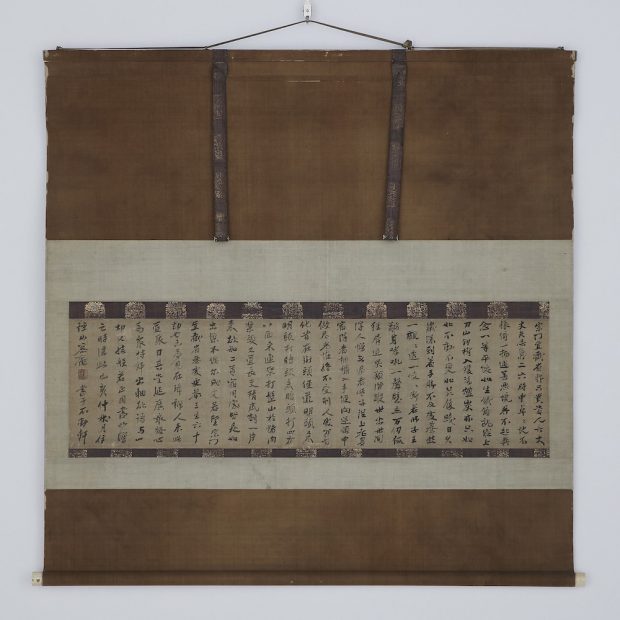 National Treasure 庵 咸 宛 法 語 宋 Southern period (1179) Daitokuji Ryukoin storehouse (displayed until 4/7)
Personally, I also loved the three-width sumo wrestlers of Tamamuro Sorin, Sawa Soran and Ezuki Sogan. In the middle is the issue of the founder Tatsuma of the Shinshu, with the Tamamuro written in the middle, the issue of Daitokuji Kaizan (an open monk) Daisuke Kusunoki, to which Sawa wrote, to the right, and on the left, the spring of which Egetsu Kazunao is his own teacher It is a three-space pair book that describes the issue of Yasouen, but it is likely to be absorbed, powerful, brushstrokes, and inhaled.
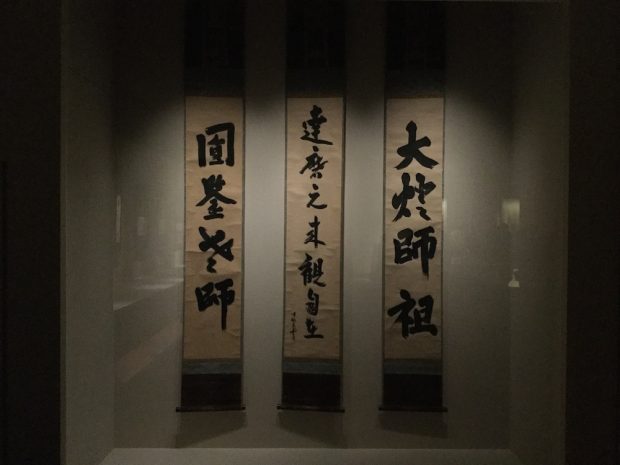 From the right, Sawa Soshu Sumi Ink Mark "Daiji Suzaku", Tamaro Soraku Sumi Ink Trace "Tarma Original Visitable", Egetsu Soken Sumi "Rankan Senshi" Daitokuji Ryukoin
There are still lots of attractions! Old writing highest peak and portrait of a warring military commander
At this exhibition, in addition to the ones at Daitokuji Ryukoin, many valuable works related to Ryukoin are presented. One of the things that attracted particular attention was "Shinsho Anshiki" "Kamemi no Okuni" from MIHO MUSEUM. It is known as one of the highest peaks of old writing, known as "Three-color Paper", "Three-color Paper", "Three-Color Paper," along with "Tsubaki-shi" and "Musashi-shi". It is said that
Shousho-Sen is a retreat created by Shogun Sakuma, who was also a war man and a warlord, in Ryuko-in. In this retreat, the general is called "Shunmatsu Shikishi" because he owned 12 of the 36 songs that Kinuuki wrote.
A small but wide piece of paper is a small piece of paper, but when you look at what is said to the Ryuko-in, there is once again a feeling of excitement.
Lastly, those who love history, those who like warlords can not stand it. A picture of the framework depicting Kuroda Yosui and Kuroda Nagamasa, which was the cause of the construction of the Tower Head, "Kuroda Kotaka Takada Kuroda Toshinori" and "Kuroda Nagamasa" (both Fukuoka and Sofukuji, designated Fukuoka Prefecture Cultural Properties ).
It is very interesting to see side-by-side portraits of the warlords of the Warring States period, Kanbei Kuroda, who was a well-known tribute and Kuroda Nagamasa parent and child who had martial arts in the battle of Sekigahara, at the same time.
On March 20th, when there was a press conference, the day of Yosui's death. It is an important memorial day for Fukuoka and Sofuku-ji, where there are Kuroda Yosui and other Kuroda family generations, but for this special exhibition, you have permission to lend valuable two-width pictures for special exhibitions. Episode was also shown at the press conference.
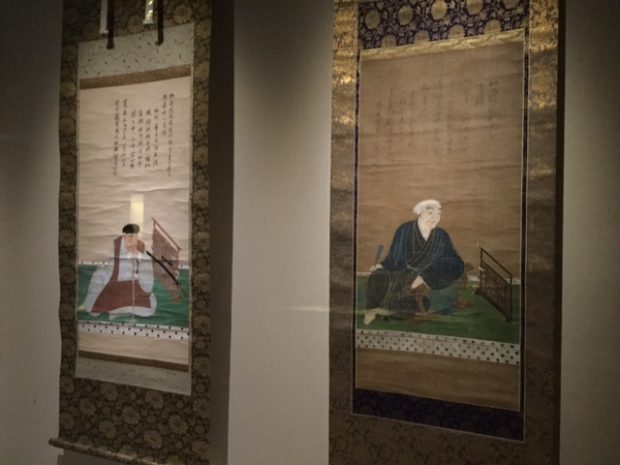 Right, Takada Kuroda Statue Torunori Kuroda On the left, Nagamasa Kuroda statue Ezuki Sogetsu Fukuoka · Sofukuji storehouse (all show up to 4/7)
One more thing, I could not see it at the preview, but Makikaki's “Ryoku / Kuri-zu” (important cultural property), which will be displayed from April 9 to May 6, is a work I would like to visit again. As mentioned above, Mr. Hatanaka, the director of the arts department, Hatanaka, commented that it was a "modern" in the introspection, "柿 柿", is an ink work I also want to see in Moorets.
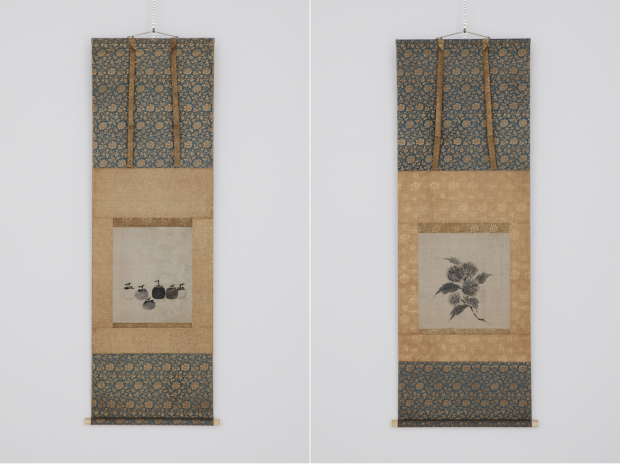 Important cultural assets: Kizuna / Kurizu Norimaki Sakai Nanjo period Daitokuji Ryukoin storehouse (displayed from 4/9 to 5/9)
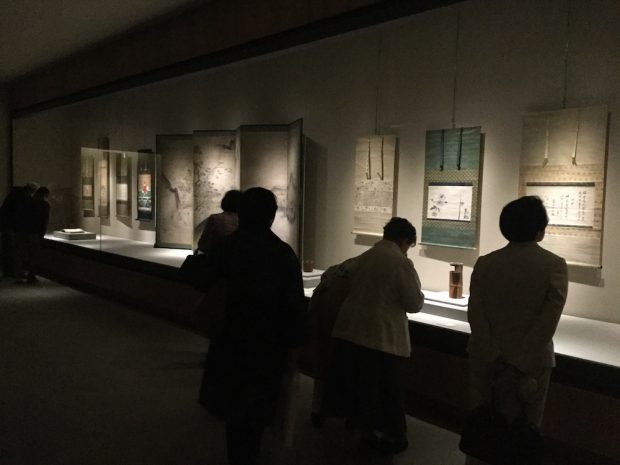
As I mentioned earlier in the day-to-day change, in this exhibition, the lighting device has been made in addition to the above. It is a dark exhibition room as a whole, but it makes you feel as if you actually put yourself in the fortune of the wolf. And the appearance that the sumo wrestler and the revelation come out beautifully in the darkness evokes an unbelievable impression.
Let's go see the exhibition of miracles in the cherry blossom-filled Tougenkyo area!
A word on the last MIHO MUSEUM, which will be the venue. This museum is located in the southern part of Shigayama, Shiga Prefecture. The design of the famous American architect IM Pei who is also known for designing the Louvre Museum pyramid. There is an art museum at the end of a long silver tunnel, but looking inside the tunnel on the other side of the art museum, there is a tree-lined branch of cherry blossoms. The day of the peek was still early, but it should be in full bloom in the middle of April. The cherry blossoms in full bloom looking through futuristic tunnels will be how beautiful it will lead us to an unreal world.
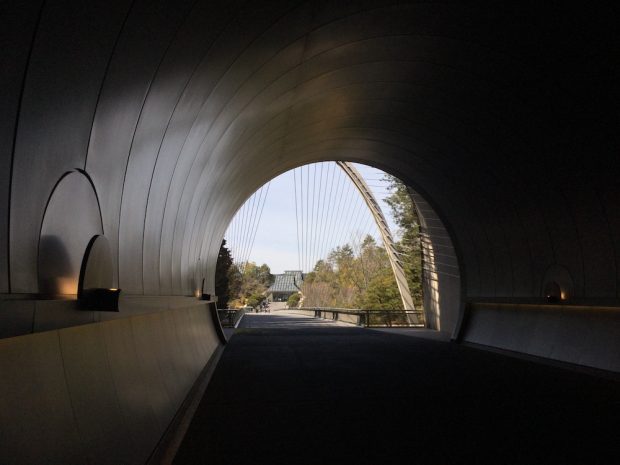 A dramatic design that crosses a suspension bridge and leads to an art museum through a futuristic tunnel. Design of the famous American architect IM Pei. The other side of the tunnel is a row of branch cherry trees. Every year around April is the best time to see.
The special exhibition "Daitokuji Ryukokuin National Treasure Yoshoku Tenkame and Ukusa Tei" will be open until May 19th. Because there are overwhelming display points, and there are also display changes, please be careful about your works.
From Heisei to the era of the new era, it is an exhibition that you want to visit by all means on large 10 consecutive holidays.
By the way ... what is that so? It's literally the case of a broken grass that is a useless and useless one. Furthermore, Mr. Kumao Kumakura, director of MIHO MUSEUM, explained it at the press conference on the introductory show, saying, "The price can not be paid, no one can buy it, it is wonderful."
After seeing the exhibition, you should understand the meaning of this word.
※ All works without indication of the exhibition period will be displayed for the whole period
Sentence / Hashimoto Kichi
Special Exhibition "Daitokuji Ryuko-in National Treasure 変 破 破 破 鞋"
During the exhibition period being held on May 19, 2019 Venue MIHOMUSEUM North Building Address Shigamachi Shigahara Shigamachi Tashiro Momoya 300
TEL 0748-82-3411
Opening hours: 10:00 to 17:00 (until 16:00)
Closed on Monday * April 29 (Mon), May 6 (Mon) will be open, April 30 (Tuesday) and May 7 (Tues) will be closed
Official site
I want to read together
・ What is the national treasure "day change heavenly eyes"? That 3 crafts of miracle can be seen in MIHO MUSEUM and others!
My motto is "I'm serious about being stupid", and I am having fun and having fun every day.