





What Exactly is a Temizusha For?
Written with the characters for “hand,” “water,” and “pavilion,” Temizusha (pronounced temizuya or chōzuya) is the dedicated space at a shrine where visitors purify both mind and body before presenting themselves to the deities.
This beautiful custom actually evolved from an ancient Shinto practice known as misogi (ritual purification). In the past, before entering a sacred space, people would perform Misogi (禊), which involved washing their bodies in a nearby river or the sea, or standing under a waterfall to wash away all impurities. Later, as society evolved, buildings were constructed specifically for the ritual of purification known as Temizu (手水), and these came to be called Temizusha. It is essentially a simplified version of Misogi adapted for the modern age.
The Pronunciation of Temizusha Changes Depending on the Shrine!
The pronunciation of Temizusha varies widely depending on the shrine. You can find out the specific pronunciation at each shrine by asking them directly. It boasts a rich variety of pronunciations, such as ‘Temizusha’, ‘Temizuya’, ‘Chozuya’, and ‘Chozusha’. At the shrine I visited, I was informed that because the water basin used to collect water is called a Chozubachi (手水鉢), this might be where the names ‘Chozusha’ and ‘Chozuya’ originated from.
What is the Etiquette for the Temizusha?
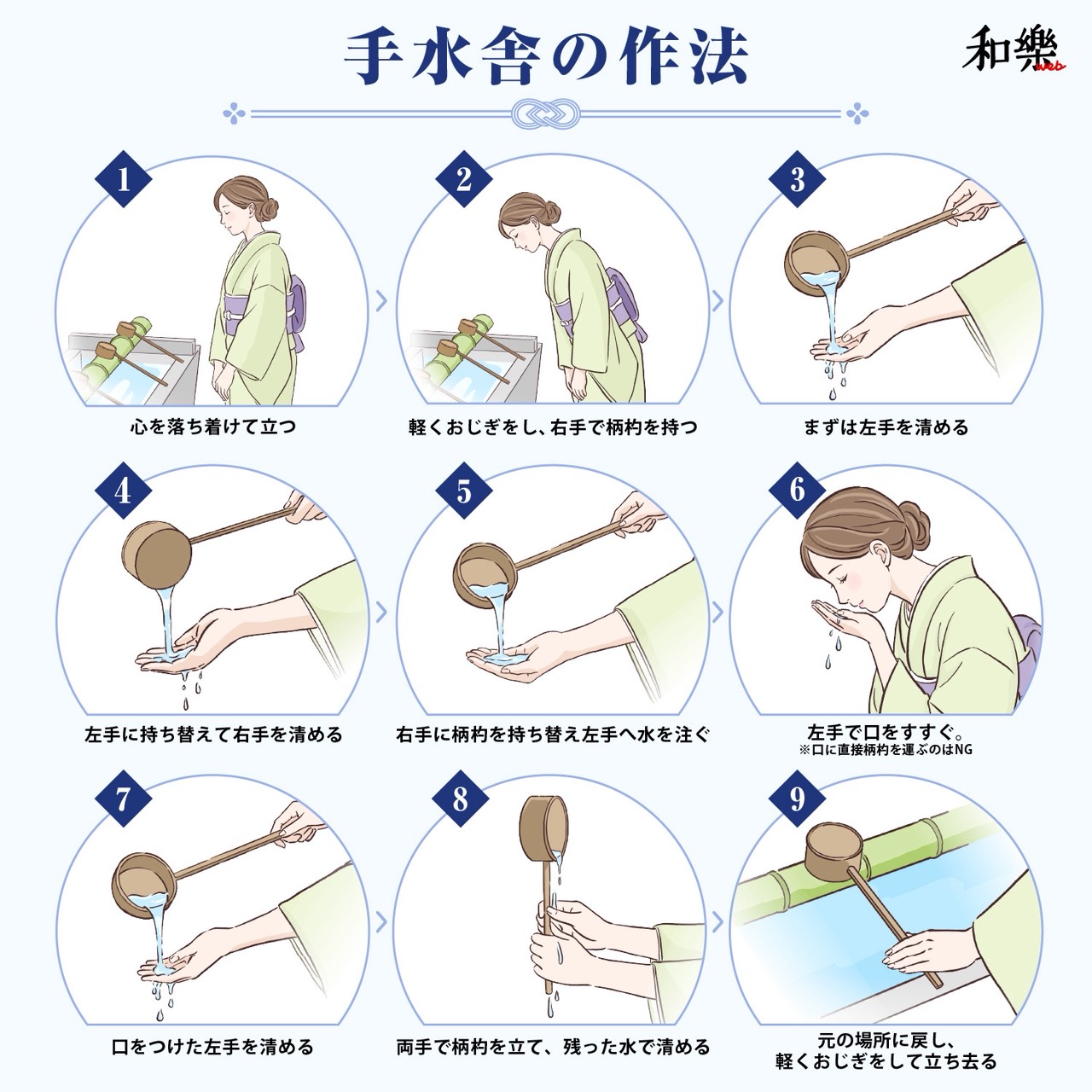
Now, how exactly should one go about the act of purification at a Temizusha? Many people might feel a bit uncertain about it. I shall explain it step by step.
(1)Upon arriving at the Temizusha, calm your mind and stand still. In the case of a temple, you may follow the same procedure as you would at a shrine without any issues.
(2)Before moving on to the Temizu etiquette, perform a slight bow. This is also necessary when passing through a Torii (鳥居) or a gate. Next, hold the Hishaku (柄杓, ladle) with your right hand and draw some water. As a rough guide, fill the Hishaku to the brim.
(3)First, purify your left hand. The amount of water to use for this step is about 30% of the total.
(4)Transfer the Hishaku to your now-purified left hand, and this time, purify your right hand. Similarly, use about 30% of the water.
(5)Once you have finished purifying your hands, transfer the Hishaku back to your purified right hand to rinse your mouth. Then, pour water from the Hishaku in your right hand into your left hand. It is perfectly fine to use the water until about 10% remains in the Hishaku.
(6)Bring the water collected in your left hand to your mouth and rinse it. Please note that as a matter of etiquette, it is unacceptable to bring the Hishaku directly to your mouth.
(7)Rinse and purify the left hand that touched your mouth.
(8)Finally, purify the Hishaku with the remaining water. Hold the Hishaku upright with both hands, allowing the water to run down the handle, washing over the part you were holding.
(9)Once you have finished purifying the Hishaku, return it to its original place. Please do so carefully, keeping the next user in mind. Just as at the beginning, perform a slight bow before stepping away.
The history of the misogi ritual is ancient, and it is said to date back to Nihon Shinwa (日本神話). It is fascinating how this custom has endured, even whilst changing its form. Do please visit a shrine when you are next in Japan and experience the etiquette of the Temizusha for yourself.
References: ‘Nihonjin ga Shiranai Jinja no Himitsu‘ (日本人が知らない神社の秘密) by Hida Hirofumi (火田博文), Saizusha (彩図社); ‘Sekai Daihyakka‘ (世界大百科), Heibonsha (平凡社); ‘Nihon Daihyakka Zenshu‘ (日本大百科全集), Shogakukan (小学館)
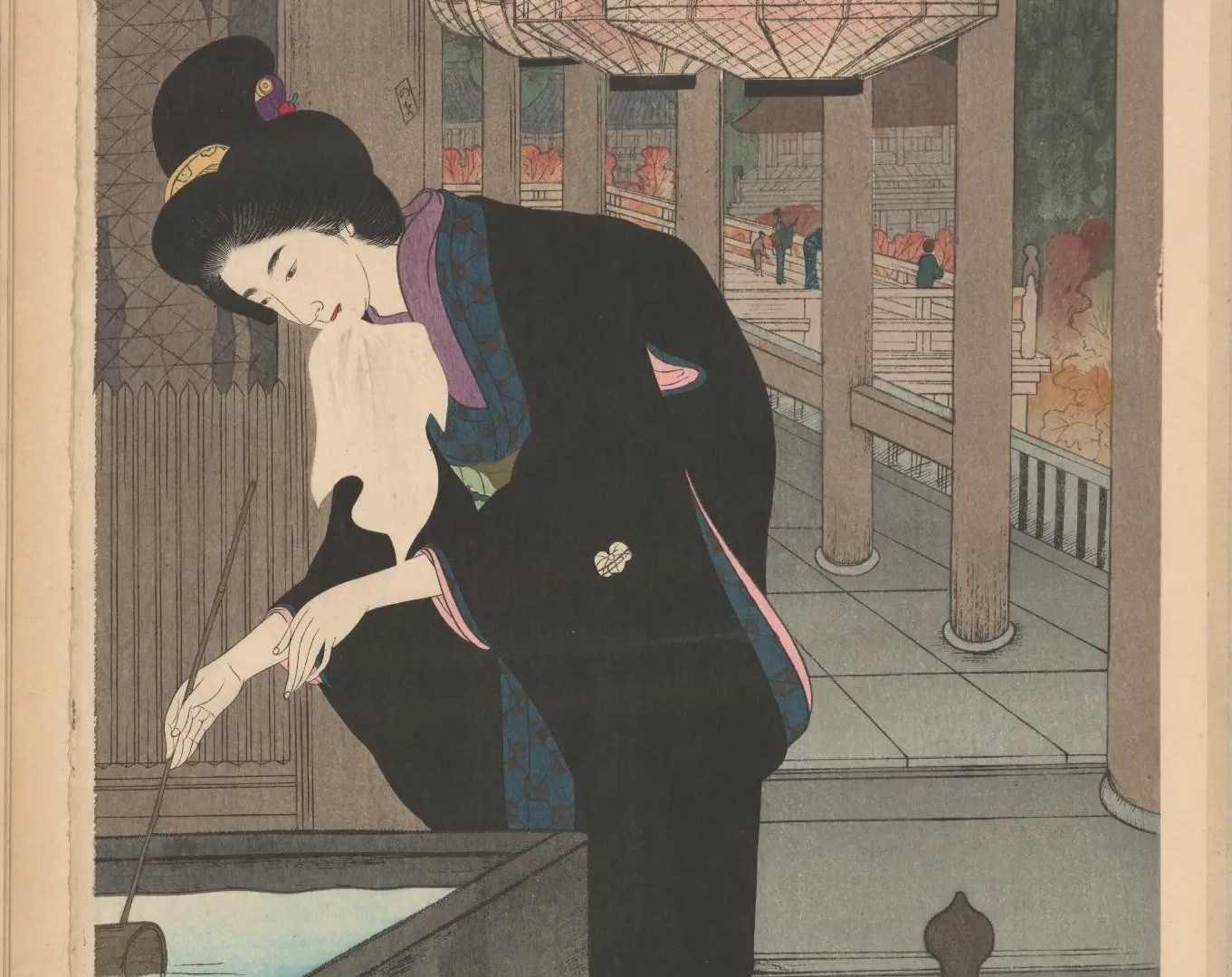
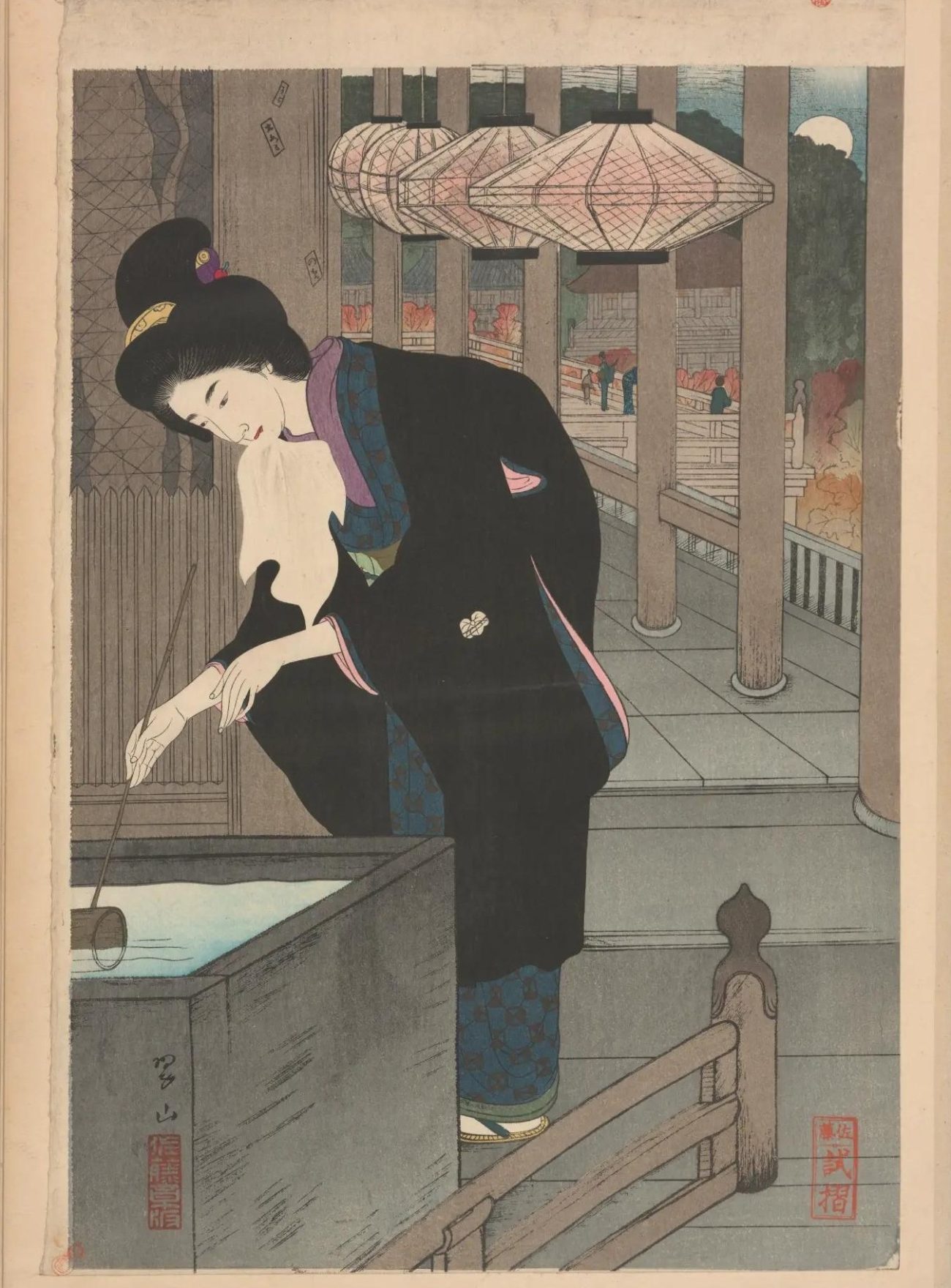
Header image: A portion of ‘Shinsen Kyoto Meisho Miki Suizan Sosaku Hanga Dai 1 2 Shu‘, Kokuritsu Kokkai Toshokan Dejitaru Korekushon
This article is translated from https://intojapanwaraku.com/culture/306011/