





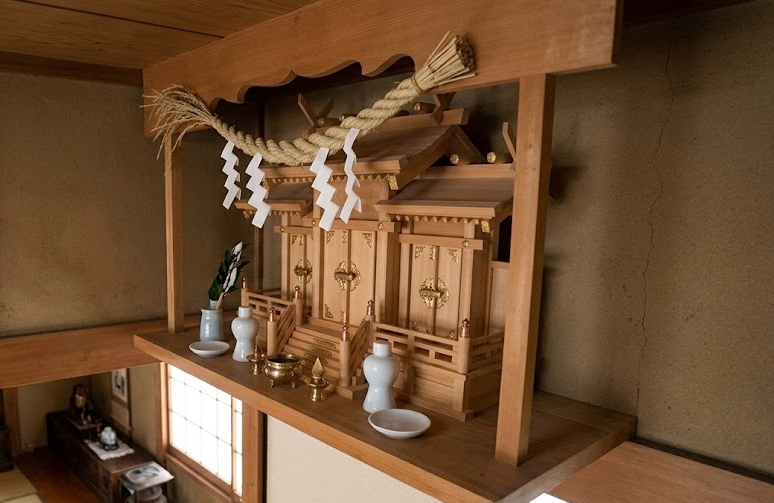
What Exactly Is a Kamidana?
A kamidana is a small shrine structure called a miyagata (宮形) placed upon a shelf positioned high on a wall. Inside it are kept wooden or paper amulets called ofuda (御札), which bear the names of deities. The most representative of these are the ofuda from Ise Jingu (伊勢神宮), but many households also enshrine ofuda of their local guardian deity, known as the ujigami (氏神様), alongside amulets from shrines associated with their family business or specific wishes, such as business prosperity or safe childbirth.
The house where I grew up also had a kamidana, and in the morning my grandparents and parents would offer omiki (お神酒)—sacred sake—and press their hands together in prayer. In the evening, they would remove the offerings and pray once more.
The most common offerings consist of rice, salt, water, and omiki, which are typically replaced daily or at regular intervals. While the offerings and decorative styles vary according to regional customs and traditions, in most cases it is customary to “string a shimenawa (注連縄) sacred rope across the front, place sakaki on the left and right, and set out lighting fixtures” (from ‘Katei Kamimatsuri no Shiori‘ [家庭 神まつりの栞], edited by Shinto Koron Sha [神道公論社]).
Regarding the orientation for enshrining the altar, it is said that “any direction is fine, though facing south has been considered best since ancient times” (from ‘Kamimatsuri to Sono Saho‘ [神まつりと其の作法], compiled by Miyazaki Prefecture Shinto Priests Association [宮崎縣神職會]).
Some households also enshrine a mirror, which stems from the belief in Shinto (神道) that deities do not have a fixed physical form. Rather than being the goshintai (ご神体)—the sacred body of the deity itself—the mirror is considered a symbol that reflects the inner purity of the person looking into it.
Why Welcome Deities into the Home?
In Japan, deities have traditionally been believed to reside not only in shrines, but also as yaoyorozu (八百萬)—eight million spirits—dwelling within mountains, rivers, trees, and all manner of everyday objects. Welcoming a deity into a kamidana is not about “confining” them inside the house, but rather “inviting” them in. The kamidana functions as a doorway for the family to offer daily gratitude, pray for safety and prosperity in the household and family business, and cultivate a continuous, intimate relationship with the deities.
While the origins of this custom are ancient, it took firm root among the common people particularly during the Edo period. As the worship of Ise spread nationwide, oshi (御師)—low-ranking priests and guides from Ise—delivered ofuda to various regions, and people began enshrining them in their homes.
Kamidana and Butsudan: What Is the Difference?
Alongside the kamidana, many Japanese homes feature a butsudan (仏壇). Although both are spaces created inside the home for prayer, their character differs significantly.
A kamidana enshrines Shinto deities—such as the gods of Ise Jingu or local ujigami—and houses symbolic yorishiro (依り代), objects that draw divine spirits, in the form of ofuda. Images or ihai (位牌)—ancestral memorial tablets—of individual ancestors are never enshrined within it, and it is positioned above eye level. (In my parents’ home, photographs of our ancestors were hung beside the kamidana.) In a sense, the kamidana serves as a doorway for “neighbourly relations with the deities”, where the family offers daily gratitude and prays for household safety.
A butsudan, on the other hand, is primarily a place to honour deceased family members and ancestral ihai. Its core purpose is ancestor veneration, and it is usually set up at a height where it is easy to pray every day, such as in a zashiki (座敷) Japanese-style tatami room or a tokonoma (床の間) alcove.
Kamidana and butsudan have developed within Japanese homes while influencing each other throughout history, and it is by no means unusual for both to be present in a single household.
Purity Is Paramount
It is said that a kamidana should be established by “selecting the purest location in the house that is convenient for making daily offerings and praying”. Furthermore, it is not made overly ornate. Simplicity, and above all, daily cleaning to maintain “purity”, are considered essential.
A small kamidana symbolically illustrates the nature of Japanese faith. The sacred is not kept at a distance inside a dedicated sanctuary; rather, it is welcomed into the home, cared for every day, and gently woven into the rhythm of ordinary life.
References:
‘Katei Kamimatsuri no Shiori‘ (家庭 神まつりの栞), edited by Shinto Koron Sha (神道公論社) (1941, from the National Diet Library Digital Collections [国立国会図書館デジタルコレクション])
‘Kamimatsuri to Sono Saho‘ (神まつりと其の作法), compiled by Miyazaki Prefecture Shinto Priests Association (宮崎縣神職會) (1936, from the National Diet Library Digital Collections)
This article is translated from https://intojapanwaraku.com/culture/314409/