







When you think of summer treats in Japan, for most people, kakigori (shaved ice) immediately comes to mind. In fact, July 25th is officially “Shaved Ice Day.” Shaved ice is traditionally called natsugoori (literally “summer ice”). The Japan Kakigori Association selected July 25th for two reasons: first, as a Japanese number pun where the date 7/25 corresponds to the sound of natsugoori—7 (na), 2 (tsu), 5 (go)—and second, because July 25, 1933, was the day Yamagata City recorded a historic high temperature of 40.8°C (105.4°F).
Nowadays, one can enjoy kakigori all year round, but it used to be a luxury item that only a select few could eat. We introduce the history of kakigori, a hallmark of summer!
(In this article, “finely shaved ice, as well as that with added sweetening such as syrup” is referred to as kakigori.)
‘Summer Ice’ was a precious item
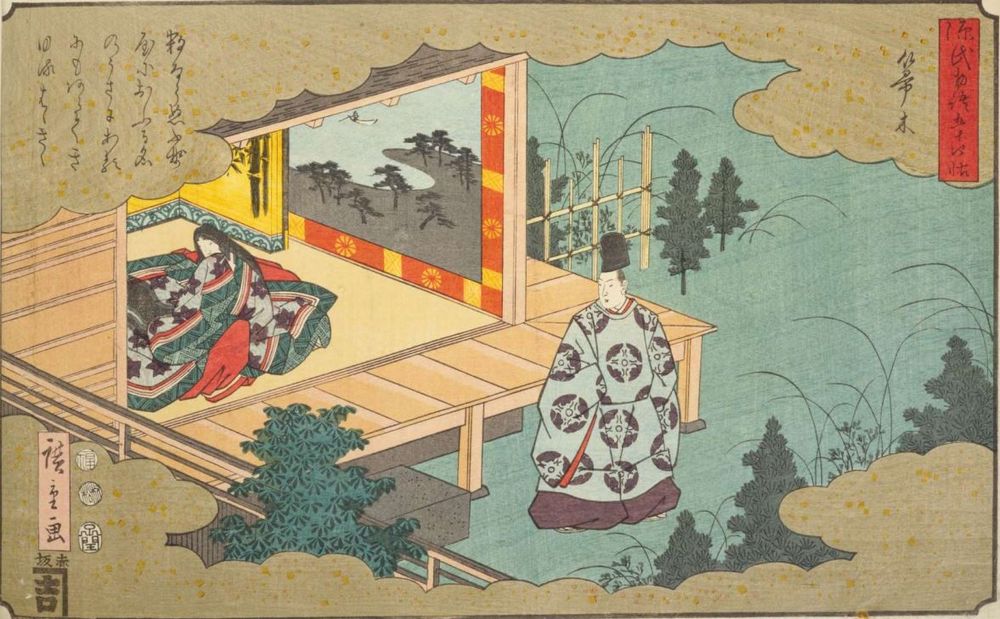
The history of kakigori is ancient, and it is said that kezurihi (削り氷), which appears in The Pillow Book (枕草子) by Sei Shonagon (清少納言) from the Heian (平安) period, was the first. In a section titled “Elegant Things,” she listed:
“Shaved ice mixed with sweet vine syrup, served in a brand-new metal bowl.”
At the time, shaved ice was known as kezurihi, and it was sweetened with amazura—a syrup made from boiled ivy sap that tasted similar to honey.
In an era without refrigerators or ice-making machines, summer ice was extremely precious. During winter, natural ice was cut out and preserved in storage facilities called himuro (氷室) built deep in cellars or caves at the foot of mountains. In summer, the ice was cut out and transported to the capital, and it is said that they warded off the summer heat in the Imperial Court. During transportation, the ice would melt, and by the time it arrived at the Imperial Palace, the ice must have become small. Only a select group of aristocratic classes were able to shave that ice with a small knife and eat it.
Furthermore, himuro already existed in the Nara (奈良) period, and there was a system of using ice as a tribute to the Emperor. In the Edo (江戸) period, it is recorded that the Kaga Han (加賀藩) presented snow-ice, which had been cut out during winter, to the Shogun every year on 1 June.
Tracing the history of kakigori
Towards the end of the Edo period, it became possible to transport large amounts of ice from the northern provinces to Edo (江戸) using ships, and ice became more familiar. It was not until the Meiji (明治) period that the first ice shop in Japan opened and ordinary people were able to taste iced water.
American ice arrives in Yokohama
At the end of the Edo period when the Port of Yokohama opened, there was an American who imported ice from Boston, America. The ice, which arrived in Yokohama via Africa taking more than half a year from departure, was about the size of a mandarin orange box and is said to have cost as much as three ryo.
The person who took interest in this ice was Nakagawa Kahe (中川嘉兵衛).
Nakagawa, originating from Mikawa no Kuni (三河国), worked as a cook under the British Minister Alcock in Yokohama, and then opened a shop dealing in beef and milk. Nakagawa engaged in a wide range of businesses, such as opening the first beef shop in Tokyo and selling bread learned from British soldiers. Having been taught by a missionary visiting Japan that ice was useful for medical care and food preservation, Nakagawa attempted to commercialise the production, extraction, and sale of natural ice, and tried making natural ice in various places.
Japan’s first kakigori shop opens!
In the summer of 1862, he transported ice from Hakodate and Lake Suwa, and opened Japan’s first kakigori shop, Korisuiya (氷水屋), on Bashamichi Street (馬車道通り) in Yokohama. When he first started the shop, iced water, known as korisui did not sell well due to rumours that it was “bad for the stomach”, but once it was known to be safe, it sold explosively, helped by the summer heat. It was two mon for a bowl, and it was so popular that people allegedly had to queue for two hours to buy it.
Nakagawa attempted to extract ice at the foot of Mount Fuji, Lake Suwa, Kamaishi, Akita, and Aomori and transport it to Yokohama, but all ended in failure. Even so, Nakagawa did not give up, poured in his entire fortune, and crossed over to Hokkaido, focusing on the ice formed in the moat of Goryokaku (五稜郭) in Hakodate. One year after the Battle of Hakodate (函館戦争) in 1869, he obtained a seven-year exclusive right for ice extraction at Goryokaku from the Hokkaido Kaitakushi (北海道開拓使), Kuroda Kiyotaka (黒田清隆).
In 1870, he established an ice-making facility at Goryokaku and began full-scale production, selling Hakodategori (箱館氷). Hakodategori gained popularity because it was cheaper and of better quality than imported ice, won out against foreign companies,and even earned an official warrant to supply the Imperial Household.
The first ice cream sold at a kakigori shop
It was in June of Meiji 2 (1869) that a full-fledged kakigori shop was established. On Yokohama Bashamichi Street, Machida Fusazo (町田房造) opened a korisui shop and sold korisui and what was known as the time as ‘aisu-kurin’. This is said to be the first ice cream in Japan, but the first one was apparently sherbet-like.
Machida, who was 28 years old at the time, devoted himself to the way of life of Katsu Kaishu (勝海舟), travelled to America twice, and returned after learning methods for making ice, matches, soap, and rivets for shipbuilding. Ice cream was expensive, and at first, foreigners only dropped by occasionally, so it did not sell well, but it is said that he tried again at the grand festival of Iseyama Kotaijingu (伊勢山皇太神宮) the following April, and Japanese customers started coming in as well.
Becoming indispensable in summer with the production of artificial ice and the development of ice-shaving machines
With the development of ice-making technology, kakigori spread among the common people as well. In 1883, Tokyo Seihyo Kabushikigaisha (東京製氷株式会社) was established in Kyobashi Shinsakaecho (京橋新栄町), and ice production using ammonia commenced. This machine was purchased under the supervision of an American, and being an older model, there seemed to be quite a few inconveniences. In 1888, the business expanded by purchasing a new machine. Regarding ice-making technology, machine ice-making became the mainstream from around 1897 onwards.

Also, in 1887, Murakami Hanzaburo (村上半三郎) invented a ice shaving machine and obtained a patent. However, it was not until the Showa period that the machine became common, and until then, a method of shaving using a block plane was typical. In this way, korisui became further popularised, and around the 1890s, it came to be loved by the common people as an indispensable item for summer.
Ice water shops in the Meiji period seen in the media
There were even deliveries!?

An illustration of a street stall selling korisui is published in the book titled Meiji no Hikari. The woman on the far left is holding a carrying box, so she might have gone for a delivery nearby. At the shop, the master is working. It merely involved wrapping a block of ice in a white cloth, smashing it with a small mallet, putting it into a glass, and pouring water over it; it might have contained syrup, but it seems it was not yet something like kakigori.
The ice shop in Kanda Ogawamachi had a rich menu

According to Meiji Jibutsu Kigen (The Origins of Meiji Culture), a Tokyo ice shop in August 1891 offered flavored shaved ice options alongside simple sweet iced water (kōrisui): hailstone ice (kōri-arare), mandarin orange syrup (kōri-mikan-sui), lemon syrup (remon-sui), ice with sweet rice dumplings (kōri-shiratama), light matcha ice (usucha-gori), and ice with sweet red bean soup (kōri-shiruko).
There were also kakigori vendors!

As in the illustration ‘Natsu no Yowatari Awa Tokushima ni Oite Shoken’ published in Fuzoku Gaho (10 August issue, Meiji 31 (1898)), there were also vendors who carried poles on their shoulders and walked around selling while crying out, “Bukkakigori~” (ぶっかき氷〜). This vendor’s cry in the hot summer must have been the most delightful thing for the common people.
By the way, korisui was only for summer, and according to Tokyo Fuzokushi Chukan (東京風俗志 中巻), it says, “As the korisui business is a summer trade, many vendors such as those selling hot sweet potato, shiruko soups, and mizugashi sweets temporarily switched to this…”
Japan’s kakigori is diversifying year by year

Today, we can enjoy a variety of kakigori.
Carefully crafted kakigori at long-established traditional Japanese sweets shops, and luxury kakigori enjoyed in the lounges of high-class hotels. Recently, in addition to local kakigori from various parts of Japan, kakigori from all over the world are also popular, such as Taiwan’s Xue hua bing which incorporates the concept that medicine and food have the same origin, and South Korea’s Bingsu with lots of toppings placed on fluffy ice. Also, the types of home-use kakigori machines are increasing. At convenience stores, various ice sweets are also sold exclusively in summer.
Summer is just getting started. The season when kakigori becomes even more delicious has arrived. What kind of kakigori will you enjoy this summer?
[Main reference materials]
Nihon Daihyakka Zensho 4 (日本大百科全書 4), Shogakukan (小学館), 1985, ‘kakigori’ entry
Yumoto Koichi (湯本豪一) Meiji Mono no Ryuko Jiten (明治ものの流行事典), Kashiwashobo (柏書房), December 2005
Yumoto Koichi Zusetsu Meiji Jibutsu Kigen Jiten (図説明治事物起源事典), Kashiwashobo, November 1996
Meiji Jibutsu Kigen (Jibutsu Kigen Senshu 2) (明治事物起源 (事物起源選集 2)), Kuresu Shuppan (クレス出版), August 2004 (Reprint of the Taisho 15 edition by Shunyodo (春陽堂))
Hiraide Kojiro (平出鏗二郎) Tokyo Fuzokushi Chukan, Fuzambo (冨山房), June 1990 (Reprint of the Meiji 34 edition)
Hara Joji (原丈二) Bunmei Kaika ga Yattekita (文明開化がやってきた), Kashiwashobo, October 2016
・Ippan Shadan Hojin Nihon Kakigori Kyokai (一般社団法人日本かき氷協会)
・‘Kori to Kurashi no Monogatari’ (氷と暮らしの物語)(Nichirei (ニチレイ))
This article is translated from https://intojapanwaraku.com/rock/gourmet-rock/17343/