











Due to the influence of the game "Token Ranbu", interest in swords is increasing now. However, there should be a lot of people who say that "swords look the same". There is a point of appreciation in the sword, but this time I will introduce a drama about the sword and the warlords. You should be very interested in knowing the background.
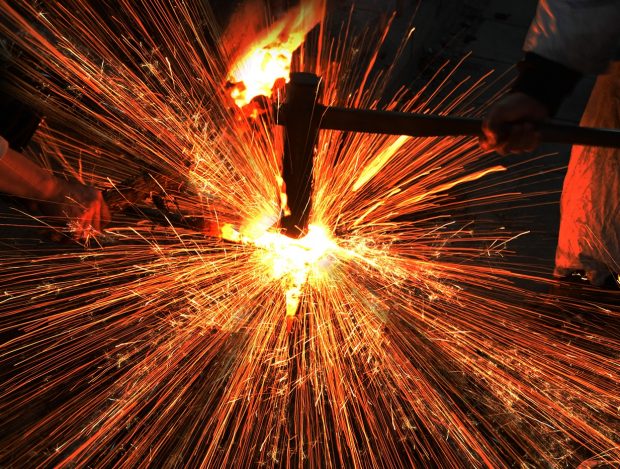
When you go to the museum or art museum, there is a crowd in the corner of the sword. It is a scene I often see these days. It's great to be interested in swords and history, even if the intriguing entrance is a game. This time, the story is about the sword and the warlords, but the sword was a consumable item at the same time of war, it was also a sacred one. The fact that one of the three types of monsters is the Tenno Ukuruken (Ame no Murokuru Tsurugi) may also indicate the Japanese mind. The good and bad of the sword also leads to the separation of life and death on the battlefield as well as martial arts. That is why the warlords all sought out the best swords, and various dramas were born.
Before we get into the main subject, let's talk a little about the swordsman who beats the sword. Since ancient times, the area that produced the Great Swordsman can be classified into five according to the times and styles. The oldest, Yamato heat transfer, which is known in heaven to be the father of Japanese sword (the sweet) (Nara Prefecture), Sanjo SoKon (Munechika Sanjo) Den Yamashiro to the father of the (Kyoto), such as the rich iron sand and charcoal Bizen Den blessed with material (Okayama Prefecture), Aishu heat transfer the Kamakura shogunate was collected Uncariae (Kanagawa Prefecture), in Den Mino warlords were defending local authority over the Warring States from morning north-south (Gifu Prefecture), these "Den Goka (charged It is called ")" . Of course, there were swordsmen in other areas, but it was affected by "Goden" not a little.
"Kido Yuki" in Kyushu cuts a thunder god
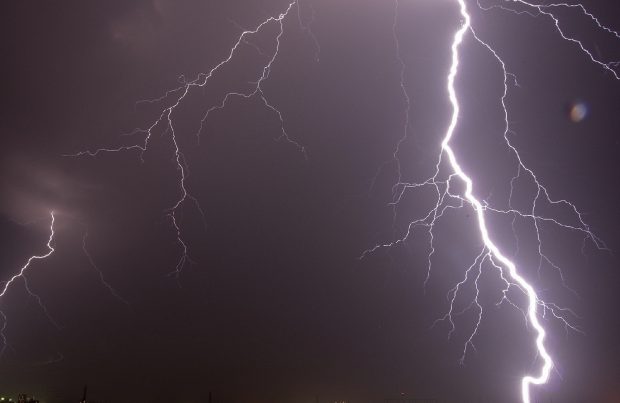
"Go! Plunge the plow into the middle of the enemy! If your life is sad, then escape!"
From the warriors who got on the boat, a great deal of ignorance flies. This man was the master of the Bunko (now, Oita Prefecture) Otomo family, Tachibana-do (Kanren <Akitasura>), who is scared of being a demonic member and the enemy and allies.
Otomo Sorin has boasted Kyushu's largest power for a while. It is road snow that supported the expansion of the print. He has been known as a general of wisdom and wisdom since his youth, and is said to have entered a battle of 37 degrees throughout his life, and he has never been defeated, but he has suffered walking difficulties due to unforeseen events.
Michiyuki, about 35 years old. When I was rested in the shade of Taiki in summer's intense heat, lightning suddenly ran and thunder fell in Taiki with a roar. When seeing the appearance of the unusual shape in the flash, Michiyuki falls without showing a hand to pull out his favorite sword "Chidori". It is said that both thunder gods and thunder beasts had a certain response. Michiyuki later changed the name of his sword from "Chidori" to "Raikiri" , but he became impotent in the lower body due to the sequelae of electric shock.
However, even if you get into the battlefield by riding a boat, the way snow battle spirit will not decline. Always come to the forefront, and when you say here, command the commander to "place your fortress in the enemy" . Allies insisted, "Do you want to defeat Michiyukiden", and it was often to defeat the enemy.
It is said that the first snowfall of road snow has been transmitted to the far east country, and Takeda Shingen of Kai (now Yamanashi Prefecture) said, “I would like to meet road snow” . Michiyuki was killed in Chikugo (currently the southern part of Fukuoka Prefecture) in Tensho 13 (1585), and "Lightning", commonly referred to as the Aishu object, was passed on by Muneshi Tachibana . In addition, it has been fixed to a short armpit by polishing a sword at present, but it is pointed out that there is a portion that has turned into a blade and that it may have actually hit lightning.
Swords data 1 "Lightening" (Lighting round)
"Lightning-off (light-raising round)" (unnamed) Wakizashi Edge length 1 size 9 inches 3 minutes (approximately 58.5 cm) Tachibana family history museum storehouse
The Battle of Kawanakajima was also a battle between the famous swords
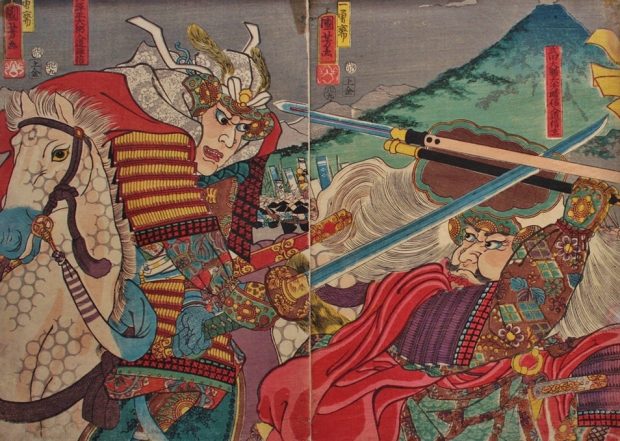
Utagawa Kuniyoshi "Kawanakajima Battle" (part)
It is Shingen who wanted to see Michiyuki, but even if he does not do it, he will confront with a man with a sword that is also said to have killed thunder. My name is Echigo (currently Niigata Prefecture) Uesugi Kenshin .
Ashinin's love sword was named "Takeshi Kanemitsu" because he was handed over by Bizen Osafune Kanemitsu and was taken over by his vassal Takeshi Mikawa Mamoru Shina (Takata Mikakawa no Kami and Mikana).
It is said that the farmers of Echigo originally possessed this kind of tradition in the "Jozan Kidan". One day, when the farmer was walking in the mountains, thunder rang. Suddenly, a roar of a lightning strike occurred overhead, and the frightened farmer pulled out the light and held it over his head and stopped when his eyes closed. If you notice it, it will be dyed red from the point of the sword to the blade, and the splashes of chiffon will also fly to the kimono. It is said that the farmers believed that "the sword cut the fallen thunder god" .
In addition, they noticed that red beans were dropped one by one without notice that holes were opened in the hemp bags that had been broken. When I looked at it, I saw the blade from the cleft of the sheath, and the azuki bean that I hit was broken (this is an episode of Azuki Nagamitsu).
Koshin was in charge of Kaneshima and battled the Kawanakajima Battle in 1556, and cut down Takeda's warriors who had set up a single cylinder (a gun) with a single sword. Then, the slashing not only cuts off the armor, but also cuts off the gun barrel at an angle, causing Takeda to surprise. However, since no major collision has occurred on Kawanakajima in 2 years, it should be called a legend.
Aside from the bamboo chopsticks Kenmitsu who said that he had killed a gun, Fushin also held the Bicho Nagamitsu "Azuki Nagamitsu" and the Aishu Fujisaburo Yukimitsu "Azuki Go Yukimitsu" It can be transmitted (there is also a misconception that Azuki-don was also long light). It is considered to be a samurai sword (Yaito) when 謙 nobu cuts to Shingen in the Kawanakajima battle, and I do not know the exact point. However, Shinshin seemed to like the Bizen sword.
The Fourth Kawanakajima Battle in Nagai 4th year (1561), where one battle between Shingen and Shinshin was believed to have occurred, has recently been paradoxical, but it is a fact that both forces clashed at Hachimanbara (Hachimanbara) . The Uesugi army, aiming for the Shingen Honjin, defeated Shinsuke Takeda 's younger brother Shinsuke Takeda , who has been defended as a shield. It is also transmitted that Akira Kakizaki (Kakizaki Kage) apologized to a theory.
It is also said that Nobunari Shigeru was killed in Bizen Saburo Kunijong, later called "Denisan" . In addition, Shingen is famous for receiving Shinshin's sword with Gunban Ichi, but it is said that Shingen also received it with the sword of Kokumune according to different theory, and that the sword is Nobunaga Oda, Hideyoshi Toyotomi after the fall of the Takeda family. The Tokugawa Shoguns moved around, and during the Edo period, they were transmitted to the Former Takeda's flagship and Muroka family.
In any case, Kenshin was a rush to Takeda Honjin, Takemata and light or red beans wavelength light, or put the sword violently at the red bean porridge line light Shingen, if it has received this in even Bizen Saburo countries Zong Shingen, just between swords It will be a match .
Sword data 2 "Takeshi Kensuke" others
"Takeshi Kanemitsu" (Bizen Osamu Kanemitsu) No extant (Oh, after missing in Toyotomi Hideyoshi, missing in Osaka)
"Azuki Nagamitsu" (Bencho Naganaga) Unknown (at present, there is no confirmation that Nagamitsu of Uesugi is Azuki Nagamitsu)
"Azuki Minato Yukimitsu" (Saishu Fujisaburo Yukimitsu) No extant (there is also a theory of confusion with Nagamitsu, but it is unknown as mentioned above)
" Distriction " (Sanjo Bizen Bizen ) No name Kengoku sect 2 long 3 inch 1 min (approx. 87.8 cm) Ii Museum
"Bizen Saburo Kunisune (for Takeda Shingensho)" unknown (The Muroka House had three cuts to support the battle of Kawanakajima, transmitted to the Meiji era, and transmitted to the hands of individuals during the Taisho era)
With Sada Chikamori Ranmaru's loyalty to Nobunaga's favorite sword
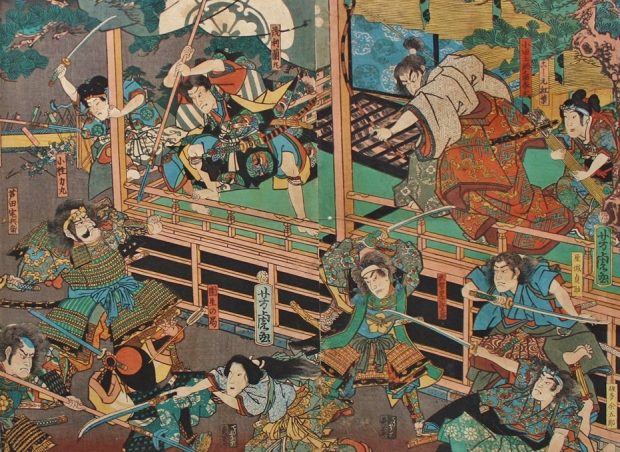
Yoshikawa Utagawa "Honnouji" (part)
"Fudo Yukimitsu, Tsukumo Hair, Goroza for People"
When Oda Nobunaga was upset, he said that he sang a song like that and boasted of his belongings. "Fudo line light" is a famous swordsmith of Aishu Den, Fujisaburo Yukimitsu (Kamakura period). It is the same person as the author of "Shogyu Yukimitsu" that Uesugi Kenshin used in Kawanakajima. The master of Jikomitsu is the founder of Aishu Den, and it is said that Shinto Gokomitsu (Mitsuto Shinto). In addition, it is Masamune to be the younger brother disciple of Jiko, or the son.
Nobunaga's line light was not a sword but rather a short sword (wakizashi), and it was called "unstable" because the immovable king and the unborn child of the genius (kensuku) were embossed. Nobunaga is known for having possessed a number of famous swords such as "Yoshimoto Samonji", "Heshikiri (Hisebe)" and "Bizen Osamu Mitsuharu" . In particular, the impassive line of light was a favorite.
By the way, the Tsukamomo hair of the song is a specialty tea bowl, also known as Tsukumo seaweed. In addition, Goro left is about Goro Niwa Goro Saemon Nagahide who joined a row from a small surname to a rowin, Nobunaga seemed to want to say, "I have the excellent item of the inferiors of either world ."
One day, Nobunaga told the surnames, "Let's guess the number of notches on the sheath of immobile line light . The sheath of the line of light was decorated with indents like a series of horizontal rings. Everyone says the number of thoughts, but it does not meet. However, there was one person who did not open her mouth. It is Mori Ranmaru ( Kinji) who is the best in Nobunaga. When Nobunaga, who thought suspiciously, asked why, "I have known that I have counted before. I have refrained from answering with an unknown face" . Nobunaga, who was delighted with the honest response of Ranmaru, is giving line light.
After that, Ranmaru cherished the enlightened line light, and it was said that he was carried even in the case of the change of Honnoji in the early morning of Tensei 10 (1582) June 2. And I will keep struggling against Akuchi Mitsuhide's armies until Nobunaga disappears in the back of the temple, and I will earn time until the end so that the Lord will not receive the enemy's shackles, but I will avenge melancholy. I was 18 years old. While Honnoji was covered in flames, Fudo line light also burned with the remains of Odaiya Tadaomi. However, although the circumstances are unknown, the burnt immobile line light has been transmitted to the Ogasawara family and is now extant.
Swords data 3 "immobile line light"
"Fudo Furumitsu" (Saishu Fujisaburo Yukimitsu) edge length 8 inch 4 minutes (about 25.5 cm) private collection
Was it the famous sword "Kotogiri" of Heiha Honda's that sword?
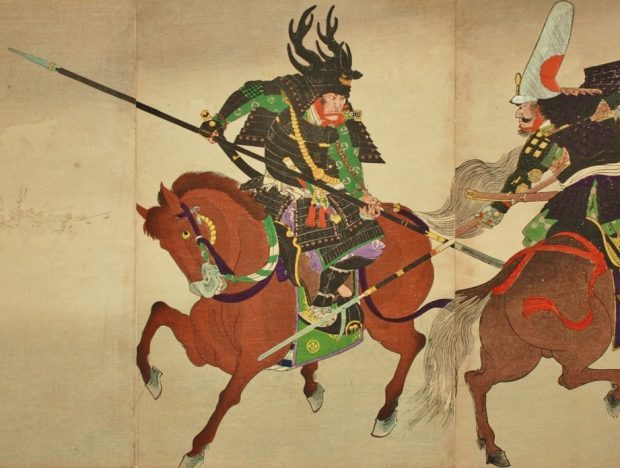
Shuen Tsuji "Senior Komaki" (part) 
Deadline (Illustration: Takeshi Mori)
"Hidekichi-Mikawa's Honda Heihachi (Hondaei Hachihachi) is the other party!"
A few captains of the Tokugawa team provoked the 80,000 followers of the Hideyoshi Habuchi army. On the shoulder of a black deer horn (Kazuno), a huge rosary (Juzu) is shouldered, and on the right side is a famous sea bream (Meissou) "Tombori" . It is the hero of the Tokugawa family, Hada Hira Hachiro (Tatsukatsu) .
Tensho 12 (1584), Komaki and Nagakute battle. There are only 500 lucky players. So Hideyoshi was amazed to sell the coffins to the 80,000 large army, and there were those who breathed, " Hide it off , " but Hideyoshi was greatly accustomed to the braveness of loyalties and was not allowed to take out his hand.
A loyal "Shingori" is a product of Mikawa Monjuha 's Fujiwara Masamasa . The nickname is derived from the fact that the flying kite touched the blade and became two.
The blade length is 1 inch 4 inches 5 inches (about 53.2 cm). It is a gem that can be counted as "Tenka Sanmeisyu", which has a lotus flower, a honji character, a three-sword sword, and a kanji character on top. By the way, the "world three people spear" is, "Japanese Patent" Kuroda house vassal-MoriFutoshi Samurai, known for "Takashi Kuroda" (Moritaee), transmitted to the Yuki family "your Tekine (tail Gine)" And is said to be overdue.
Tadakatsu used the black-painted pattern of 1-length 3-length (about 3.9 m) and made him nameless in numerous battles. It is also interesting to note that the true Mikawa Bungo facto is the flow of Senko Muramasa , which is believed to have a connection with the Tokugawa family.
Muramasa and Isekuni (now, Mie) in the middle of the Muromachi period, and a group worked in the Tokaido area including Mikawa (now, Aichi Prefecture). The sharpness is outstanding and attracts many warlords. On the other hand, the reason why today is also known from the image of "Yogami" is that there was a tradition called the Tokugawa family that is a sword.
In other words, "Ieyasu's grandfather, Kiyoyasu, was killed and his father, Hirotada, was used when he was stabbed." The sword was Muramasa, "" Ieyasu himself was injured at the village of Muramasa, and said, "This is also Muramasa . " In addition, Muramasa was a disciple of Ashu Masamune , but there is also a story that he was overlooked by evil and left the teacher.
However, Ieyasu gave Yoshimasa , the first founder of his son Owari Tokugawa, a Muramasa sword as an apprentice. It seems that Ieyasu himself did not think so because the image of the sword was made in the later generations. Since the village Shoichi school was originally active around Mikawa, Mikawa warriors usually used Muramasa swords. Also, since Masamune is a Kamakura-era person and Murasasa is a Muromachi-era, there is no reason for him to be a teacher and a brother. It was also natural that the local swordsman who beat the mark was the flow of Muramasa.
Sword data 4 "蜻蛉" and others
" Shogiri " (Mikawa Bunso Seishin) 穂 Hocho 1 scale 4 厘 5 pieces (approximately 53.2 cm) personal storage
"Sword (for Tokugawa Ieyasusho) " (named Muramasa) Blade length 2 scale 2 inch 7 minutes (approximately 86.2 cm) Tokugawa Museum of Art collection
Oni Musashi, a sculptor who carved "human innocence" at the base of Nosada
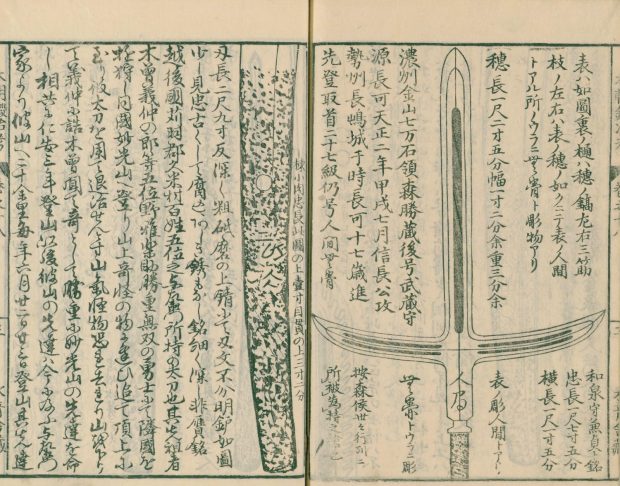
The "Human Boneless" Wolf as Described in "This Morning Blacksmith Vol. 18" (From the Digital Collections of the National Diet Library)
"In front of this ax, people have no bones . " There is a warlord who loves the cross-shaped ax carved in such a noisy meaning as "human boneless" . Mori Musashi manager long allowed (Mori Musashi or all) . It is an older brother of Akira Ranmaru, who accepted Fudo line light from Oda Nobunaga and was smitten by the strangeness of Honnoji. However, unlike the cool impression Ranmaru, the seven-year-old syllabary was superior to the muscular bones, and was a strongman of the Oda family who took the nickname of "Oni Musashi" . And there is a reason that the favorite crosshairs are sharp enough to be engraved as "human boneless". It is the creation of "Izumi no Kamikanada" .
Nijo Izumi Mori Kande was a swordsman who worked in Mino-Kuniseki (now, Seki-shi, Gifu) in the late Muromachi period, and the sword is the most excellent "big business (sloppy, very cutting sword) This is known as a thing) ". It was also known as Seki's "Sakusoku Rokugen-gen" (Magorokukane, "Seki's Sakusoku Roku") . Since Nisei and Kosei decided to make their own words in vain when making inscriptions, they are also called " Nosada " and are used regularly by warlike military commanders.
In the third battle of Ise Nagashima Ichimokuichi, Tensho 2 (1574), Nagakasa showed the work of killing 27 enemies with caress to surprise Nobunaga, and he continued to go wild in numerous battles. If you pierce the neck of an enemy who has longed for a long time and pierce the ground with a don and a whistle, the neck passes through the cross blade and is said to fall under the handle. It would be a parable that it was so sharp.
Although he is feared by his enemies, he is deeply sad, and comforts his mother again when he and his three younger brothers are lost at the same time in Honnoji. There was one side that showed a detailed concern to family and vassals. In addition, I will find out Yasuda Sakubei Kunushige (Ayushi Sakubei Kunushiku) , the subject of Akechi who drank his younger brother Ranmaru. When I was wondering if I would revenge my younger brother, Nagakada said, "I was a strong enemy who attacked my younger brother, but it is a martial art as a samurai." Yes. The sense of this area may be difficult for ordinary people to understand.
Nagayoshi always considered his own Takebe first, and in order to pass it, there were places where he could break fine rules and military decrees. It may be close to a kind, a clown . Nobunaga often warned in the letter, but he did not punish him heavy, but rather he was delighted with the long-awaited swaying "tilting". Was Nobunaga finding something similar to you?
Two years after the change of Honnoji, such a long-handed player fights with Tokugawas, fighting on the side with Hideyoshi Hazaki in the battle of Komaki and Nagakute, with Shikichi Ikeda and others, and shot with a gun. I will avenge. Because he was struggling at the forefront, the enemy did not think that he was a general, nor did he take away his neck and fort, and the fortification of "human innocence" was passed on to generations after generations.
Swords data 5 "human boneless"
"Human boneless" (Izumi Mamoru Kanesu) 穂 Honcho 1 scale 2 5 5 minutes (about 47.5 cm) Private collection ※ The copy is kept at Ako Oishi Shrine (Ako City, Hyogo Prefecture)
Why do Japanese find beauty in swords
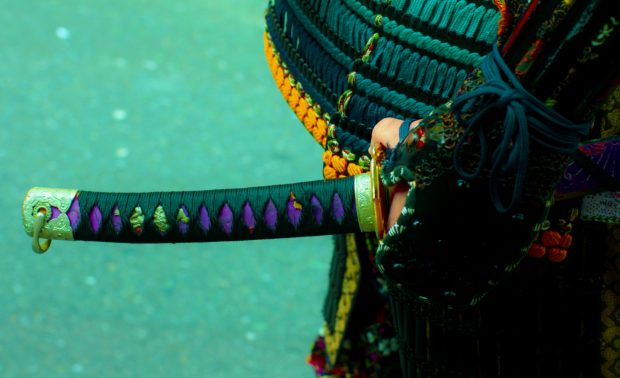
Well, how was it? This time I introduced the anecdotes of Sengoku warlords and love swords and atago, but these are only a few, and there are still interesting episodes. Also, not only in the Warring States period, but back in time, or even looking back from the Edo period to the end of the Bakumatsu, there is no shortage of anecdotes. Why are there so many stories about Japanese people and swords?
It is said that “Swords are the soul of samurai warriors” is in the middle of the Edo period, but as mentioned at the beginning, it seems that the Tenshukuunken (Kusanagi sword) is considered to be one of the three main objects. Since ancient times, the Japanese have been thinking that the holy power will dwell in the sword. It may be natural because you commit your life and defeat the enemy, so to speak, with a sword, the exchange of life. The warlords' swords have various nicknames, not just an expression of sharpness, but with the reverence to "something beyond wisdom" of the sword that governs life and death.
In addition, if the warriors make important promises, we will use a method called gold hammer . The promise of the samurai was "on the sword" , as they swear that their promises were not different and they shook each other's sword blades and thorns. If it is different, it will be called "a man who can not be upwind of a samurai" . In other words, the sword was synonymous with the personality and soul of the owner. In addition, if a samurai receives a shame, he cuts himself to save his honor. The sword was to decide one's life and death, and it was also a symbol of " preventing a humble behavior as a person " and symbolizing the view of life and death. Japanese people may feel tension and pure beauty in their swords without being conscious of us today, because Japanese people have inherited the activities of their predecessors in the pulse.
Warring States warlords, in particular, committed their lives to their swords and lived together. For them, the sword is not merely a tool to fulfill the purpose, but it is not an appreciation for beauty. It would be sacred and be described as a "love sword" that should be his own life. Next time, when you go to the museum, please try to face the sword while imagining the feelings they entrusted. You will surely feel something that has never been done before.
References: Fukunaga Drunk Sword "Japanese Sword-Yomoyama Story" (Oyama Cabinet), Maki Hidehiko "Nagatoden" (Shinkigensha) et al.
Sentence / Mr. Akito
I am from Tokyo. Work at a publisher. He has been in the editorial department of historical magazines for 18 years, including 12 years as editor-in-chief. Although he left the editorial department, he has not burned out yet, and he has been voluntarily posting historical articles on note for 30 consecutive days, and is captured by Takagi editor-in-chief. We believe that "knowing history is knowing humans". I have no eyes on ramen.