












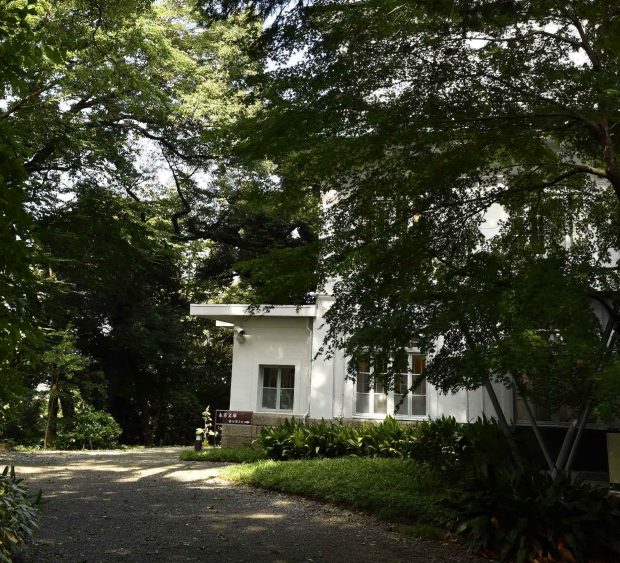
A series of studies on the Japanese culture of notable young Kabuki actors, Onoe Ukon and Kenken. This time, I went to the exhibition "Daimy Art Primer-Beauty of Princesses and Princesses-" held at Nagao Bunko in Mejirodai. Nagao Bunko is an art museum located at a corner of the large Hosokawa House residence from the Edo period to the post-war period. In the morning, in the interview before the opening, as soon as I came into the site of the Nagao Bunko, "Wow! I thought that the air is not Tokyo", Kenken showed a pleasant smile. Well, let's go from the exhibition room on the 4th floor!
The stylish armor of the Hosokawa family is novel!
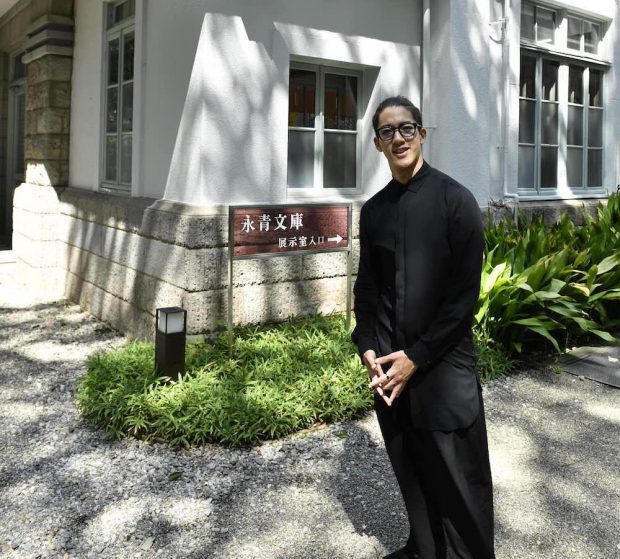
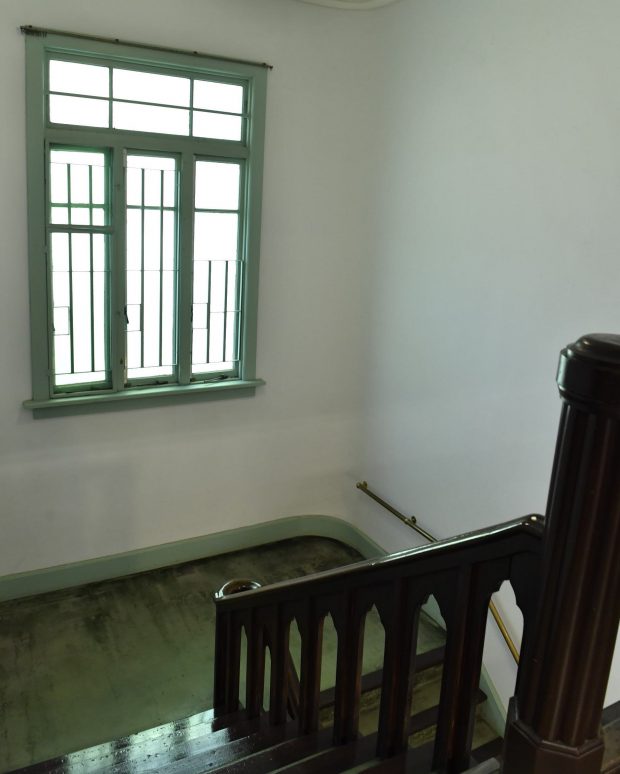
It may be helping today's weather, but somehow the atmosphere seems to be able to see the sea far from the window of this Western-style building .... I felt the air of the building when it came in from the front entrance was also very good.
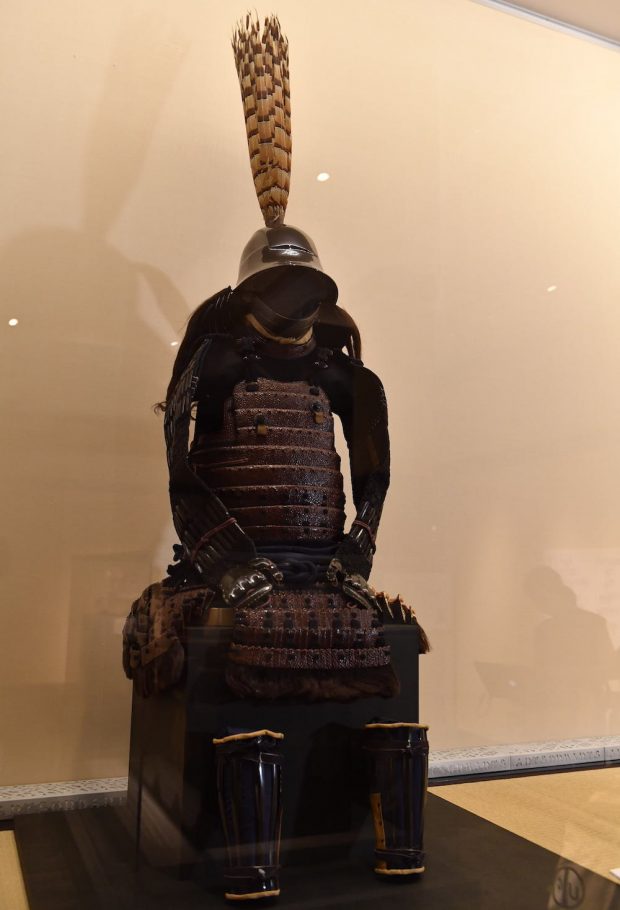 "Maroon leather wrapping thread 向 威" 具 Late Edo period
First of all, I was surprised at the stylishness of the characteristic armor of the Hosokawa family "Maroon leather wrapping thread 向 向 枚 足 足 足". It is possible to respond to the battle of the Warring States period when firewood and guns were popular, with a style called "Sansai style foot" that Hosokawa's second generation, Tadaoki invented using his own 50 years of war experience. It seems to be made lightweight. The color scheme is good, and it is nice to have a head with a tail of a mountain bird. Seen from the side, there are decorative hairs (made of horses, cows and yaks) behind the coffins.
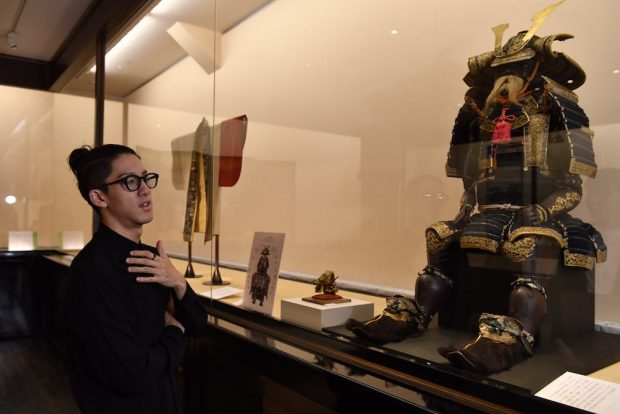 "Sakura-monmon-kinshi-butsu-maru-ganji" Mid-Edo period
On the other hand, the “Sakura-Bite Binto Bodhisattva Leg”, which was displayed next to it, is a colorful, luxurious, back-to-back armor that imitates medieval vats and bodice. This is a man, a form often seen in kabuki. In Kabuki, although there is a chance to put on chopsticks, it is surprisingly rare to put on a whip. The item "Kumaya Jinya" is most popular. It's quite heavy even in a costume when it's fully equipped, so it's still great when it's real. It is about 6 kg heavier than "Sansai style foot".
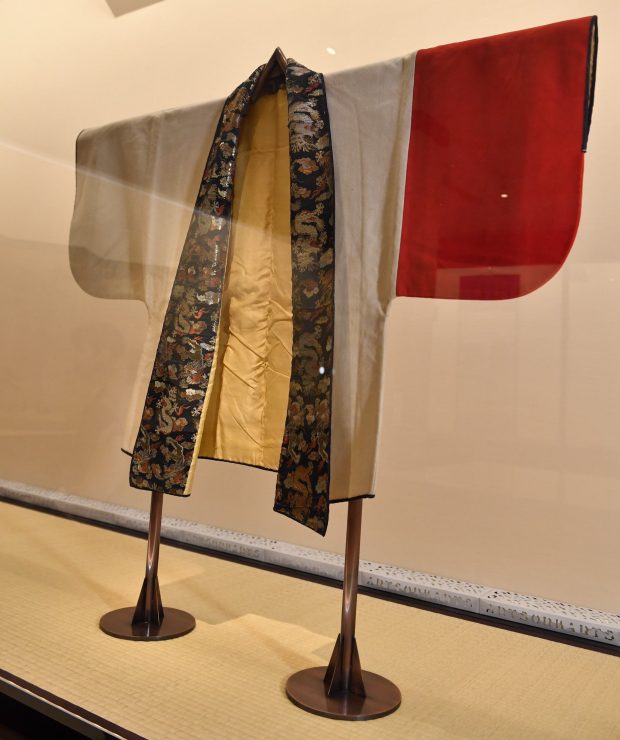 "Shirara 紗 left sleeve 緋 緋" Late Edo period
On top of the cocoon we weave a parting suit. It's on the coffin, it's difficult to make it look good because it makes my back look curled up (laughs). However, the design of this white parting fabric, only the left sleeve, was cool. It is fashionable.
Essential martial arts of martial arts, dog pursuits? !
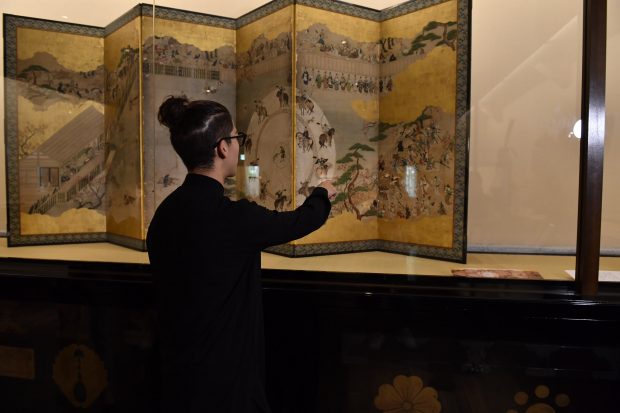 "Dog Followed by Dogs" style in the early Edo period
A work that depicts a game or a dog chase that shoots a dog released from a horse top with a leopard arrow (an arrow that does not damage the dog) from a horse made of rope and a circular baba. I was surprised to see this. It was a required martial art of a samurai as "Sanjo on the horseback" together with a drift horse and a samurai.
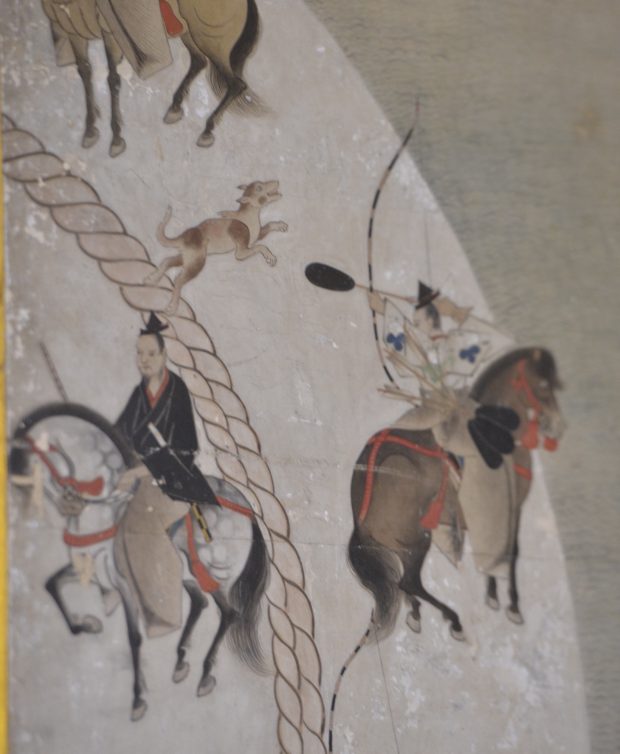
This is true, stop it. Hall, don't take it (laughs).
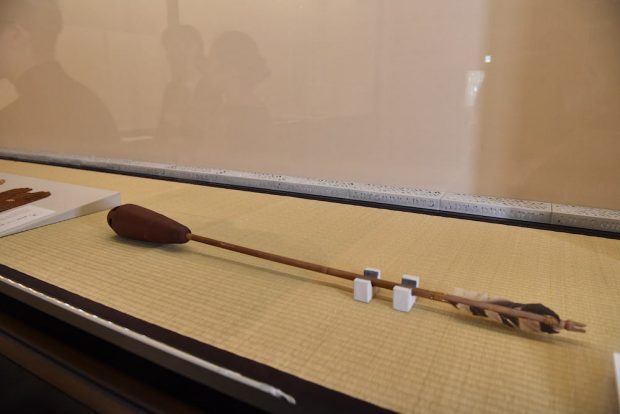
No matter how round the point of the arrow is, it will hurt you. It hurts absolutely. I want it to be at least in the ground floor, but there are also people who chase to the outside .... I don't know why this was born and developed into an addiction, but this screen painting also depicts the state of the vacationers, and there is also a festive atmosphere like a festival. Well ... I was a little shocked (laughs). Even so, it is amazing that the leopard eyes drawn in this picture now exist.
The Japanese spirit in the princess's daughter-in-law
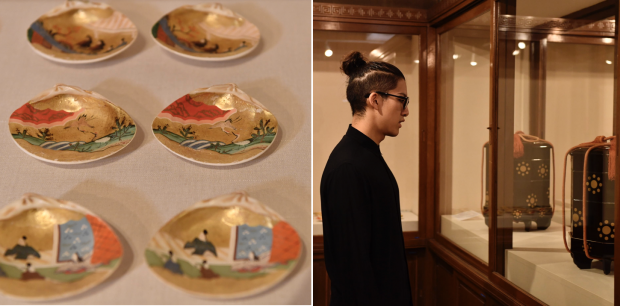 "Shuyou Monma picture shellfish bowl" There are 378 pairs of shellfish in a pair of shellfish shells. Late Edo period
On the third floor, I thought I saw the complete set of princess-in-law's tools, but it's just an idea born out of a leisurely flow of time, whether it's shellfishing or incense games. right. Isn't it extravagant? The combination of shellfish seems to be a play like so-called nervous breakdown, drawing a picture on the wall. Moreover, the shellfish is the most important item among the marriage tools, and it was before the princess in the procession .... For a moment, why? I also thought, but it would be a manifestation of a resolution that oneself marries and builds up the couple enthusiasm, saying that the shell and the shell are together and the couple is enlightened. It was a practice for the shellfish to lead the way only because it had to be the most important of its heart. Well, the feeling that if you try to make a beautiful thing extravagantly, is the spirit unique to Japanese people?
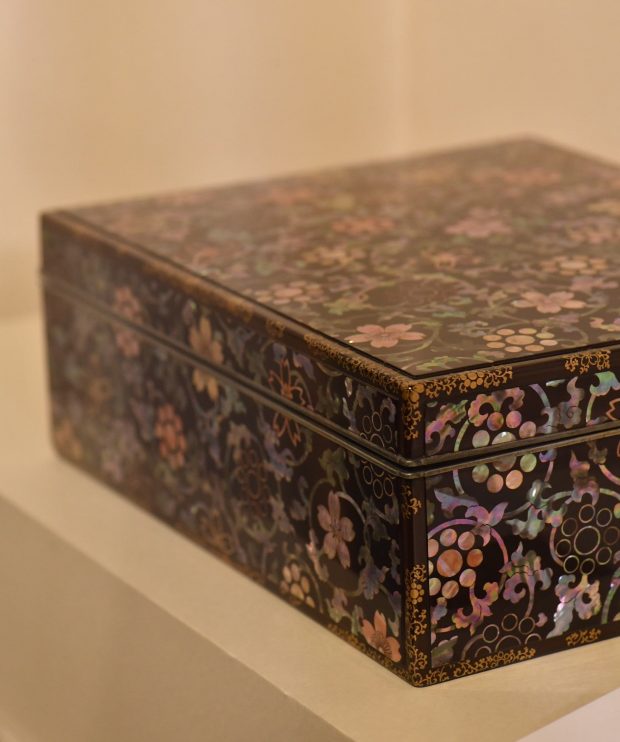 "Sakura-Arabusa Nine-day-mongery paper box" late Edo period
Even so, Hosokawa's House of the Nineteenth Crest is very powerful in design. You may be locked in being treated with long-life or various furniture. I feel the weight and size of Daimyo, but the crafts and materials that are scattered in the paper box of the spiral chopsticks also become a very feminine and lovely atmosphere. Over time, it looks modern.
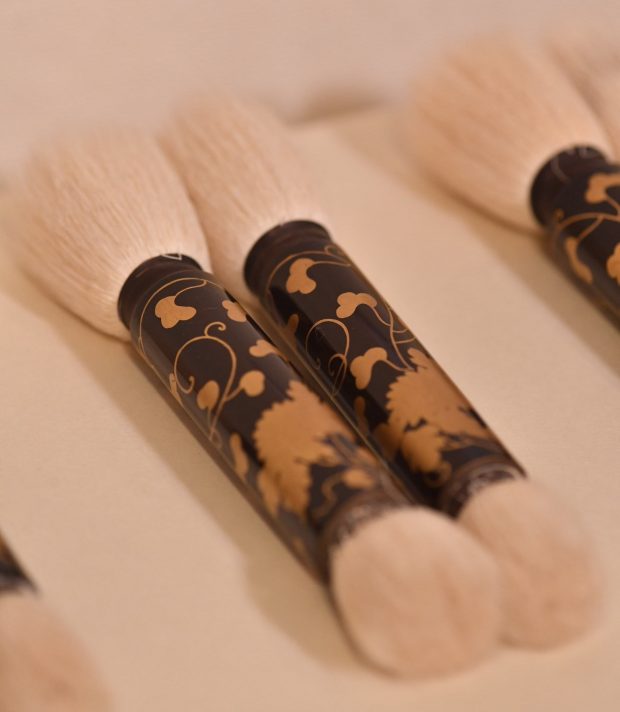
This is a brush for makeup. It was strange that there were two for some reason. Is it spare? Well, it is a really luxury thing. I think after all that the feeling that if you make it in any way let's make something beautiful.
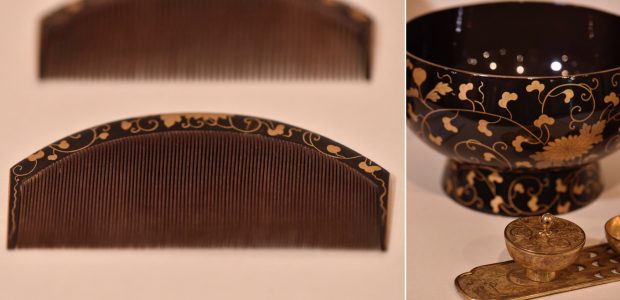 Out of the "Kikukaragusa 化粧 makeup tools", comb, rinse your mouth when you brush your teeth black earwax. Late Edo period
We, too, are obliged to use pre-cosmetic tools every day, but we tend to use reasonably simplified ones. In this way, when looking at something like the paintings of the Maki-e, I thought I should think more carefully about what I put around and used. My great-grandfather, the sixth generation Kikugoro, is in the dressing room, and there is a picture with an iron bottle on the side, but the iron bottle is actually still. Somehow over time I feel the sixth generation of breath. You will feel the same way.
Over time and space, touch something genuine
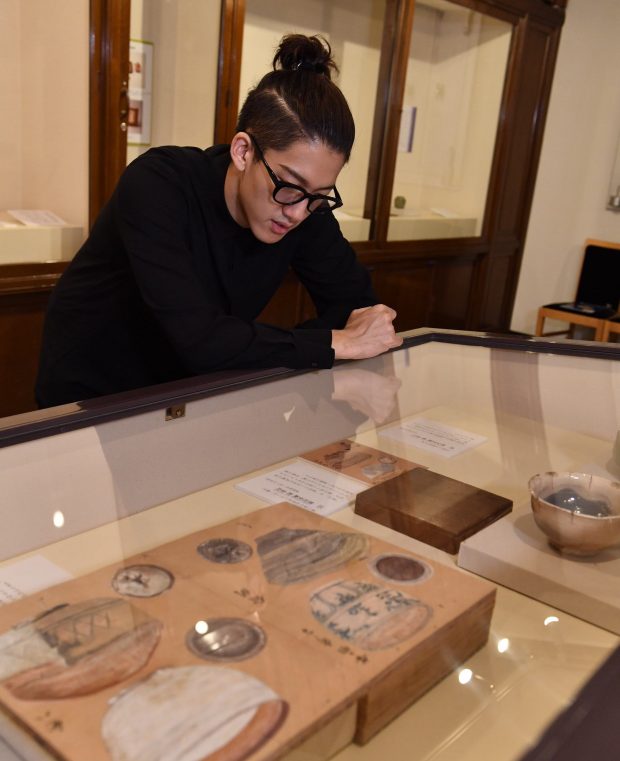 Kenken looks at "Chain Teacup Photo Box". The relationship between the Hosokawa House and Cha-no-yu is deep, and in particular, Fudayo Tadako (Sansai) is a senior brother of Rikyu and is regarded as one who faithfully inherited the teachings. There are several tea utensils related to Rikyu and Sansai to the Hosokawa family. The “Chain Tea Bowl Photo Box” is a tea tool pictorial book depicting the 142 bowls and 70 bowls that the Hosokawa House and his vassals possessed by the idea of Yatsushiro and Shigeken.
If the picture and the real thing match, you will feel more familiar. I feel that I am touching something genuinely beyond time and space. I really like this “Kawabori-cha-en-me-n-en-hachi” itself.
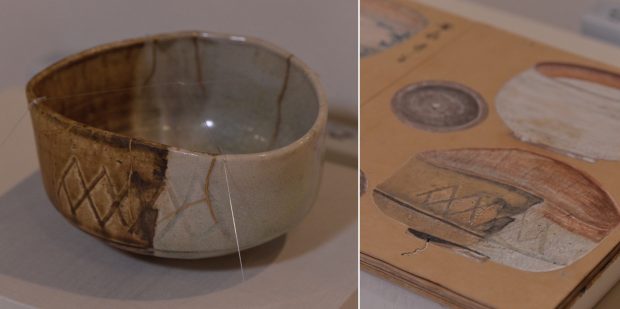 "Kanbu tea bowl incense" in the early Edo period
By the way, the Hosokawa family's house was said to be carrying carefully the favorite tea bowl even at the change of attendance. I have a lot of travel in local performances, etc., but my possessions become simpler because I don't want to break it or damage it. However, it is important to always put the real thing around as if carrying the tea bowl carefully. As I'm glad there is something left by my great-great-grandfather, I think it's a pity that when my offspring inherits the mark, there's nothing left by me or their ancestors. Yes. Take good things carefully, place them around you and leave them as they are transmitted. It's something that lives longer than you.
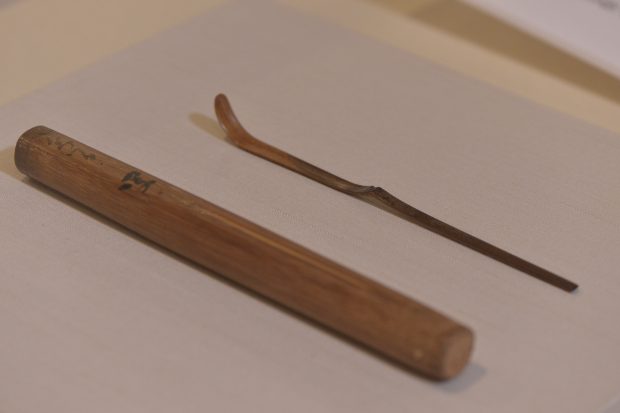 "Chaan Kurotsuru Raki" is said to have been created by Sansai imitating "Rakuzuru" by Rishu. Momoyama-early Edo period
When you see in this way, I think that the tool will come true when it represents that person. I also thought that Sansai had a very high humanity because of the sharpness and delicacy of the bowl. Then, I, I have a good taste created by Togo Hosokawa of today! I was a little proud of that again today (laughs).
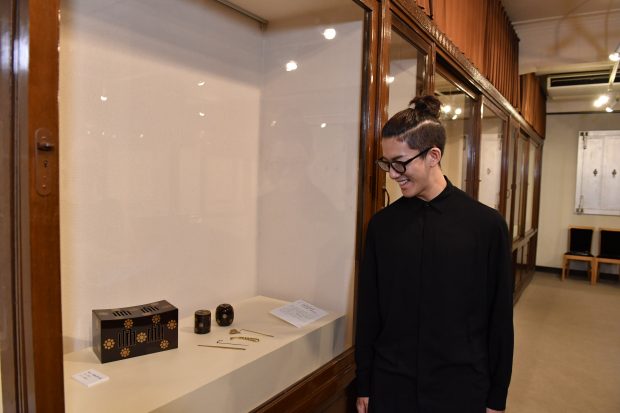
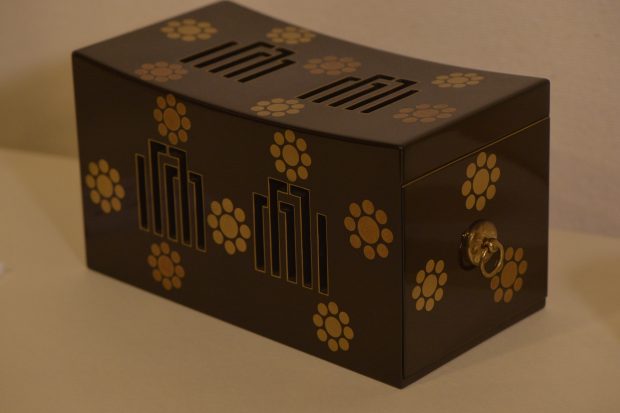 "Juyado Monma-Eki Pillow" mid-Edo period
There are pillows that have various functions, but this is the first time I saw fragrant pillows. I was amazed to think that it was a great idea to burn incense and put your head on it. For a moment, I passed through without being aware. That's good, isn't it? The women at that time were basically tied up and their commitment to hair was also strong, so you might end up with the idea of making something like this.
Noh is one of the culture to be learned for Daimyo
Noh was defined as a martial arts of samurai, and it was one of the culture to be learned for Daimyo. During the Edo period, the Hosokawa family had the Kinharu-style and Kita-style Noh performers, so it seems that many musical instruments, Enomoto, etc. are left, including faces and costumes. A few years ago, I appeared in the new Kabuki "Genji Monogatari", and for the first time I played with the people of Noh, and from that I started to watch Noh properly. I thought that the world of Noh is deep, and the more you know, the more fun you have.
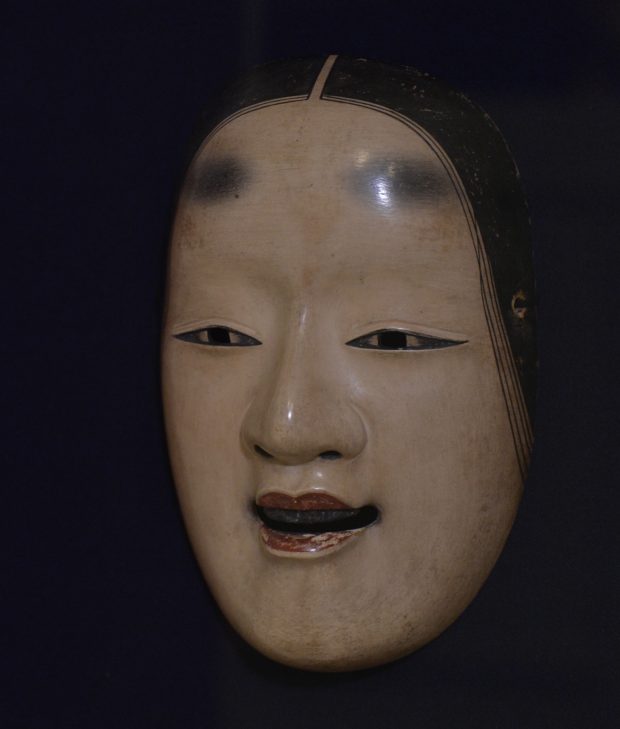 The Noh mask of a woman who remains in the Hosokawa family. "Sonjiro" Early Edo period
Among Kabuki, there are performances by Matsuba-no-mono which are based on Noh "Fun Benkei", "Kumano", "Autumn Hunting" and "Sumidagawa". The head is also done with a bald thorn called oak. There is a face that fits the hair, and I think that the most ideal form is Noh, and I have many tips from Noh. I will move my face closer to Noh with makeup. The restriction of facial expressions is surprisingly much higher than the role of normal female form, so it is difficult because it is impossible to move facial expressions.
I will forget time when I am here, and I will forget that this is Tokyo. There is a Higo Hosokawa garden under the museum, so it was originally a very large site. In fact, my ancestor's tomb is in the nearby Zoshigaya cemetery from here, so I come to visit it two or three times a year. So I knew somehow that there was a long blue paperback, but this time, for the first time I came .... No, it was good. There are a lot of things that you can't understand unless you actually come and feel it. The pace is also good that the exhibition changes four times a year. Next time I will see Hakuin, so I will try to come home on the way back to the grave.
"Daimy Art Introductory Beauty of Princess and Princess"
The exhibition is being held on October 3, 018. Venue Nagao Bunko
Address 1-1-1 Mejirodai, Bunkyo-ku, Tokyo
Opening hours 10 o'clock-16 o'clock (until 16 o'clock entrance), closed on Monday (the next day if Monday is a public holiday)
※ The next Fall Exhibition “Beauty of Edo Painting – Hakuin, from Sensui to Kano School” is October 13-December 5, 2018.
Onoe Ukon Profile
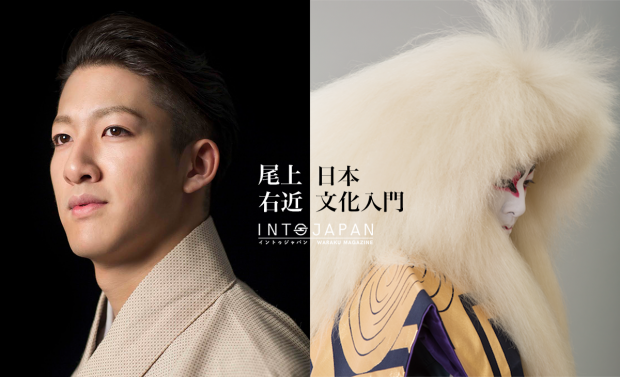
Kabuki actor. Born in 1992. Born as the second son of Edo Joruri Siyomoto Festival House and Shichimoto Yonju Taito. My brother is Kiyomoto Kiyomoto, who is a member of the Kiyomoto Section Shamisen. My great grandfather is the sixth generation Kikugorou. My mother's grandfather is Koji Tsuruta. In April 2000, under the name of Kensuke Okamura (Konsuke), he performed the first stage with the Kabuki theater performance "Mitsuru Suezukika" Matsumoto and played an active role as a great child. The second generation in 2005 was attacked by Ukon Ukon. The arm of the dance is also present. In addition, while continuing the actor, as a professional of Kiyomoto, the 7th generation of Tayuo Eju who is the father's former name is attacked, and it is scheduled to appear in the stage performance of Misonoza on October 1st (Month) to 25th (Thu). 【Official Twitter】 【Official Instagram】 【Official Blog】
Photography / Kenji Miura Composition / Noriko Nii
[Mr. Ogami's introduction to Japanese culture]
The first Hokusai LOVE Western artists な
Speaking of the 2nd Taikan Fuji?
The third Tokyo International Exposition of the super-competitive room group!
The 4th Kenken is a Sword Museum!
The path to the birth of the 5th Makie Charm of Harunobu Suzuki
What is the 6th Japanese architecture!
The seventh national treasure "Gaso dokodoku" is interesting!
At the 8th Nagao Bunko, I see "the beauty of the palace and princess"